

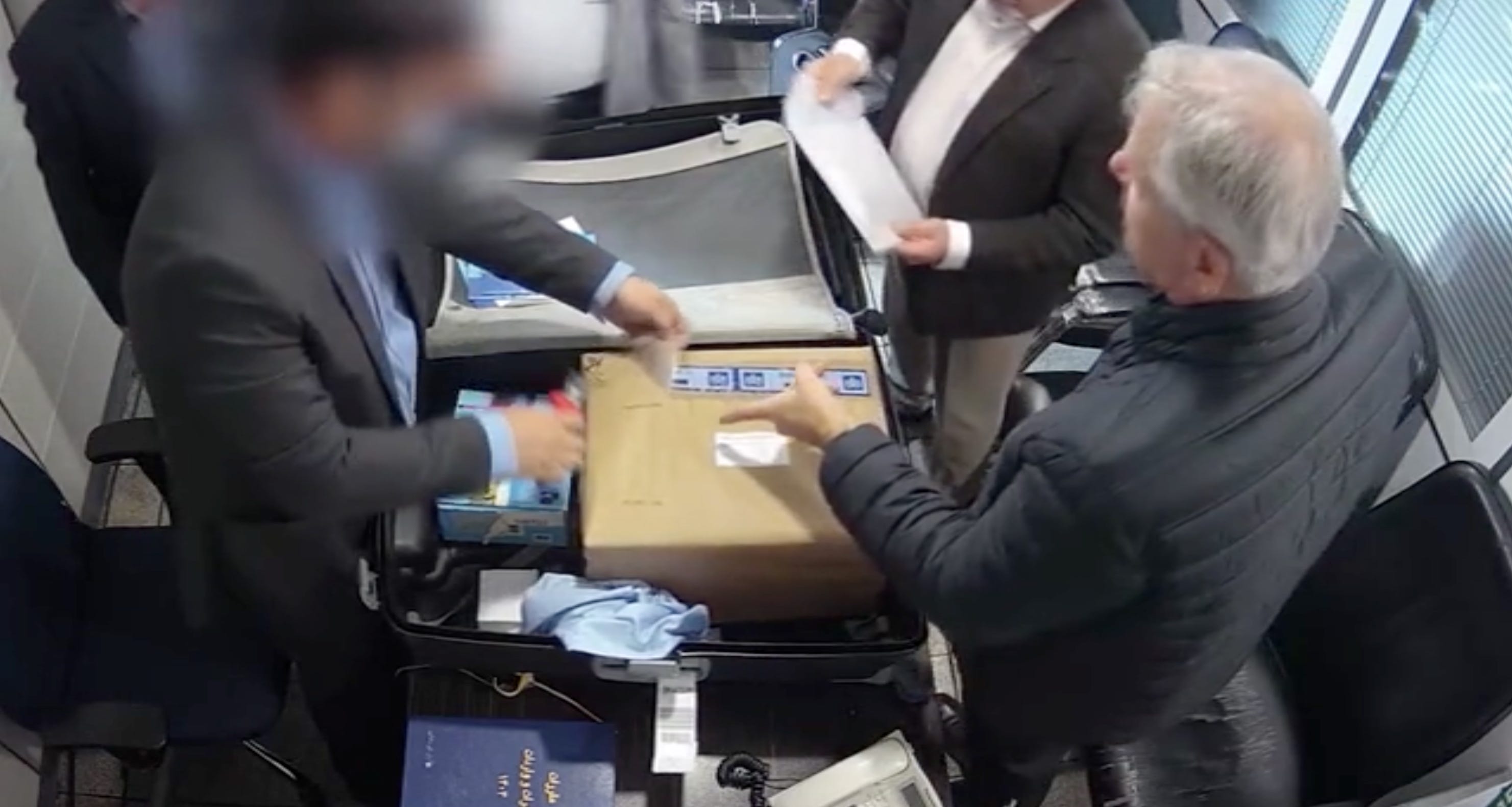
Somewhere between a diplomatic greeting and a customs clearance, the encounter that has set off the latest round of Dutch-Iranian recriminations appears to have begun with a simple refusal. According to a report published on 23 February 2026 by Fars News — the Iranian news agency with close ties to the Islamic Revolutionary Guard Corps — a senior European diplomat arriving at Imam Khomeini International Airport in Tehran in January or early February of this year declined to put his luggage through the X-ray scanner (Dehghan, Fars News, 23 February 2026). The reason given: diplomatic immunity. Iranian customs officials sealed and confiscated the baggage. Days later, when the bag was opened in the presence of diplomatic representatives and officials from the Iranian Foreign Ministry, it contained three Starlink satellite modems and seven satellite phones, concealed inside a suitcase. By then, the diplomat had left the country (Dehghan, Fars News, 23 February 2026).
The diplomat identified by Fars News — under the slightly mangled rendering “André van Vijgen” — is almost certainly André van Wiggen, a Dutch Foreign Ministry official who served as Deputy Head of Mission at the Netherlands Embassy in Tehran from 2019 to 2022, and subsequently as Head of Political Affairs at the Netherlands Embassy in Washington, D.C. (Van Wiggen, LinkedIn, 2022; Tehran Times, 17 November 2020). As a matter of institutional record, Van Wiggen’s extensive career has also encompassed the role of Ambassador to Mali, Afghanistan, and Burundi (Van Wiggen, LinkedIn, profile). The article also cited WikiLeaks diplomatic cables allegedly showing Van Wiggen shared intelligence assessments on Iran with American officials during his Tehran posting. The content and significance of those cables could not be independently verified.
Neither the Dutch Foreign Ministry nor Van Wiggen have publicly commented at the time of writing. The Netherlands Embassy in Tehran has been operating with limited public access and heightened security protocols since the January 2026 unrest in Iran (Netherlands and You, 2026). None of the allegations in the Fars News report have been confirmed by independent sources. Van Wiggen’s guilt or innocence in any legal sense cannot be determined from available evidence; this article does not suggest it can be.
What the incident does offer is a window onto a bilateral intelligence relationship between the Netherlands and Iran that has been accumulating grievances, operations, and mutual accusations for the better part of two decades — and onto the specific technology, Starlink satellite internet, that has become the sharpest point of friction between Tehran and the West in the months since Iran’s violent crackdown on protesters in January 2026.
The technology at the centre
Before turning to the history of the bilateral relationship, it is worth understanding precisely why the alleged contents of that suitcase matter.
Iran’s January 2026 crackdown on anti-government protests was accompanied by what experts described as the country’s most severe and technically sophisticated internet blackout on record. On January 8, as demonstrations spread across Tehran and more than 190 other cities, Iranian authorities imposed a nationwide internet shutdown (Wikipedia: 2026 Internet Blackout in Iran, 2026). According to digital rights groups, packet loss in Tehran during active jamming surged from 30 to over 80 percent (Filter.Watch, as cited in Defence Security Asia, January 2026). Mobile and fixed-line broadband collapsed together. For the first time, Iranian authorities also deployed military-grade electronic warfare systems against Starlink — the commercial low-earth-orbit satellite constellation operated by Elon Musk’s SpaceX — which had until then functioned as a fallback communications channel for protesters during earlier crackdowns. “I have been monitoring and researching access to the internet for the past 20 years,” Amir Rashidi, director of digital rights at the Miaan Group, told Al Jazeera, “and I have never seen such a thing in my life” (Al Jazeera, 14 January 2026).
Starlink has no licence to operate in Iran and is prohibited under Iranian law. Possession of a terminal can carry a sentence of up to ten years (TechPolicy.Press, February 2026). Yet an estimated 50,000 terminals had been smuggled into the country in recent years, through routes crossing the Iraqi border and maritime channels in the Persian Gulf (Bloomberg, 20 February 2026). During the blackout, they represented the only reliable mechanism for protesters to document and share evidence of state violence with the outside world.
The United States government moved to reinforce this network. The Trump administration covertly smuggled approximately 6,000 additional Starlink terminals into Iran following the January crackdown — the first time the US had directly sent the devices inside the country — drawing on State Department funds redirected from other internet-freedom initiatives (Wall Street Journal, February 2026, as reported by Times of Israel, Jerusalem Post, and others). The black-market price of a single Starlink terminal inside Iran, which had previously sold for $700 to $1,000, soared to as much as $4,000 as military tensions in the region escalated further (Bloomberg, 20 February 2026). SpaceX waived subscription fees for terminals connecting from Iran.
Tehran’s legal counteroffensive began almost simultaneously. On February 10, Iranian diplomats told a UN scientific meeting in Vienna that the “illegal operation” of Starlink in Iran violated the nation’s sovereignty and constituted “unauthorized military use of a commercial satellite mega-constellation” (Bloomberg, 10 February 2026). Iran has also raised the matter with the International Telecommunication Union in Geneva, where it argues that SpaceX is operating without national government authorization — a claim on which the ITU has, according to one analysis, found in Iran’s favour (SpaceNews, February 2026).
Within this context, three Starlink modems and seven satellite phones in a diplomat’s suitcase arriving in Tehran acquire a symbolic weight that transcends the specific legal question of whether they were there at all.
A long rivalry
The diplomatic relationship between the Netherlands and Iran is, by any measure, one of the most turbulent bilateral relationships in Western Europe’s dealings with Tehran.
Its rupture begins formally in 2011, when the Dutch Foreign Minister announced the suspension of official diplomatic relations after Iran executed Zahra Bahrami, a dual Dutch-Iranian citizen, on narcotics charges that human rights organizations condemned as politically motivated (Wikipedia: Iran-Netherlands Relations). The relationship was eventually partially restored, but the underlying suspicion was not.
The intelligence dimension of the rivalry runs deeper and older, and it surfaced spectacularly in January 2024 when the Dutch newspaper De Volkskrant published the results of a two-year investigation revealing that Erik van Sabben, a Dutch civil engineer secretly recruited by the AIVD — the Dutch General Intelligence and Security Service — had infiltrated Iran’s underground nuclear facility at Natanz in 2007 and installed water pumps carrying an early version of the Stuxnet virus (Modderkolk, De Volkskrant, 8 January 2024; Leiden University, January 2024; DutchNews.nl, 8 January 2024). Van Sabben was subsequently named: a dual-passport holder with an Iranian wife and business connections in Iran, working from Dubai, who appears to have had only partial knowledge of the operation’s true purpose. “The Americans used us,” one intelligence source told the newspaper (NL Times, 8 January 2024). Van Sabben died in a motorcycle accident in Dubai in early 2009. The Dutch government, including Prime Minister Balkenende’s cabinet and the parliamentary committee that is supposed to be informed of sensitive intelligence operations, knew nothing about the Stuxnet mission (Leiden University, January 2024). The legal scholar Wim Voermans of Leiden University described the course of events as “most concerning,” observing that a spy had been “sent on a secret mission and no one was aware of it. And that mission could have put us in direct conflict with Iran” (Leiden University, January 2024).
The near-thousand centrifuges at Natanz that Stuxnet disabled are the backdrop against which every subsequent Dutch-Iranian intelligence encounter should be read. From Tehran’s perspective, the Netherlands is not merely a small European state that occasionally voices diplomatic displeasure. It is a country whose intelligence services participated in sabotaging Iran’s nuclear programme in collaboration with American and Israeli intelligence — and did so without the knowledge of its own elected government.
The expulsions followed in waves. In June 2018, the AIVD expelled two Iranian diplomats from the Netherlands without publicly disclosing the reason (AIVD spokesperson Hulbert Bredemeijer, as cited by AFP, Times of Israel, July 2018). Iran summoned the Dutch ambassador and described the measure as “irrational and illegal” (Times of Israel, July 2018). The following year, in 2019, the Netherlands expelled two further Iranian diplomats, this time publicly accusing Tehran of involvement in the murders of Iranian dissidents on Dutch soil in 2015 and 2017, including the killing of Ahmad Mola Nissi, a Dutch-Iranian political activist shot dead in The Hague (L’Orient Today, April 2025; DutchNews.nl, April 2025). Iran reciprocated.
The pattern reasserted itself in April 2025, when the AIVD published its annual report attributing an assassination attempt on an Iranian activist in Haarlem in June 2024 to the Iranian state, and linking the operation to the same networks suspected in the near-fatal shooting of Spanish politician Alejo Vidal-Quadras in Madrid in November 2023 (DutchNews.nl, 24 April 2025; NL Times, 25 April 2025). “Both assassination attempts are part of the method Iran has been using for many years: using criminal networks in Europe to silence suspected opponents of the regime,” the AIVD report stated (New Arab, 24 April 2025). Dutch Foreign Minister Caspar Veldkamp summoned the Iranian ambassador in The Hague (NL Times, 25 April 2025). Within twenty-four hours, Iran summoned the Dutch ambassador in Tehran — Emiel de Bont — and its Foreign Ministry’s director-general for Western Europe called the accusations “baseless and unacceptable” (DutchNews.nl, 25 April 2025).
This is the institutional history inside which the airport encounter becomes legible. Not as an anomaly, but as a beat in a long-running rhythm.
The legal question
The Vienna Convention on Diplomatic Relations, which governs the inspection of diplomatic baggage, is not a simple instrument. Article 36(2) grants diplomatic agents exemption from customs inspection of their personal baggage, and provides that it shall not be detained — but it also stipulates an exception: “unless there are serious grounds for presuming that it contains articles not covered by the exemptions” set out in Article 36(1), which include items for personal use but exclude items whose import or export is prohibited by law (Vienna Convention on Diplomatic Relations, 1961). In cases where serious grounds exist, “the inspection shall be carried out only in the presence of the diplomatic agent or of his authorized representative” (Vienna Convention, Article 36(2)).
Whether Iran had legally sufficient “serious grounds” for presuming the contents of the bag violated Iranian customs law is precisely the kind of question that international legal scholars rarely resolve from a distance — and the one that each side will use to claim the moral high ground.
The broader principle has some grounding in legal commentary. As Eileen Denza’s authoritative Oxford commentary on the Vienna Convention notes, the Article 36 exemption applies to articles for the official use of a mission or the personal use of a diplomatic agent — not to items whose import is prohibited by the receiving state’s law (Denza, Oxford University Press, 2016). A UK court, in a case involving a diplomat found carrying prohibited goods, stated the matter in terms that international law scholars have since cited with approval: the diplomatic right had been “infringed” only because the diplomat was “abusing” it “for purposes unrelated to those for which the right was given” (Lewis & Clark Law School, Global Law Alliance). Whether the alleged contents of the bag in question constituted such an abuse is precisely what remains in dispute.
When a host state has “serious grounds” to suspect misuse, the convention provides a mechanism: the diplomat may be asked to open the bag voluntarily. If they refuse, the host state’s options are limited to declaring the diplomat persona non grata — which is itself a drastic step — rather than seizing and opening the baggage unilaterally.
Iran’s decision to seal and confiscate rather than to immediately expel the diplomat sits in a legally ambiguous position. Depending on the facts — which only those present at Imam Khomeini Airport can verify — it may represent a legitimate invocation of the convention’s security exception, or it may represent a violation of the same treaty. Neither conclusion can be stated definitively without facts that are not publicly available.
The new terrain of intelligence rivalry
What the airport incident and the Starlink blackout together illuminate is a fundamental shift in the instruments through which states compete.
The traditional image of intelligence rivalry — dead-drops, recruited assets, compromised cables — has not disappeared. But layered over it is a new category of contest involving commercial technology. Starlink is a product sold by a private American company. Its terminals are manufactured in the United States and purchased on the open market. Yet during Iran’s January crackdown, they functioned, in effect, as instruments of American information policy, enabling the US government to sustain communications for an opposition movement it was simultaneously expressing public support for and covertly supplying with equipment. Iran’s electronic warfare response — deploying military-grade jamming against a commercial satellite constellation — in turn blurred the line between civilian infrastructure and a military target, which is precisely the accusation Iran has now brought to the UN forum in Vienna (Bloomberg, 10 February 2026).
The diplomat’s suitcase sits at the intersection of these two worlds. If the Fars News account is accurate, a European official arriving at an Iranian airport was carrying equipment — Starlink modems, satellite phones — that would enable Iranians to bypass the internet blackout their own government had imposed. From Tehran’s perspective, this is not meaningfully different from smuggling weapons. From a Western perspective, it may be consistent with well-established practices of assisting civil society in states whose governments restrict basic communications. Both characterisations capture something real, and neither resolves the underlying question of what, exactly, diplomatic immunity is for.
The Netherlands has never publicly acknowledged active intelligence operations against Iran beyond what has been admitted after the fact — the Stuxnet involvement was revealed not by Dutch authorities but by investigative journalists (De Volkskrant, January 2024). The Dutch government’s standard posture is to neither confirm nor deny. Fars News, as an outlet that reflects the institutional interests of the IRGC, has every reason to publish the story as an act of political signalling as much as factual disclosure — both domestically, where it serves as evidence of European interference in the January unrest, and diplomatically, where it constitutes implicit leverage. The WikiLeaks cables cited in the piece, which allegedly show Van Wiggen sharing intelligence with American counterparts, are consistent with diplomatic practice between allied states; their citation in this context, framed as evidence of something darker, illustrates how the same facts acquire different meanings depending on the institutional lens applied.
What neither side disputes is the broader context: that the Netherlands and Iran have been conducting a low-intensity intelligence rivalry for nearly two decades, that the instruments of that rivalry are evolving to include commercial satellite technology and electronic warfare, and that the legal frameworks designed to manage great-power competition — the Vienna Convention, the ITU regulations, the Outer Space Treaty — were designed for a world in which the relevant actors were states, not private satellite companies, and in which the relevant distinctions between civilian and military technology were rather more obvious than they have become.
The contents of the suitcase — three Starlink modems, seven satellite phones, hidden inside a diplomatic bag at Imam Khomeini Airport — are now on the record. What they reveal is not primarily a story about one diplomat or one bag. They are a material inventory of the current moment: the tools by which states compete when the battlefield is a population’s access to information, and the conventions designed to manage that competition have not caught up with the technology. A Starlink modem is not a weapon in any traditional sense. In Tehran in January 2026, it was something more consequential — a device capable of keeping a protest movement connected to the world after the state had cut every other wire. That Iran treats its presence in a diplomatic bag as an act of war, and that the West may treat its delivery as an act of solidarity, tells you more about where this rivalry is headed than any cable, expulsion, or legal filing. The suitcase has been opened. The argument about what was inside it — and what it means — is just beginning.
Sources
This article is based on extensive open‑source research, including reports, investigations, policy papers, corporate documents, and legal or NGO.
For readability, individual sources are not listed here in full. If you want to review the complete bibliography, including direct links, outlet names and publication dates, you can request it by sending me a private message on Substack. I will share the full source list and additional background material on request.
Wow 😮. Masterful writing and very impressive resilience from Iran for more than 50+ years of brutal sanctions.
Thanks alot for this gem!
O boy, you did a better job then our Dutch newspapers.
I rarely get on the edge of my seat. But from the word Dutch to the last dot i was on the very edge..
Looks like dutch Cyber panic will now break out..... all the epstein maxwell-sisters mossad backdoors will be at risk.