
Europe's Silent Surrender
Inside the Deal that lets U.S. Agencies mine the Personal Data of Europe’s Citizens

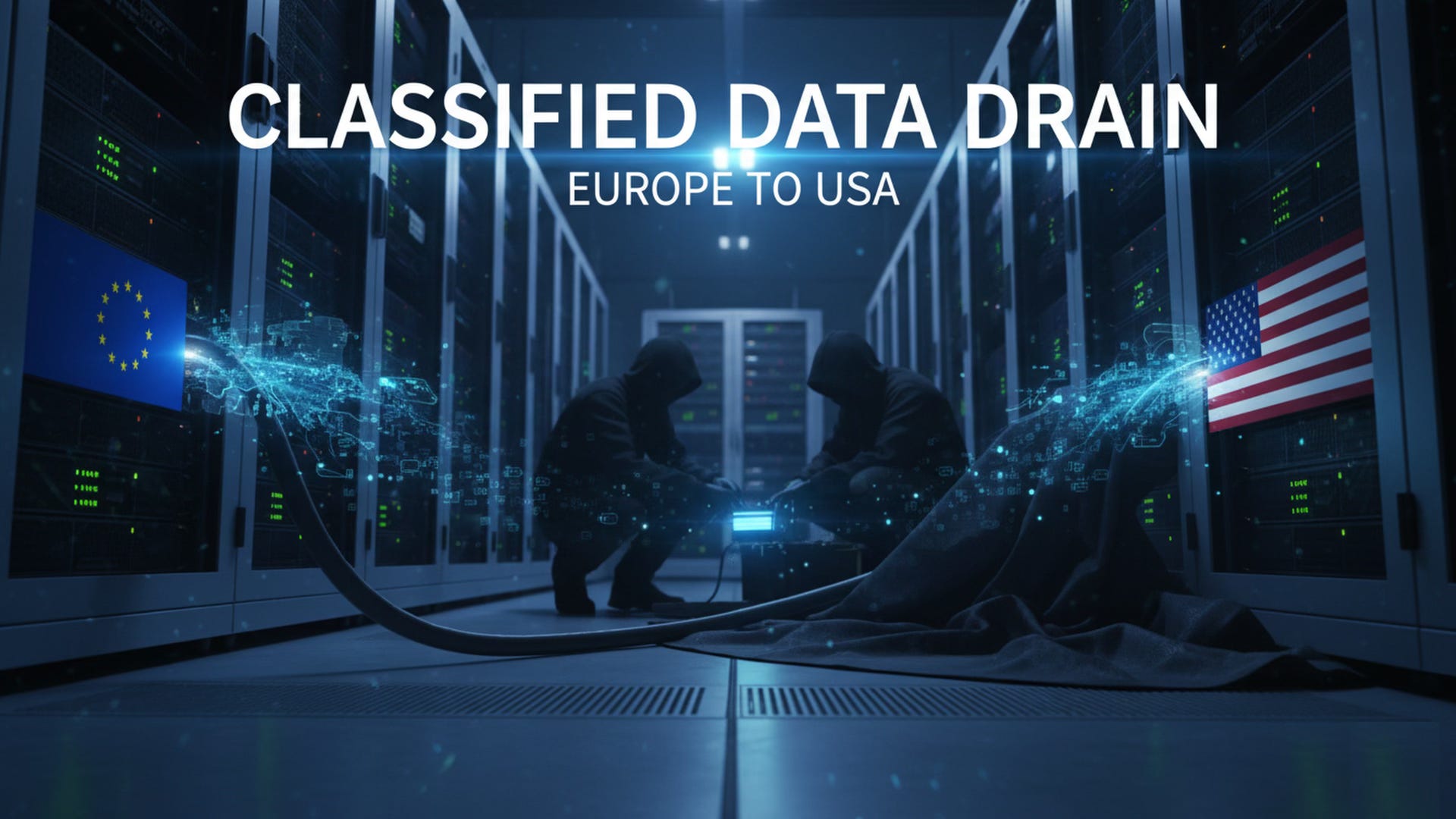
When you unlock your phone in 2026, book a ticket, or message a friend, part of that moment will not stay in Europe. It will travel — quietly, invisibly — into U.S. corporate and intelligence systems that dissect your behaviour, map your habits, and fold the traces of your private life into vast analytical engines you will never see. You don’t consent to this in any meaningful sense. You aren’t told when it happens. Yet it is happening every day — because your government has decided that your privacy is negotiable, and that your data is a resource others are entitled to study, monetise, and weaponise in ways that serve them, not you.
Europe’s consumers have been handed into a system they never voted for — a system in which their messages, purchases, locations, photos, medical traces, and behavioural patterns are routinely exported to the United States, where they are analysed, profiled, and fed into security and commercial intelligence pipelines. This is happening quietly, legally, and at scale. And it is happening because EU governments have decided that maintaining political harmony with Washington matters more than defending the privacy rights they claim to protect.
What Brussels presents as a technical “data-transfer framework” is, in reality, a structural concession: Europe accepts that U.S. authorities and U.S. tech companies will obtain and analyse European data, while citizens are left with little visibility, weak remedies, and no meaningful ability to prevent it. The rhetoric speaks of “adequacy” and “trust.” The practice entrenches dependence and exposes Europeans to a surveillance ecosystem they neither control nor benefit from.
A legal green light that masks political surrender
The EU-U.S. Data Privacy Framework — reinforced by the September 2025 General Court ruling — reopened the pipeline for mass transfers of Europeans’ personal data to U.S. cloud providers, platforms, ad-tech networks, and AI systems. Officials insist the U.S. now offers “essentially equivalent” protection, even though earlier arrangements collapsed for the same unresolved reason: when American intelligence agencies want access to European data, U.S. law gives them the upper hand.
The imbalance has not disappeared. It has been normalised. Europeans are told their rights are protected, while the real priority remains friction-free data flows for U.S. firms and geopolitical convenience for governments.
Surveillance capitalism — now wrapped in official legitimacy
For U.S. companies, European data is a behavioural goldmine: travel patterns, social interactions, inferred psychology, biometrics, consumer profiling. These streams are analysed, monetised, and reused across products and AI pipelines with only thin layers of disclosure. What once appeared questionable now proceeds under the comforting badge of “compliant transfer,” pushing regulators toward procedural box-ticking instead of confronting the exploitation of consumers’ private lives.
Remedies in theory, opacity in reality
Europeans are promised complaint channels and a U.S. “review court,” but the burden sits squarely on the individual — a person who cannot see when intelligence agencies touched their data, cannot test whether access was proportionate, and must navigate proceedings dominated by classified evidence and institutional loyalty to security prerogatives. This is presented as accountability; in practice, it shields systemic surveillance behind legal ritual.
Dependency disguised as pragmatism
Europe’s digital infrastructure — clouds, productivity suites, ad networks, app stores, AI services — is deeply dependent on U.S. providers. Rather than reducing that dependency, policymakers perpetually retrofit transatlantic deals to keep the machinery running. The language of “data protection” becomes a policy veneer over a strategic decision: trade and intelligence alignment first; consumer rights somewhere far behind.
The next shock is predictable
Civil society groups warn that the framework mirrors the defects that doomed its predecessors: bulk collection persists, remedies are limited and opaque, and “equivalence” reads like diplomatic cover, not constitutional reality. If courts strike it down again, Europeans will discover — once more — that the legal foundation beneath the transfer and analysis of their data was never solid. Until then, U.S. companies will continue to obtain and analyse European data at scale, while governments insist the system is safe.
Sources:
https://www.workforcebulletin.com/adequacy-of-the-eu-u-s-data-privacy-framework-survives-challenge
https://privacymatters.dlapiper.com/2025/09/eu-u-s-data-privacy-framework-survives-first-challenge/
https://www.jdsupra.com/legalnews/framework-intact-for-now-eu-us-data-1811919/
https://noyb.eu/en/eu-us-data-transfers-time-prepare-more-trouble-come
https://www.edpb.europa.eu/system/files/2024-07/edpb_dpf_faq-for-individuals_en_0.pdf
Anxiety levels have grown substantially re: security. Then when the COVID drama accelerated things, advanced technologies catapulted.
Anytime security red flags were raised, they were met with unconvincing, nontechnical, pacifying responses. Then I started digging…
Thomas, many thanks for all your work. Best wishes in 2026!