
Gaza After The Bombs
How Trump's "Board of Peace" Transforms Surveillance Capitalism Into Colonial Control

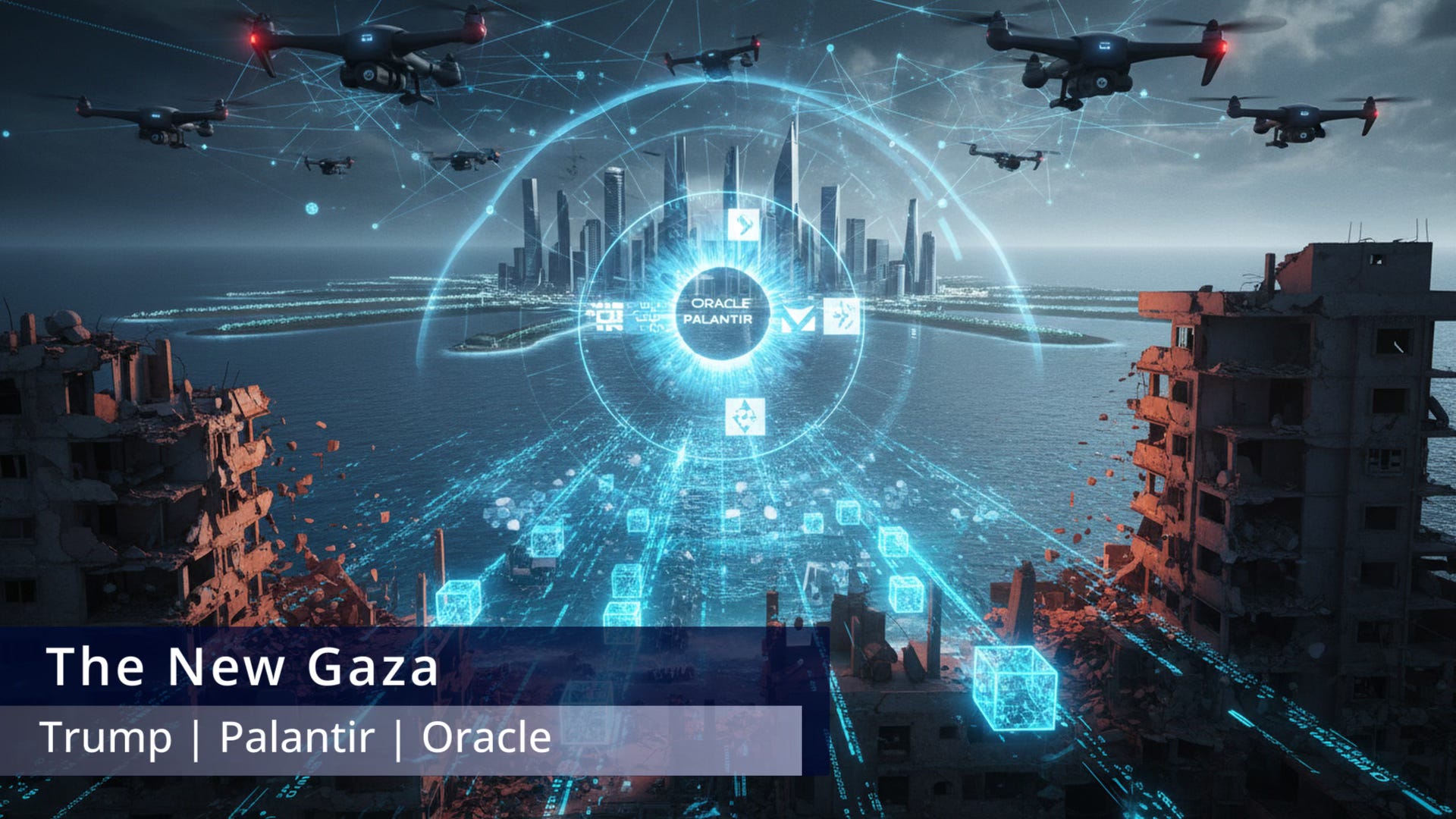
On a winter morning in Davos, Donald Trump stood before cameras to announce what he called “one of the most consequential bodies ever created.” The Board of Peace, he declared, would rebuild Gaza and usher in a new era of prosperity. What Trump didn’t mention—what the carefully crafted charter buried in bureaucratic language—was that he had structured himself as the board’s indefinite chairman, the only individual named in the founding document, with sole power to appoint members, set agendas, and issue binding resolutions.[1] Countries seeking permanent seats would need to pay $1 billion for the privilege.[2] The Guardian’s assessment cut through the pageantry: “a Trump-dominated pay-to-play club” designed to supplant the United Nations itself.[3]
The charter, circulated to national capitals two months after the UN Security Council believed it had endorsed a Gaza reconstruction body, made no reference to Gaza at all.[3] Instead, it presented the Board of Peace as a permanent global institution, its real mandate obscured behind the rhetoric of humanitarian concern. What emerged from leaked documents and interviews with former officials was something far more troubling: a techno-authoritarian experiment that would transform Gaza into what critics call the world’s largest open-air data farm, where every Palestinian becomes a test subject for surveillance technologies pioneered in warfare and now repurposed for what Trump’s billionaire allies euphemistically term “peace administration.”
The Infrastructure of Digital Control
Behind the Board of Peace’s public face lies a surveillance apparatus built by two of Silicon Valley’s most powerful firms. Palantir Technologies, co-founded by Peter Thiel, and Oracle Corporation, controlled by Larry Ellison, have positioned themselves as the technological backbone of what Trump envisions as “New Gaza.” The relationship between these companies, their executives’ vast wealth, and the Trump administration’s Gaza plans reveals a vertically integrated defense-technology stack that transforms reconstruction into a profit center while subjecting an entire population to comprehensive digital monitoring.
Palantir’s role in this architecture cannot be overstated. The company has secured more than $900 million in federal contracts since Trump’s second term began,[4] including a $30 million deal with Immigration and Customs Enforcement to build “ImmigrationOS”—a system that provides what ICE calls “near real-time visibility” into immigrants’ movements as the agency targets 3,000 arrests daily.[5] The platform pulls together vast datasets: passport records, Social Security files, IRS tax data, license-plate reader information, even Medicaid records.[6] According to documents reviewed by the Electronic Frontier Foundation, Palantir’s ELITE tool (Enhanced Leads Identification & Targeting for Enforcement) creates dossiers on individuals and generates “confidence scores” on current addresses, populating maps with potential targets.[7]
This is the same technology Palantir is deploying for Israel. In January 2024, CEO Alex Karp flew to Tel Aviv with co-founder Peter Thiel to sign a strategic partnership with the Israeli Defense Forces.[8] Karp, who describes his company’s work as creating a “digital kill chain,” has been explicit about Palantir’s role. At the Reagan National Defense Forum, he condemned companies that remained silent after October 7, noting that “there are only three companies that have been publicly pro-Israel”—naming Palantir among them.[9] The company’s AI systems, including its Artificial Intelligence Platform (AIP), analyze enemy targets and propose combat operations.[10] These same tools, tested and refined in Gaza’s destruction, are now being adapted for what the Board of Peace charter calls “stabilization and long-term success.”
What Karp calls a tool, others recognize as algorithmic warfare. Protesters have confronted him at public events, one shouting: “You’re getting wealthy off of killing Palestinians. Palantir kills Palestinians with their AI and technology.” Karp’s response revealed his worldview: “The primary source of death in Palestine is the fact that Hamas has realized that there are millions and millions of useful idiots.”[11] When employees resigned in protest, Karp dismissed their concerns: “We’ve lost employees. I’m sure we’ll lose employees. If you have a position that does not cost you ever to lose an employee, it’s not a position.”[12]
Congressional Democrats, led by Senator Elizabeth Warren and Representative Jamie Raskin, have called for investigations into what they characterize as troubling conflicts of interest.[13] Stephen Miller, Trump’s deputy chief of staff and architect of immigration policy, holds between $100,000 and $250,000 in Palantir stock. His senior policy advisor Kara Frederick owns between $50,000 and $100,000 in the company.[13] As Wired reporter Makena Kelly observed, Palantir is “becoming an operating system for the entire government,” with the Department of Government Efficiency—led by Elon Musk—using Palantir to “centralize data all across government” into what sources describe as a “master database.”[14]
Oracle’s Shadow Empire
If Palantir provides the surveillance software, Oracle supplies the infrastructure on which everything runs. Larry Ellison, Oracle’s founder and largest shareholder, has spent the past four years systematically positioning himself to control Gaza’s digital future. The mechanism is Tony Blair.
Since 2021, Ellison has given or pledged $350 million to the Tony Blair Institute for Global Change, effectively making TBI an Oracle subsidiary.[15] An investigation by Lighthouse Reports and Democracy for Sale revealed the extent of this capture. Current and former TBI employees described joint retreats becoming commonplace by 2023, with Oracle executives and Blair’s team convening as “part of the same organization.” At TBI’s London headquarters, Oracle staff began “sliding into TBI employees’ calendars” to “scope out opportunities” in countries where the institute operated.[16] Senior TBI employees traveled to Oracle’s Austin headquarters for coordination sessions managed by a TBI staffer whose role is to “scale and manage” the Oracle partnership.[16]
Former TBI employees spoke of being pressured to push Oracle technology “despite knowing they were not in the best interests of the country in question, and even had the potential to cause harm.”[16] In Kenya, officials grew so exhausted from Oracle pitches they started calling Blair “Uncle Larry”—a reference to his dependence on Ellison’s funding.[17] When Britain’s Labour government announced plans for national digital IDs in 2025, just 48 hours after Blair’s institute published a report calling for their adoption, the sequence revealed TBI’s function: laundering corporate lobbying through the prestige of a former prime minister’s think tank.[18]
Ellison’s vision for surveillance society is not hidden. On an investor call in 2023, he declared: “We’re going to have supervision. Every police officer is going to be supervised at all times, and if there’s a problem, AI will report that problem and report it to the appropriate person. Citizens will be on their best behavior because we are constantly recording and reporting everything that’s going on.”[15] This is the future he funds Blair to construct in Gaza, where leaked planning documents reveal proposals for “AI-powered, smart planned cities” in which “all services and economy” would be conducted through “ID-based digital systems.”[19]
Ellison’s ties to Israel run deep. He has donated heavily to Friends of the Israeli Defense Forces, a charity that directs millions to soldiers fighting in Gaza.[20] Through Oracle, he built Israel’s first cloud services infrastructure and partnered with Rafael Systems, one of Israel’s largest military companies, which manufactures the Spike missiles believed responsible for killing seven aid workers, including three Britons, in April 2024.[21] Oracle is, in author Antony Loewenstein’s assessment, “an integral part of the Israeli military.”[21]
The Ellison-Blair-Oracle nexus extends beyond Gaza. Ellison vetted Marco Rubio’s loyalty to Israel in 2015, emailing then-Israeli UN Ambassador Ron Prosor to inquire about the senator’s positions. After receiving assurance that Rubio “will be a great friend for Israel,” Ellison hosted a high-profile fundraiser and funneled $5 million into a super PAC supporting Rubio’s presidential campaign.[22] Today, Rubio serves as Trump’s Secretary of State, overseeing both the hostile TikTok takeover—where Oracle is positioned to control the platform’s algorithm—and the Gaza redevelopment plan that Blair and Ellison have designed.[23] As DropSite News documented, Ellison’s influence has created a circular system where the same billionaire vets officials, funds their rise, employs them through subsidized think tanks, and profits from the policies they implement.[22]
Blair’s Colonial Architecture
Tony Blair’s role as de facto ruler of Gaza through the Gaza International Transitional Authority (GITA) would represent a troubling restoration of colonial governance models. The leaked 21-page document obtained by Haaretz and The Times of Israel reveals a hierarchy that places “international diplomats and businesspeople on top and Palestinians on the ground at the bottom.”[24] Blair would serve as chairman with “supreme political and legal authority,” acting as “senior political executive, principal spokesperson, and strategic coordinator for the entire transitional authority.”[25]
The structure is explicitly hierarchical. A seven-to-ten-member international board would make “binding decisions, approve legislation and appointments and provide strategic direction.”[26] Only one Palestinian would sit on this board, likely “from the business or security sector,” with no independent authority.[24] Below the board sits the Palestinian Executive Authority, a “professional, neutral” body that handles implementation but has no policymaking power. Its role is completely subordinate to the international board.[27]
For at least the first year, GITA’s senior officials wouldn’t even be located in Gaza. They would run the territory from El-Arish in Egypt, along with Cairo and Amman.[27] An “executive protection unit,” staffed by “elite personnel from Arab and international contributors,” would guard board members.[26] An international security force would control Gaza’s crossings, naval approaches, and “perimeter zones” in coordination with Israel and Egypt.[26] The document mentions running “targeted operations to prevent the resurgence of armed groups” but never names Hamas, suggesting a broader mandate for suppressing resistance.[27]
The timeline envisions three to five years of international trusteeship before transferring power to what the document vaguely terms a “reformed Palestinian Authority”—with no explanation of what reforms would be required or who would determine their adequacy.[25] The budget for this administration alone—not including reconstruction or aid—runs $90 million in year one, $134 million in year two, and $164 million in year three.[28] The economic plan centers on the “Gaza Rehabilitation and Investment Fund,” managed by the businesspeople listed in the document, financed through Gulf donations, Western investments, and internationally guaranteed loans, with an operational model that is “business-profit oriented.”[28]
Blair’s dependence on Ellison compromises any pretense of independence. As a source close to Blair’s operation told Democracy for Sale: “It’s hard to get across just how deeply connected the two organizations are. The meetings were like they’re part of the same organization.”[16] This is the man Trump has empowered to govern two million Palestinians, a figure whose tenure as Middle East Quartet envoy from 2007 to 2015 left Palestinians deeply suspicious of his motivations, and whose Iraq War legacy marks him as a controversial figure globally. His appointment to lead Gaza, backed by Ellison’s hundreds of millions and Oracle’s technological infrastructure, strips away any legitimacy the Board of Peace might claim.
The Digital Enclosure
The “New Gaza” vision that emerges from leaked planning documents reads like science fiction grafted onto ethnic cleansing. The GREAT Trust proposal—Gaza Reconstitution, Economic Acceleration and Transformation—envisions transforming the coastal strip into a tech-fueled special economic zone where Palestinians become either test subjects or voluntary exiles. The 38-page prospectus published by The Washington Post details a plan for “AI-powered smart cities,” a “blockchain registry for land,” and digital tokens that Palestinians could exchange for apartments in new developments or relocate elsewhere with cash payments of $5,000 per person.[29]
According to graphics in the proposal, six to eight planned cities would be constructed on the “inner side of the Gaza Ring,” sandwiched between the “Trump Touristic Riviera and Islands”—artificial islands modeled on Dubai’s Palm Islands—and areas designated for data centers and advanced manufacturing.[19] Large thoroughfares would cut through these cities: the Mohammed Bin Zayed Freeway network and the Mohammed bin Salman Ring Freeway, named for the rulers of Abu Dhabi and Saudi Arabia respectively.[19] An “Elon Musk Smart Manufacturing Zone” features prominently, reflecting Musk’s partnerships with both Oracle and Palantir, and his $1 billion investment in Musk’s Twitter purchase.[19]
The plan’s digital infrastructure component is particularly revealing. Land would be tokenized on blockchain, creating what proponents call a transparent property registry but critics recognize as a mechanism to facilitate displacement.[30] Palestinians who temporarily leave would receive digital tokens tied to their land, redeemable later for housing in the new smart cities.[30] This “voluntary” displacement—incentivized through cash bonuses, food allowances, and housing subsidies for up to four years—would enable the reconstruction to proceed with the current population relocated to restricted zones or other countries entirely.[29]
The World Bank, led by Ajay Banga—a Board of Peace executive member—would serve as the procurement vehicle.[31] Banga’s focus on “digital economies,” “digital and data infrastructure,” and “digital government services” aligns perfectly with the GREAT Trust vision.[32] The World Bank announced in October 2025 that it had “convened expert groups to plan for reconstruction in Gaza,” and Banga emphasized in his Annual Meetings speech that “reconstruction is an essential part of our mandate.”[33] His presence on the Board of Peace ensures that World Bank resources and institutional legitimacy flow toward this digitalized reconstruction model.
What the planners describe as innovation, legal experts recognize as potential war crimes. Rutgers professor Adil Haque warned that any scheme preventing Palestinians from returning home or failing to provide adequate food, medical care, and shelter would be unlawful “regardless of any cash incentive offered for departures.”[29] The plan’s reliance on voluntary departure obscures coercion: offering cash to people whose homes have been destroyed, whose economy has been demolished, and whose basic services have been denied creates conditions that make “choice” meaningless.
The Billionaires’ Bonanza
Marc Rowan’s potential appointment to the Board of Peace adds another layer of financial interest to Gaza’s future. As CEO of Apollo Global Management, which manages $785 billion in assets, Rowan is expected to design “complex financial structures aimed at attracting private global capital to Gaza.”[34] His role centers on what the White House calls “large-scale funding and capital mobilization”—turning reconstruction into investment opportunities for global capital.[31]
Rowan’s advocacy extends beyond finance. In December 2023, he led University of Pennsylvania donors in demanding the removal of the university president and board chair, citing concerns about the university’s response to alleged antisemitism following October 7.[35] He has funded pro-Israel advocacy groups and the Israeli-American Council, which works to strengthen ties between Israeli and American Jewish communities.[34] His $1 million contribution to Trump’s 2020 campaign and his hosting of a fundraiser for House Education Committee Chair Virginia Foxx demonstrate his political investments.[35] Now those investments pay dividends: a seat on the board overseeing billions in reconstruction contracts, with Apollo positioned to structure the deals.
Yakir Gabay, an Israeli businessman who holds Cypriot citizenship, rounds out the billionaire contingent. Gabay owns approximately 15 percent of Aroundtown, Europe’s largest commercial real estate company, with a portfolio valued around $30 billion.[34] His focus on “housing solutions and investment models for Gaza’s massive displacement crisis” suggests real estate development at scale, with displaced Palestinians creating opportunities for new construction rather than obstacles to it.
Jared Kushner’s presence adds dynastic corruption to corporate capture. Trump’s son-in-law, who previously suggested Palestinians are incapable of self-governance and described Gaza as having “very valuable waterfront property,” was the driving force behind the Abraham Accords—the normalization deals between Israel and Arab states that marginalized Palestinian concerns.[36] Kushner’s role in convening the planning sessions, his participation in meetings with the Palestinian technocratic committee, and his presence on both the Executive Board and Gaza Executive Board give him oversight of the entire apparatus.[31] His real estate ambitions are well-documented; his access to reconstruction planning gives those ambitions a captive market.
The Techno-Authoritarian Merger
What makes Trump’s Board of Peace particularly dangerous is how it formalizes the merger of state power, corporate surveillance technology, and military-tested AI systems into a governance model. Palantir’s tools, refined through analyzing targets for Israeli strikes, become the foundation for “technocratic governance.” Oracle’s infrastructure, built to support Israel’s military operations, becomes the backbone for “smart city” administration. The Ellison-Thiel alliance creates what analysts call a “vertically integrated defense-technology stack”—Thiel provides the software, Ellison provides the platform, and both profit from the $1 billion permanent membership fees and reconstruction contracts flowing through Trump’s board.
This isn’t reconstruction. It’s the creation of what twelve former Palantir employees, in a letter condemning their former employer, called “authoritarian” systems normalized under the guise of a “revolution led by oligarchs.”[37] When Senator Warren and Representative Raskin requested investigations into conflicts of interest, they noted that “these apparent conflicts of interest risk the further erosion of public confidence” in government agencies “at a time when taxpayer dollars are being funneled toward practices that are increasingly regarded as inhumane.”[13]
The technologies being deployed in Gaza have a documented history of abuse. Palantir’s use of Medicaid data to target immigrants for deportation,[7] its ELITE system that generates “confidence scores” on potential targets,[7] and its integration of IRS records and Social Security files into searchable databases[6] all violate the principle that data collected for one purpose shouldn’t be repurposed for surveillance and enforcement. The Privacy Act of 1974 was designed to prevent exactly this kind of data consolidation. Congressional concerns about Palantir creating “mega-databases” across federal agencies reflect fears that once built, such systems become tools of repression regardless of their stated purpose.[14]
International Resistance and Imperial Overreach
The Guardian’s characterization of the Board of Peace as “an imperial court” captures how the structure functions: Trump as emperor, billionaires as courtiers, and Palestinians as subjects without representation.[3] The charter gives Trump power to interpret its provisions, veto decisions, remove members, and approve actions—essentially unlimited authority.[1] Other board members can vote, but Trump must approve their decisions.[1] The $1 billion permanent membership fee ensures that only nations aligned with US interests (or desperately seeking favor) participate.[2]
France refused to join, with Foreign Minister Jean-Noel Barrot stating: “Yes to implementing the peace plan presented by the president of the United States, which we wholeheartedly support, but no to creating an organization as it has been presented, which would replace the United Nations.”[38] Canada’s government confirmed it would not “pay for a seat,” with Prime Minister Mark Carney accepting the invitation only if the terms changed.[39] Britain expressed concerns about where funds would go and what legal framework governs the board’s operations.[40] Spain placed its invitation “under review.”[41] Germany, Italy, and most of Western Europe stayed away from the Davos signing ceremony.[41]
The countries that did join—Hungary, Vietnam, Argentina, Pakistan, UAE, Bahrain, Morocco—tell their own story.[42] Viktor Orbán, Hungary’s autocratic leader and Trump’s “most ardent supporter in Europe,” signed immediately.[43] Javier Milei, Argentina’s libertarian president who campaigned on dollarizing his economy and eliminating state institutions, called it “an honor” to be a founding member.[44] The United Arab Emirates, which normalized relations with Israel through the Abraham Accords and has its own history of surveillance state building, sent its special envoy.[41] These are not the guardians of Palestinian self-determination.
Israeli Prime Minister Benjamin Netanyahu initially objected to the board’s composition, particularly the inclusion of Turkey and Qatar, stating the board “was not coordinated with Israel and runs contrary to its policy.”[45] Yet after Trump’s assurances, Netanyahu agreed to join—despite facing an International Criminal Court arrest warrant for war crimes in Gaza.[46] His participation on a body supposedly dedicated to peace and reconstruction carries its own dark irony, and reveals the board’s true function: not to hold Israel accountable but to manage Palestinian territory under terms acceptable to Israeli security demands and American corporate interests.
The Precedent and the Pattern
What Trump has constructed isn’t unprecedented—it’s the logical conclusion of trends that have been developing for decades. The Palestine Laboratory, as author Antony Loewenstein documents, has long served as a testing ground for occupation technologies that Israel then exports globally.[47] Surveillance systems, crowd control weapons, border security technology, and now AI-powered targeting systems are refined in Palestinian territories before being marketed to authoritarian and democratic regimes worldwide. The Board of Peace formalizes this model: Gaza becomes a laboratory not just for weapons but for governance itself, where tech billionaires experiment with total surveillance under the banner of humanitarian reconstruction.
The circular economy of militarized technology appears clearly. Companies like Palantir and Oracle profit from supplying Israel’s war machine. The same technologies, tested in combat, are then repurposed for “peace” administration, with the same companies winning reconstruction contracts. The firms that enabled the destruction profit from managing the aftermath. The billionaires who hold stock in these companies sit on the board overseeing contract allocation. The Trump administration official who architected the immigration crackdown owns significant Palantir shares while ICE expands its contracts with the company.[13]
This is surveillance capitalism merged with neo-colonialism, producing a new model of imperial control. Traditional colonialism seized territory through military force and governed through appointed administrators. Neo-colonialism exercised control through economic dependency and debt. What Trump’s Board of Peace represents is techno-colonialism: governance through digital infrastructure that monitors every transaction, tracks every movement, and records every interaction. The colonized population isn’t just subject to foreign rule—they’re datafied, their existence captured in systems designed by companies whose executives see them as security threats rather than human beings with rights.
Beyond Gaza
The Board of Peace charter’s expansive language suggests Trump envisions this model extending far beyond Gaza. The document calls for “a more nimble and effective international peace-building body” that will “secure peace in places where it has for too long proven elusive.”[1] Trump’s invitation letters claimed the board would “embark on a bold new approach to resolving global conflict,” positioning it as a rival to the UN Security Council.[48] At Davos, Trump stated: “Once the board is formed we can do pretty much whatever we want to do... I think we can spread out to other things as we succeed with Gaza.”[41]
The implications are chilling. If the Gaza experiment succeeds—if Trump and his billionaire allies manage to impose this surveillance-and-profit model on two million Palestinians without effective resistance—it becomes the template for every other conflict zone where American power can be projected. Ukraine, Sudan, Yemen, the Democratic Republic of Congo: anywhere reconstruction follows conflict, the Board of Peace model offers a framework for transforming crisis into capital while subjecting populations to comprehensive monitoring.
The critics aren’t wrong to call this a panopticon. Jeremy Bentham’s 18th-century prison design—a circular structure with a central tower where guards could observe all inmates without being seen themselves—has become a metaphor for surveillance societies where the possibility of constant observation produces compliant behavior. What Oracle’s Ellison described as citizens being “on their best behavior because we are constantly recording and reporting everything that’s going on” is the panopticon made digital and universal.[15]
China’s social credit system offers a preview of where this leads: a society where algorithm-generated scores determine access to services, where dissent can be detected through spending patterns and movement tracking, where the distinction between criminal and citizen becomes a matter of predictive analytics rather than law. When Palantir’s ELITE system generates “confidence scores” on current addresses, it’s performing the same function—transforming people into data points, reducing citizenship to algorithmic assessment.[7]
What’s at Stake
The Board of Peace represents a fundamental challenge to international law, Palestinian self-determination, and the basic principle that reconstruction should serve those being reconstructed rather than those doing the reconstructing. Every element of Trump’s structure—from the indefinite chairman role to the $1 billion membership fees, from the Oracle-Palantir technological backbone to the digital token land system—subordinates Palestinian needs to American corporate profits and surveillance imperatives.
The Guardian noted that most of the Board of Peace charter “focused on internal rules granting sweeping authority to the chairman,” with Trump the only individual named, and effective control concentrated in his hands through appointment power and funding control.[3] Trump builds his personal empire, using Gaza’s devastation as the foundation.
Civil liberties organizations have warned about the “panopticon being created.” The American Immigration Council notes that “the architecture of an AI system—how it integrates data, flags individuals, and triggers action—is a form of policymaking.”[5] When systems like ImmigrationOS or the planned Gaza infrastructure determine who receives aid, who can move freely, whose businesses get licenses, and whose activities trigger investigation, the developers of those systems are exercising governmental authority without democratic accountability.
The Electronic Frontier Foundation emphasizes that “different government agencies necessarily collect information to provide essential services or collect taxes, but the danger comes when the government begins pooling that data and using it for reasons unrelated to the purpose it was collected.”[7] Palantir’s business model depends on exactly this kind of data consolidation. Oracle’s infrastructure enables it. Tony Blair’s institute provides the intellectual framework and political cover. Trump’s Board of Peace gives it legal sanction and international legitimacy.
Palestinians have already rejected the colonial aspects of these plans. Hamas denounced Blair’s potential leadership role, calling him “the devil’s brother.”[49] Palestinian officials have expressed concern that the GITA structure “effectively legally separates Gaza from the West Bank” and undermines the possibility of a unified Palestinian state.[50] Dr. Mustafa Barghouti, Secretary-General of the Palestinian National Initiative, characterized the Board of Peace as an attempt “to liquidate the Palestinian cause and turn Gaza into a free economic zone controlled by Israel and American companies.”
The Choice Ahead
What happens in Gaza will determine whether the international community accepts this model of techno-colonial governance or rejects it as a violation of basic human rights and national sovereignty. If Trump’s Board of Peace succeeds—if Palestinians can be subjected to comprehensive digital surveillance, their land tokenized and sold to investors, their governance outsourced to billionaires, and their resistance suppressed through AI-powered monitoring—then the precedent is set for every other population facing reconstruction after conflict.
The technologies exist. The corporate structures are in place. The political will in Washington, Jerusalem, and certain capitals exists to implement this vision. What’s missing is international resistance and Palestinian self-determination. European nations expressing concern but not outright opposition, Arab states participating while privately objecting, and the broader international community watching as this unfolds without mounting effective challenges—all enable the Board of Peace to proceed.
The question isn’t whether Trump can build his Gaza Riviera with its smart cities and blockchain land registries. Given enough money and military backing, physical infrastructure can be constructed. The question is whether any reconstruction not centered on Palestinian needs, not accountable to Palestinian governance, and not designed to serve Palestinian self-determination can be called “peace.” The answer should be obvious. What Trump and his billionaire allies are building isn’t peace—it’s a laboratory for 21st-century colonialism, where Silicon Valley surveillance meets real estate speculation on the ruins of Palestinian society.
If we allow this to happen in Gaza, it will happen elsewhere. The Board of Peace, with its pay-to-play membership structure, its indefinite chairman with unlimited authority, and its fusion of state power with corporate surveillance technology, represents a fundamental threat to the international order established after World War II. That order, flawed as it was, at least nominally committed to principles like self-determination, human rights, and national sovereignty. Trump’s alternative—Mar-a-Lago diplomacy where those who pay get permanent seats and those who can’t are relegated to municipal administration—replaces international law with billionaire’s prerogative.
The Gazans Trump claims to help will be the first to live under this system. They won’t be its last victims unless we recognize what the Board of Peace actually is: techno-authoritarian colonialism, transforming surveillance capitalism’s tools of control into instruments of governance. The panopticon they’re building in Gaza is meant to be exported worldwide, one “peace” at a time.
Sources
This article is based on extensive open‑source research, including reports, investigations, policy papers, corporate documents, and legal or NGO analyses related to Gaza, AI‑assisted targeting, surveillance infrastructure, and post‑war reconstruction schemes.
For readability, individual sources are not listed here in full. If you want to review the complete bibliography, including direct links, outlet names and publication dates, you can request it by sending me a private message on Substack. I will share the full source list and additional background material on request.
Reding this article, I got a sense of déjà vu. Russia was a paly ground for Harvard "intellectuals" in 1990s. The country's assets were distributed amongst the population using a voucher scheme. We know what were the consequences.
Of course, the technology today allows tighter control and way more power.
War with Iran.
Anything to avoid releasing the Epstein files, which would reveal the Billionaire Donor classes of Paedophilia.
https://rumble.com/v74r8x2-emj-live-155-end-of-the-globalist-new-world-order.html?e9s=src_v1_ucp_a
Must Listen-
Literature, Logos and War with Iran.
Sola Scriptora and Satanism of Trump? Trump is a jew?
--------------------------------------------
Genocide as Service- Gaza/Ukraine
The baton of empire was passed from the WASP oligarchy to their junior partners, the Jews in 1974.
---------------------------------------------
These Are The Plunderers: How Private Equity Runs—and wrecks—America is a book written by Gretchen Morgensen and Joshua Rosner. It explains who exactly runs America. It names four principle predatory capitalists whose equity firms have destroyed the lives of millions of American workers:Henry Kravis, Steven Schwarzman, David Rubinstein and Leon Black. They are all Jews. They are the bandits, the outlaws, the léstai.
The authors of the book are Jews too. That’s why you are not supposed to see that the world as spélaion léstón, a cave of thieves, is a Jewish-run world. Why is this important?
--------------------‐------------------------
Satanism is the hidden grammar of the American empire. The inspiration for seminal American thinkers from Tom Paine, to Herman Melville, to Ralph Waldo Emerson, to Jack London, and even Saul Alinsky, has been Satan's speech at the beginning of John Milton's Puritan epic Paradise Lost. Americans believe that it is better to reign in hell than to serve in heaven.
The secret grammar of America is Protestantism and the secret grammar of Protestantism is satanism as articulated by John Milton in Paradise Lost, and other poets, Lord Byron, William Blake and Percy Bysshe Shelley and William Shakespeare.
" They killed Christ and are the enemy of the entire human race" St Paul
Greater Isreal project.
Zionist billionaires/Chabad-Lubavitch
Larry Elison of Oracle,
Mark Benioff of Salesforce,
Rupert Murdock,
Bill Ackman,
Alex Karp of Palintir,
Micheal Bloomberg
Michael Dell
Jan Koum.
---------------------------------------------
Shillman is on the board of the David Horowitz Freedom Center. Horowitz is who first took Charlie Kirk under his wing and was the first major donor. Shillman is also on the board of Friends if the IDF. These are the type of people currently funding and directing TPUSA which is why it’s always America last Israel first
The Shillam, Wexner, Ackman, Adelson, Dell, Singer, Zalik, Kraft, Bernie Marcus, the late Jack Roth, crowd sure does have an oh so coincidental overlap with Jeffrey Epstein. ding.
Oracle- L Elison, Palintir- Alex Karp, Open AI - Sam Altman- Tony Blair Institute- Zionist AI Surveillence Panoptican.