
Manufacturing Consent before the Bombs drop
How a Coordinated Campaign Is Preparing the Ground for Another Middle East Intervention

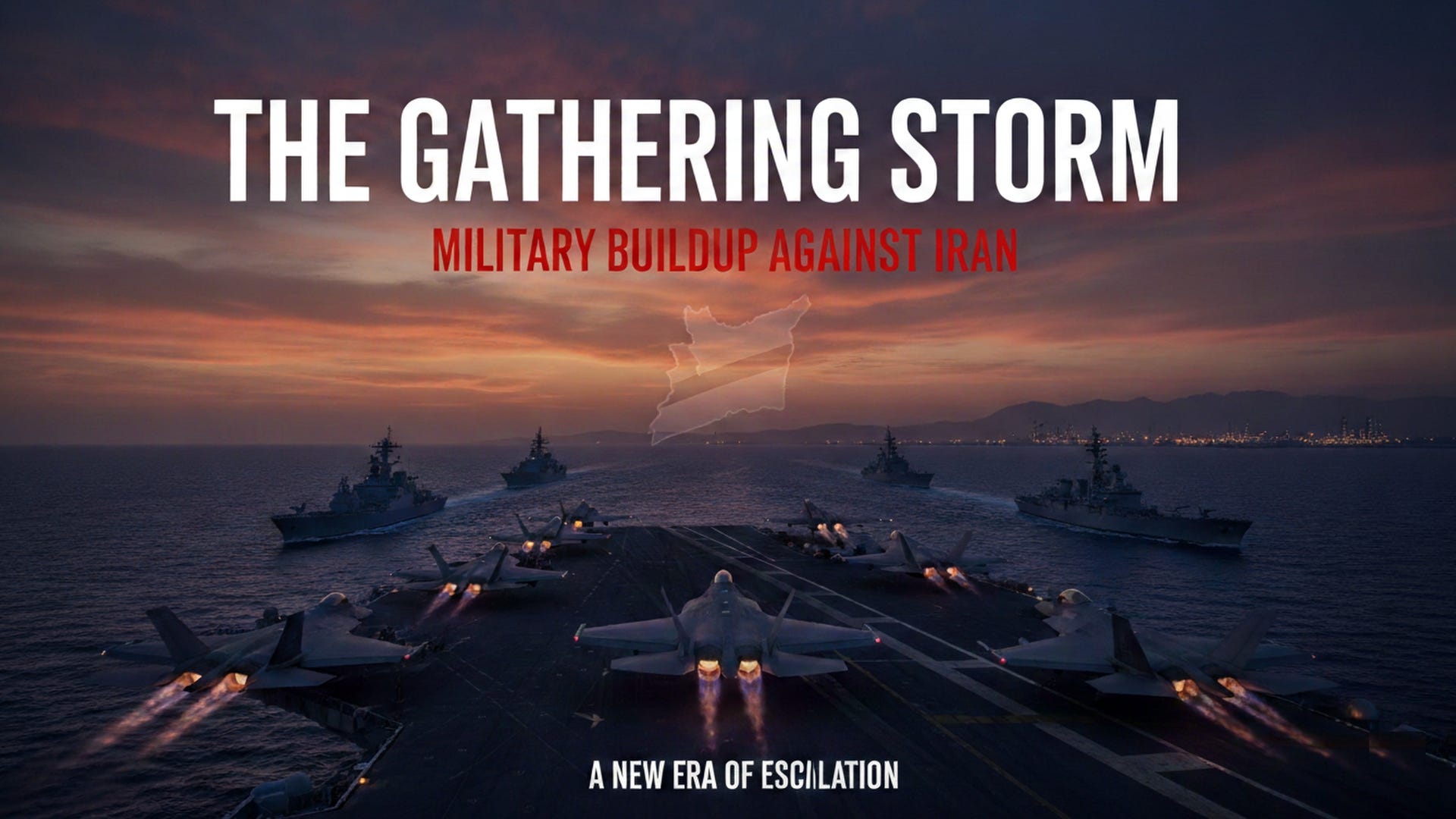
Between January 27 and January 29, 2026, something carefully orchestrated unfolded across Western capitals. Within a single 48-hour window, the USS Abraham Lincoln carrier group arrived in the Gulf, Donald Trump declared “time is running out,” the European Union unanimously designated Iran’s Revolutionary Guard as a terrorist organization, German Chancellor Friedrich Merz announced “Iran’s days are numbered,” and oil prices surged to a six-month high. This was not the chaotic unfolding of a spontaneous crisis. This was the methodical drumbeat of a prepared military campaign seeking its moment.
Analysis of 235 news headlines from 11 countries reveals a coordinated information operation that mirrors—with disturbing precision—the preparatory phases of interventions in Iraq and Libya. The pattern is unmistakable: synchronized political statements, expanding legal justifications, carefully managed market reactions, and a near-total absence of dissenting voices from major powers that might complicate the narrative. What emerges is not a picture of diplomacy exhausted, but of diplomacy deliberately sidelined.
The Multiplication of Justifications
When rationales for military action proliferate rather than clarify, it signals strategy. The stated reasons for pressure on Iran have expanded in a revealing sequence over the past week. On January 22, the mission was forcing a nuclear deal. By January 27, it had become supporting Iranian protesters against regime crackdown. The January 29 EU terror designation added counterterrorism to the menu. Chancellor Merz’s “days are numbered” comment introduced explicit regime change. Four distinct justifications in seven days.
This multiplication serves a calculated purpose. If public support wavers for one rationale, three others remain available. When the Bush administration shifted from weapons of mass destruction to spreading democracy to fighting terrorism in Iraq, it demonstrated that expanding justifications indicate commitment to a predetermined course, not responsive policymaking. The same dynamic characterized Libya, where a no-fly zone to protect civilians became an air campaign for regime change within weeks.
Intelligence officials who spoke on condition of anonymity describe a planning process that began months ago, independent of recent protest developments in Iran. “The carrier group deployment wasn’t ordered last week,” one former Defense Department official explained. “These movements take weeks to coordinate. The political messaging was timed to the arrival, not the other way around.” The protests, then, provided useful additional justification for plans already in motion.
Synchronized Escalation: The Coordination Evidence
The 48-hour sequence bears the hallmarks of coordinated messaging. Diplomatic unanimity—especially within the fractious European Union—does not emerge spontaneously. The IRGC terror designation required consensus from 27 member states, achieved with remarkable speed despite the grave implications. France and Germany, which have historically resisted aggressive Middle East interventions, aligned with unusual rapidity.
Reporting from Brussels indicates the designation was fast-tracked through committees that normally require months of deliberation. A European diplomat, speaking on background, acknowledged the process was “compressed” but declined to specify why. The answer lies in the timeline: legal frameworks precede military operations. The terror designation creates international legal cover for strikes against IRGC targets anywhere, not just within Iran’s borders.
German Chancellor Merz’s statement—unprecedented in its bluntness from a German leader regarding military matters in the Middle East—suggests coordination at the highest levels. Germany does not casually predict the collapse of foreign governments. That Merz chose to make this declaration within hours of the EU designation points to scripted messaging. When asked by German media whether he was advocating military action, Merz offered the non-denial: “I am describing reality.”
Meanwhile, Israeli officials were quietly sharing targeting intelligence with the Pentagon, according to reports in Axios. This intelligence sharing represents active participation in operational planning, not merely consultation among allies. Israeli military planners have identified approximately 300 IRGC-linked targets, according to defense analysts familiar with the matter. The message is clear: if the United States strikes, Israel is already integrated into the campaign.
The Missing Voices
What is most revealing about this moment is not what is being said, but what is absent. The collected headlines show zero articles from Chinese state media—no Xinhua, no CGTN, no Global Times. For a nation with strategic partnerships in Tehran and opposition to Western intervention, this silence in Western news aggregators is remarkable. Either Chinese counter-narratives exist but are being filtered from Western view, or Beijing has calculated that public opposition at this stage would be counterproductive.
Russia’s Sputnik offers warnings about regional chaos, dismissed in Western coverage as predictable Kremlin propaganda. Turkish officials, despite Ankara’s complex relationship with Tehran and its own interests in Syria and Iraq, are completely absent from the discourse. Saudi Arabia, the UAE, and the broader Arab League—all of whom would face direct consequences from military action against Iran—have produced no visible statements in Western media coverage.
The Iranian perspective has been reduced to threats. “Unprecedented response,” “crushing retaliation,” “finger on trigger”—these are the only Iranian voices given space in Western reporting. No diplomatic proposals from Tehran appear in the coverage, no attempt by Iranian officials to de-escalate through anything but deterrence rhetoric. Either such proposals do not exist, or they are being systematically excluded because they would complicate the narrative that military action is the only remaining option.
This selective silencing has precedent. In the run-up to Iraq, voices questioning the intelligence on weapons of mass destruction existed but were marginalized. Scott Ritter, the former UN weapons inspector who insisted Iraq had been disarmed, was sidelined in mainstream coverage. The pattern repeats: dissenting voices exist but receive no platform, creating false impression of consensus.
Her my interview with the Iranian Oxford Scholar Yassamine Mather
Market Signals and Reality Checks
Financial markets offer their own form of analysis, often more honest than political rhetoric. The response to this escalation contains a critical contradiction. Oil prices surged 5 percent to $71 per barrel, reaching a six-month high—the expected reaction to supply disruption fears. Yet gold, the traditional safe-haven asset that rallies during geopolitical crises, fell 10 percent during the same period.
Traders position themselves based on actual probability, not political theater. If markets believed war with Iran was imminent, gold would rally sharply as investors flee to safety. Instead, the gold crash suggests sophisticated market participants view this as a pressure campaign rather than genuine preparation for military conflict. The oil spike reflects concern about Strait of Hormuz disruption, but the gold drop indicates skepticism about whether strikes will actually occur, - unless some hidden market manipulation is the real driving factor.
This divergence warrants attention. Either markets are badly misreading the situation—unlikely given the sophistication of institutional traders—or the public escalation serves primarily as coercive diplomacy rather than war preparation. Yet the military assets are real, the rhetoric is real, and historical precedent shows that pressure campaigns can transform into actual wars when escalation momentum becomes difficult to reverse.
The oil market itself reveals another omitted reality. Twenty to thirty percent of global oil supply transits the Strait of Hormuz. Iranian forces possess thousands of anti-ship missiles and hundreds of small attack boats capable of temporarily closing the strait. A sustained closure would trigger global recession, yet no Western official addresses this risk publicly. The assumption appears to be that Iran would not retaliate against Gulf shipping, or that such retaliation could be quickly suppressed. Both assumptions are questionable.
Historical Pattern Recognition: Iraq and Libya Redux
The current sequence matches established patterns of intervention preparation with disturbing accuracy. In the months before the Iraq invasion, the Bush administration coordinated allied support, created legal frameworks through UN resolutions (however contested), synchronized media messaging about imminent threats, and expanded justifications from WMD to terrorism to democracy promotion. The coalition-building followed identical logic: present unified front, marginalize dissenting voices, establish legal cover, deploy assets, then strike.
Libya followed a compressed version of the same template. What began as humanitarian intervention to protect civilians in Benghazi transformed within weeks into a full air campaign for regime change, with NATO coordination that had clearly been planned well in advance of UN Security Council authorization. The French and British, who led that intervention, now align with Washington on Iran.
Key similarities emerge:
Multiple expanding justifications rather than single clear casus belli
Humanitarian framing (Iraqi liberation, Libyan civilian protection, now Iranian protesters) layered over strategic interests
Rapid legal framework construction (UN resolutions then, EU terror designation now)
Allied coordination producing appearance of international consensus
Missing voices from major powers that might oppose (Russia and China marginalized in coverage)
Asset deployment preceding rather than following political decision points
One crucial difference: Iran possesses far greater military capabilities than Iraq or Libya. The Islamic Republic fields ballistic missiles that can reach Tel Aviv, regional proxy forces across Lebanon, Syria, Iraq and Yemen, and the ability to close the Strait of Hormuz. This is not the degraded Iraqi military of 2003 or the isolated Libyan regime of 2011. The costs of intervention are vastly higher, which makes the push for military action all the more striking.
Israel’s Central Role
The Israeli dimension deserves particular scrutiny. While Trump speaks of nuclear threats and support for Iranian protesters, Israeli officials focus on the direct military threat Tehran poses to Tel Aviv. The framing is transparent: any American strike on Iran will automatically trigger retaliation against Israel, which then necessitates Israeli participation in a broader campaign. The coordination is already in place—intelligence sharing, target lists, integrated planning.
This represents the latest iteration of a long-standing pattern. American military interventions in the Middle East consistently align with Israeli strategic interests while being presented as serving broader U.S. national security goals. The 2003 Iraq invasion removed a strategic threat to Israel while being sold to Americans as counterterrorism and WMD prevention. The ongoing pressure on Syria has weakened another state on Israel’s border. Now Iran, the most significant remaining state opposing Israeli regional dominance, faces the threat of American military action.
The Israeli government has been explicit about viewing the Abraham Accords and normalization with Arab states as part of a broader strategy to isolate Iran. The current escalation serves this project perfectly. The timing is notable: Israeli elections are scheduled for later this year, and Prime Minister Netanyahu faces corruption charges. History shows Israeli leaders have initiated or escalated military operations during moments of domestic political vulnerability.
None of this constitutes conspiracy—it is openly stated strategic alignment. The problem is not that Israel pursues its interests, but that American blood and treasure are deployed in service of those interests while being presented to the American public as national security imperatives. The pattern has repeated for decades: pressure from pro-Israel lobbying groups, sympathetic officials in key positions, and a bipartisan consensus that questioning Israeli policy objectives is politically dangerous.
What They Are Not Telling You
The most significant omissions in current coverage concern costs and consequences. No mainstream Western outlet has published detailed analysis of what happens after potential strikes. The assumption appears to be that surgical action against nuclear facilities or IRGC targets would remain contained, that Iran would absorb the attacks without major retaliation, and that regional stability would somehow be enhanced by removing the Iranian threat.
This is fantasy. Iran has spent four decades preparing for exactly this scenario, developing asymmetric capabilities specifically designed to impose massive costs on any attacker. Hezbollah possesses an estimated 150,000 rockets capable of overwhelming Israeli air defenses. Iraqi Shia militias could target American forces across Iraq. Houthi forces in Yemen could strike Saudi and Emirati infrastructure. And Iranian missiles could hit oil infrastructure throughout the Gulf.
The strait closure scenario alone should give pause. Even temporary disruption of Hormuz shipping would spike oil prices above $100 per barrel, potentially to $150 or higher if the closure persisted for weeks. Global economic impacts would be severe: recession in oil-importing nations, inflation spikes, supply chain disruptions affecting everything from manufacturing to food prices. Yet these consequences receive minimal discussion in political rhetoric or media coverage.
Civilian casualties represent another omitted reality. Strikes on Iranian nuclear facilities, which are dispersed and often located near population centers, would kill thousands of Iranian civilians. The Fordow facility is buried under a mountain near Qom, a religious center with over one million inhabitants. Attacks on IRGC facilities throughout Iranian cities would kill military personnel and civilians alike. The protest movement that supposedly justifies intervention would see its participants killed by American bombs.
The regional war scenario is not hypothetical. Former Defense Department officials with Middle East experience describe it as the most likely outcome of any strike campaign. “You can’t hit Iran without triggering everything else,” one explained. “The question isn’t whether Hezbollah would fire on Israel, it’s whether Turkey stays out, whether the Iraqi government can control the militias, whether Saudi Arabia’s oil infrastructure can be defended. Once you start, you’re in it, and it spreads.”
The Seven to Fourteen Day Window
Based on carrier group positioning, intelligence preparation timelines, and the pace of rhetorical escalation, the decision point arrives within the next seven to fourteen days. This is not speculation but assessment based on operational requirements. Carrier groups maintain position for limited periods before requiring resupply and maintenance. The political messaging has reached fever pitch—sustaining this level of rhetoric without action would represent a significant climb-down.
Three scenarios present themselves. First, the escalation is pure coercive diplomacy: maximum pressure designed to force Iranian concessions without actual military action. The gold market crash suggests some traders believe this scenario. Second, limited strikes occur against specific targets—perhaps nuclear facilities or IRGC command structures—with the expectation of managing retaliation through additional military action. Third, broader campaign begins with the intention of regime change through sustained air strikes combined with support for opposition forces.
The multiplication of justifications makes the first scenario less likely than it might otherwise be. Officials who simply wanted to pressure Iran toward negotiations would maintain focus on the nuclear issue. The addition of humanitarian intervention rhetoric and explicit regime change language from German officials suggests ambitions beyond negotiating leverage. Once regime change enters the stated objectives, the logic of limited action becomes harder to maintain.
Intelligence analysts who spoke on condition of anonymity describe planning for multiple contingencies, with final decision authority resting with President Trump. The assessment among some officials is that Trump views military action as politically beneficial heading into election season, while others believe he remains genuinely conflicted about starting another Middle East war after campaigning against such interventions. The uncertainty lies not in capability or preparation but in political will.
The Pattern They Cannot Hide
Return to the 48-hour window: the synchronized statements, the legal frameworks, the military deployments, the market reactions, the media saturation. This is what coordinated preparation looks like. It is not chaotic, it is not reactive, it is not driven by sudden crisis developments. It is methodical, planned, and aimed at creating conditions where military action appears not just justified but necessary.
The comparison to previous interventions is not meant to predict identical outcomes. Iran is not Iraq or Libya. The costs are higher, the capabilities greater, the regional dynamics more complex. But the process of creating consensus, marginalizing dissent, multiplying justifications, and deploying assets follows established patterns that have preceded military action in the past.
What makes this moment particularly dangerous is the convergence of Israeli pressure, American political calculations, European acquiescence, and the systematic exclusion of voices that might complicate the drive toward intervention. The missing Chinese and Arab perspectives, the reduction of Iranian discourse to threats, the absence of serious cost-benefit analysis—these silences are themselves a form of preparation, clearing the informational battlefield of obstacles to action.
The next week will reveal whether this coordination produces actual military strikes or represents costly coercion. Either way, the machinery of intervention has been assembled and tested. The legal frameworks are in place. The allied coordination is functioning. The military assets are positioned. And the public narrative has been crafted to present military action as responding to Iranian aggression rather than initiating it.
History suggests that once this machinery begins operating, it develops its own momentum. Backing down becomes politically costly. Hawks gain influence. Diplomatic off-ramps become harder to take without appearing weak. The 48-hour window that revealed the coordination pattern may be remembered as the moment when another Middle East war became nearly inevitable because powerful interests prepared the ground carefully enough that alternatives disappeared from view.
The question is no longer whether they are preparing for war. The coordination makes that clear. The question is whether this preparation will culminate in actual strikes, or whether the pressure campaign can be maintained as coercion without crossing into military action. Both outcomes serve Israeli interests. Both align with a bipartisan American foreign policy consensus that views Iranian power as inherently threatening rather than as manageable through sustained diplomatic engagement. And both carry risks that the public is not being told about honestly.
The 48-hour window revealed the pattern. The next 14 days will reveal whether that pattern leads where similar patterns have led before.
Sources:
This exposé is based on 235 publications from 11 countries in the 48 hour timeframe between Jan. 27 to 29, 2026, just as the War rhetoric has heated up.
For readability, individual sources are not listed here in full. If you want to review the complete bibliography, including direct links, outlet names and publication dates, you can request it by sending me a private message on Substack. I will share the full source list as CVS file with you.
Well balanced analysis of a potentially catastrophic situation. Buckle up and hold on to your seats.
Hmm, consent? Manufactured? Lobotomies, chaos, 400 percent inflation on many goods and services, smash and grab Gestapo, total Axis of Evil, Israel/USA? Chomsky-Epstein bullshit?
And we are the Nobodies?
Russia: Total casualties are estimated to be over 1.2 million.
Ukraine: Total casualties are estimated at 500,000 to 600,000.
Who's numbers will Ritter or Sleboda or Meisheimer talk about?
+--+
Fleas dream of buying themselves a dog, and nobodies dream of escaping
poverty: that one magical day good luck will suddenly rain down on
them—will rain down in buckets. But good luck doesn’t rain down
yesterday, today, tomorrow, or ever. Good luck doesn’t even fall in a
fine drizzle, no matter how hard the nobodies summon it, even if their
left hand is tickling, or if they begin the new day with their right
foot, or start the new year with a change of brooms.
The nobodies: nobody’s children, owners of nothing. The nobodies: the
no ones, the nobodied, running like rabbits, dying through life,
screwed every which way.
Who are not, but could be.
Who don’t speak languages, but dialects.
Who don’t have religions, but superstitions.
Who don’t create art, but handicrafts.
Who don’t have culture, but folklore.
Who are not human beings, but human resources.
Who do not have faces, but arms.
Who do not have names, but numbers.
Who do not appear in the history of the world, but in the police
blotter of the local paper.
The nobodies, who are not worth the bullet that kills them.”
― From Open Veins of Latin America: Five Centuries of the Pillage of a Continent
https://paulokirk.substack.com/p/ahh-that-hebrew-double-speak-planned