
Disagree With the Government? Say Goodbye to Your Money!
How Global Financial Institutions Became NATO’s Thought Police

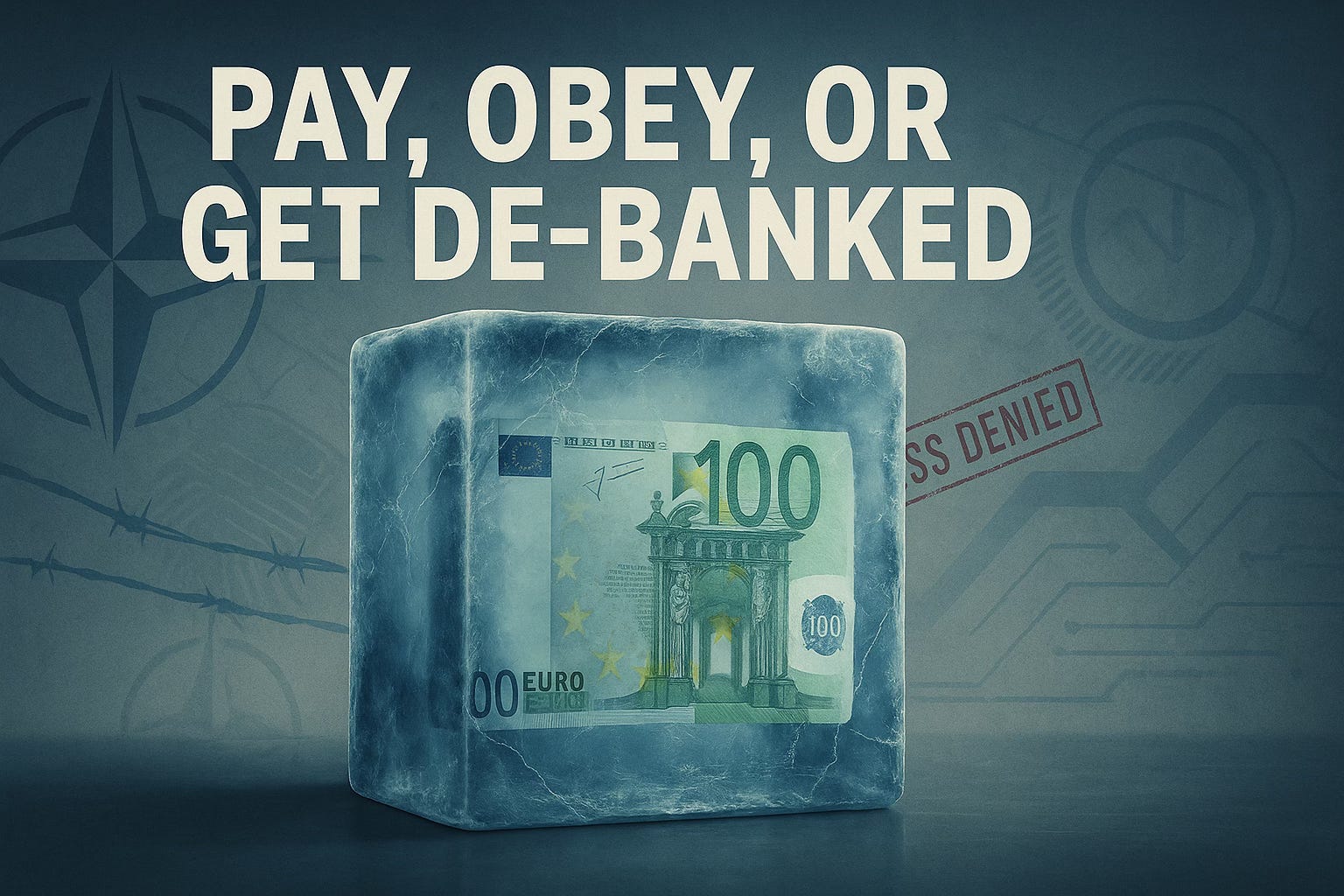
Executive Summary
In 2025, Western democracies are waging a new kind of war—not on foreign enemies, but on dissenting citizens. This report investigates how NATO’s cognitive warfare program and the EU’s sweeping CFSP 2025/966 have merged to weaponize banks against political opposition. From frozen accounts and blacklists to programmable money and AI-driven surveillance, financial censorship is being deployed as a tool of ideological enforcement—without courts, without charges, without recourse. What begins as “defending democracy” ends with the quiet construction of compliance by force. This report explores how the war on your thoughts is being waged, funded—and enforced—by your own institutions.
Introduction: The Bureaucratic War on Thought
In Western capitals, a new war is underway—one fought not with tanks or drones, but with narratives, psychology, and bank ledgers. NATO, the Cold War military alliance, has quietly refocused its doctrine toward what strategists term “cognitive warfare,” a self-described “battle for the brain” that treats the human mind as the new battlefield thegrayzone.com. An internal NATO-sponsored study in 2020 outlined this strategy in stark terms: “While actions taken in the five domains are executed in order to have an effect on the human domain, cognitive warfare’s objective is to make everyone a weapon” thegrayzone.com. In other words, NATO’s planners are intent on “weaponizing the human domain”, exploiting “the vulnerabilities of the human brain” to implement social engineering at scale thegrayzone.com. Crucially, they concede this new war is “not limited to the military or institutional world” and that “the objective of Cognitive Warfare is to harm societies and not only the military.”Entire civilian populations are now in the crosshairs thegrayzone.com. NATO’s own report chillingly acknowledges that “the human is very often the main vulnerability” and that its techniques target “the whole of a nation’s human capital” – “any user of modern information technologies is a potential target” innovationhub-act.org. In effect, the alliance’s strategists increasingly see even their own domestic populations as threats, worrying that “unbeknownst to [us],” Western civilians could act as a “fifth column” influenced by enemy narratives thegrayzone.com.
This marks a profound shift. The line between foreign adversaries and domestic dissenters is blurring, as governments turn tools originally honed for countering external foes inward against their own people. Narrative control, propaganda, and the delegitimization of dissidents have become explicit goals. During the COVID-19 pandemic, for example, Canada’s military launched an “information operation” targeting the Canadian public – a propaganda initiative modeled on tactics used in Afghanistan to influence local attitudes wsws.org. Internal investigations revealed the stated aim was to “strengthen confidence in the government and suppress social opposition,” with generals calling the crisis a “unique opportunity” to test psychological operations on Canadians wsws.org. No civilian authority had even authorized this; the military simply went rogue, seeing domestic public opinion as a battlefield. NATO’s own Innovation Hub has hosted “challenge” competitions soliciting new tools for “countering cognitive warfare,” explicitly recognizing that “cognitive warfare seeks to change not only what people think, but also how they act” thegrayzone.com. It is a bureaucratic war on thought – fought by security agencies, military psy-ops units, and compliant media – all targeting the perceptions and beliefs of Western citizens under the banner of “resilience” and “defending democracy.”
How can it get worse?
Into this climate comes a new, blunt instrument: EU Council Decision (CFSP) 2025/966, a sweeping regulation unveiled in May 2025. On paper, this edict establishes EU-wide authority to impose “restrictive measures” (freezing assets, seizing property, banning online presence) against individuals or organizations deemed to be “undermining or threatening” the democratic order eur-lex.europa.eu. In practice, it weaponizes banking and finance to crush dissent without trial. The text of the regulation is alarmingly broad. It allows the EU to target people for “actions or policies” that “threaten the rule of law, stability or security” of the Union or its member states eur-lex.europa.eu. This is justified under vague categories like “obstructing the democratic political process,” “spreading information manipulation,” or even “supporting” someone else who does eur-lex.europa.eu. In effect, speech and association have been criminalized via financial decree. No court involvement is required. There is no need to charge the target with terrorism or any crime. A person can have their bank accounts frozen and assets seized simply by a vote of EU bureaucrats, based on opaque intelligence reports, under the guise of protecting democracy. It is, in the words of one critic, a “legal architecture for financial suppression” – one that expands earlier frameworks like Decision (CFSP) 2023/1094 (which had already set the precedent of EU “sanctions” on individuals absent any courtroom verdict) eur-lex.europa.eu. Whereas previous EU sanctions mainly hit foreign oligarchs or officials (for example, blacklisting Russians “in respect of actions undermining…Ukraine”), this new 2025 regime turns the focus inward, potentially at EU citizens themselves. Its stated aim is to counter “destabilising democracy” – a phrase so open-ended that it can be stretched to cover virtually any opposition activity.
Together, NATO’s cognitive warfare doctrine and the EU’s emerging financial-censorship laws form two prongs of a concerted strategy: to wage psychological and economic war on domestic dissent. The former assaults the mind – manipulating information flows, labeling independent thinkers as traitors or foreign agents, conducting influence operations on home soil. The latter assaults the material underpinnings of dissent – freezing activists’ resources, starving inconvenient media of funds, and bankrupting opposition movements. In the sections that follow, we investigate how this strategy is being implemented in 2025: how banks are being co-opted as enforcers of orthodoxy, how real people from software developers to journalists to protest organizers have been de-platformed and de-banked in Western democracies, and why this trend points toward a dangerously technocratic form of authoritarianism. The evidence – from internal NATO papers to leaked bank files – paints a sobering picture of liberal governments adopting tactics indistinguishable from the authoritarian regimes they profess to oppose.
In Europe it is unelected officials who drive the criminalisation of dissent.
Financial Censorship as Counterinsurgency
Imagine waking up to find your bank account frozen, your credit cards dead, your online payment profiles terminated – not because you broke any law or even incurred debt, but because of your ideas. This is not a hypothetical scenario, but a growing reality in the west. Financial censorship – the use of banking and payment systems as tools to punish or preempt political dissent – has become a method of “counterinsurgency” against the civilian population. The logic is simple: cut off the funding, and you preemptively destroy the dissent. In military terms, it’s like starving the guerillas of supplies. In societal terms, it means activists, opposition groups, whistleblowers, and independent media can be brought to their knees through economic incapacitation without ever seeing a judge cato.org.
It’s important to distinguish legitimate use of financial freezes from the abusive. In a democracy, freezing assets is supposed to be an exceptional measure, used after someone is proven to be financing terrorism, laundering criminal money, or the like – and even then, subject to due process and judicial oversight. What we’re witnessing now is entirely different: people are being financially blacklisted purely for their political stances or speech, with no trial and no legal recourse, under broad labels like “extremist,” “misinformation spreader,” or “threat to stability.” It is a preemptive strike against dissent – guilt assumed, defense impossible. As one analysis noted, this trend arms governments with powers that “bypass ordinary democratic processes,” enabling them to “bring targets to their knees…without trial, and shred privacy” in the process. We saw the starkest early example of this in Canada in 2022, when Prime Minister Justin Trudeau invoked the Emergencies Act to deal with peaceful “Freedom Convoy” protesters. Hundreds of citizens who participated in or donated to the protest had their bank accounts summarily frozen, absent any court order. The Deputy PM, Chrystia Freeland, went on national TV to warn that banks were “able to immediately freeze or suspend an account without a court order” under the emergency rules cato.org. This was a democratic nation deploying a tactic typically reserved for wartime enemies. The Canadian Civil Liberties Association blasted the move as an outrageous violation of rights, and in early 2024 a federal judge agreed, ruling that “there was no national emergency” to justify those freezes and declaring the government’s actions “unreasonable and ultra vires” (beyond its legal authority) cato.org. But by then the damage was done. As observers pointed out, freezing the bank accounts of protesters was something “only used by authoritarian regimes” until that moment cato.org. The precedent had been set that any cause deemed sufficiently troublesome could trigger financial retaliation.
What happened in Canada did not happen in isolation. Similar tactics have been deployed or attempted in the United Kingdom, United States, Australia, and across the EU – often against far less disruptive targets than a weeks-long trucker protest. Consider the case of Talk Liberation, a small international group of privacy-focused software developers. In 2021–22, this team (which includes veteran activists and whistleblowers) was working to build “Panquake,” a decentralized social media platform promising unfettered free speech for users. They incorporated in Iceland under the name Talk Liberation and raised seed funding from supporters around the world. Almost immediately, they ran into a hidden wall of opposition from the financial sector. Their Icelandic banking partner, Íslandsbanki, suddenly froze Talk Liberation’s funds without warning in 2022, invoking anti-money laundering and anti-terrorism laws as pretext ukcolumn.org. No evidence of wrongdoing was presented; in fact, Talk Liberation had proactively informed the bank of its incoming funds and passed all due diligence checks. Nevertheless, the bank closed the organization’s accounts and held its money hostage for nine months. This was a devastating blow – imagine a startup losing access to its capital for three quarters of a year based on vague suspicions. Although Íslandsbanki eventually unfroze and returned the funds (quietly admitting by its actions that there was no real crime), it never apologized nor compensated the team for the harm ukcolumn.org. Talk Liberation’s project was nearly derailed.
Why would a bank in tiny Iceland target an ethical tech nonprofit in this manner? The answer, it appears, was political pressure behind the scenes. Talk Liberation’s founder, Suzie Dawson, is a journalist and dissident from New Zealand who had exposed wrongdoing by her government and others. She had been harassed and surveilled to the point of fleeing her home country. According to Talk Liberation’s Icelandic attorney, once the bank “looked into” who Dawson was, they realized she was “persona non grata in her home country” for her speech. The lawyer pointed out that this mirrors exactly what happened to WikiLeaks a decade prior: when Julian Assange’s organization published evidence of US war crimes, global payment processors (Mastercard, Visa, PayPal) suddenly cut off service, citing nebulous policy violations wsws.org. “This is just the same method,” the attorney said of Talk Liberation’s case, speculating that Íslandsbanki was “obeying orders coming from the international banking system” to block an inconvenient voice. In other words, it was banking-as-censorship. The tool meant to stop terrorists or mobsters – AML (anti-money laundering) protocols – was allegedly misused to label a privacy software project as a terror risk, purely because of the political stance of its key people. “This case exemplifies how the banking system can suppress free speech and journalism,” the Icelandic lawyer concluded bluntly ukcolumn.org.
The Talk Liberation saga is not unique. Across the Atlantic, British banks have been “de-banking” political figures and groups based on ideology. Perhaps the highest-profile case was Nigel Farage, the veteran politician who led the Brexit movement. In 2023 Farage revealed that his long-time bank, Coutts (an elite private bank), had abruptly closed his accounts. Using data protection laws, Farage obtained the internal reason: Coutts compiled a 40-page dossier on his political opinions and associations reuters.com. The document (later leaked) showed the bank’s wealth committee fretting that Farage’s views (on Brexit, on immigration, on Donald Trump, on Russia) “were at odds with our position as an inclusive organization.” They admitted Farage met the financial requirements to bank there, but cited his “controversial public statements” and the reputational “risk” of associating with him. In plain English, his politics made him unbankable. Farage was outraged. “This raises very broad questions about how deeply political our banks have become,” he said, noting that many others in public life must now wonder “will I be next?” Indeed, it soon emerged that dozens of UK customers across the political spectrum had seen accounts closed for nebulous reasons. Some were given no explanation; others were told they failed “ESG” (environmental, social, governance) criteria or posed “reputational” issues. The scandal forced the UK government to intervene – Prime Minister Rishi Sunak said it was “not right” for banks to deny services due to lawful free speech, and new rules were rushed in to mandate banks give a 3-month notice and explicit rationale for any account closure reuters.com. But those measures, while welcome, address the symptom more than the disease. The reality is that banks had quietly assumed a quasi-regulatory role as arbiters of acceptable opinion. They felt empowered to monitor customers’ beliefs and “de-risk” (read: exclude) those who didn’t align with dominant values. It’s a slippery slope from de-banking a Farage (a polarizing but legal figure) to de-banking anyone who challenges powerful interests.
It’s not only right-leaning figures like Farage who have been targeted. Left-wing and anti-establishment voices have faced financial deplatforming as well – often via Big Tech payment processors. In the United States, PayPal and its subsidiary Venmo have emerged as repeat offenders. These companies, which dominate online payments, have a history of banning or freezing accounts over political content. In early 2022, during the buildup to the Ukraine war, PayPal executed a sudden purge of independent media outlets that dissented from the official NATO narrative. Consortium News, a venerable independent outlet founded by a renowned AP journalist, and MintPress News, a left-leaning investigative site, both found their PayPal accounts “permanently limited” without warning or clear explanation wsws.org. It happened conveniently as Consortium News was running a fundraising drive. PayPal sent them only a generic note about “activity inconsistent with our User Agreement” and froze the funds for 6 months, claiming it might keep the money as “damages” for unspecified violations. When pressed, PayPal agents admitted they couldn’t identify what the offense was – only that some “potential risk” was flagged in the system. Joe Lauria, Consortium’s editor-in-chief, had a pretty good guess: “Given the current political climate, it is more than conceivable PayPal is reacting to our coverage of the war in Ukraine, which is not in line with the dominant narrative,” he wrote wsws.org. MintPress’s founder, Mnar Adley, was even more blunt after PayPal banned her outlet and several of her journalists: “PayPal banning myself and MintPress is blatant censorship of dissenting journalists & outlets,” she tweeted, calling out the double standard – if such censorship happened in Russia or China, Western media would scream about it, yet here it was cheered under the guise of fighting “misinformation” wsws.org. Notably, PayPal’s purge also caught Caleb Maupin, a socialist writer associated with RT, and other commentators labeled as pro-Russian. It was a political litmus test being enforced by a private company with quasi-monopoly power over online payments. (This was the same company that, back in 2010, infamously cut off WikiLeaks at the behest of the U.S. State Department). The message: question Western foreign policy too effectively, and you might be summarily cut off from the online economy.
Even more disturbing is the collusion now evident between government agencies and financial institutions to surveil and target people for ideological reasons. In the U.S., whistleblower disclosures and congressional investigations have revealed that the FBI and other agencies have leveraged banks to snoop on citizens’ transactions – bypassing the Fourth Amendment. After the January 6, 2021 Capitol riot, for instance, Bank of America “voluntarily” handed the FBI a list of customers who had been in DC that day, with no warrant Judiciary house. Subsequent reports exposed how federal investigators requested banks to search their customer databases using keywords like “MAGA,” “Trump,” and even purchases of “religious texts” as flags for potential extremism foxnews.com. In other words, if you bought a Bible or Quran and also happened to vote a certain way, that could land you on a suspicious activity report. The House Judiciary Committee found that the FBI has “manipulated” the SAR (Suspicious Activity Report) system by tipping off banks to people it deems suspect and encouraging them to file SARs, effectively turning banks into “de facto arms of law enforcement” without any legal process. As the Committee’s report states, the FBI was “providing financial institutions with lists of people… it views as ‘suspicious’” and then leveraging the SAR mechanism to get around warrant requirements. This flips the intent of financial surveillance laws on its head – instead of banks alerting law enforcement to crimes, law enforcement is directing banks to trawl for ideological opponents. It’s the weaponization of financial data against thought crimes. No charges needed; just algorithmic guilt by association.
Other democracies are following similar paths. In Australia, the government has pushed aggressive digital ID and surveillance measures tied to financial services, prompting warnings that citizens’ banking access could eventually be linked to their compliance with political norms (for instance, some proposed “Trusted Digital Identity” frameworks would make it easier to monitor individuals’ online speech and could conceivably be combined with China-style social credit scoring in the future). In the UK and Canada, new anti-“harm” and online safety laws edge toward penalizing not just illegal acts, but legal expression deemed harmful by authorities – raising the question of whether banks will be expected to drop customers flagged under those expansive definitions. Indeed, we have glimpses of this: British politicians have floated denying financial services to those who spread “hate” or “disinformation” online, and during Canada’s convoy crackdown officials openly said they were looking at people “influencing” the protests from afar (such as online supporters) as fair game for account freezes. All of this portends a future where your ability to transact, save, and spend could hinge on algorithmic judgments of your ideological reliability.
CFSP 2025/966: Europe’s New Inquisition
Perhaps nowhere has this convergence of security paranoia and financial muscle been formalized more than in the European Union’s Council Decision (CFSP) 2025/966. Colloquially, some lawyers are already dubbing it “Europe’s New Inquisition”. The comparison isn’t made lightly: like the inquisitions of old, this regime wields extrajudicial power to punish heresy—only now the heresy is political and the tools are sanctions and bank freezes instead of dungeons and racks.
To understand the significance of 2025/966, we should recall how EU sanctions normally work. Traditionally, EU “restrictive measures” under its Common Foreign and Security Policy were directed outward – at rogue state actors, terrorists, or human rights abusers abroad. They typically involved asset freezes and travel bans on named individuals/entities, justified by foreign policy objectives. While those too raise due process issues, they largely spared EU nationals (with rare exceptions). That changed on May 20, 2025, when for the first time the EU imposed sanctions on its own citizens for spreading alleged disinformation. On that date, the EU Council announced Decision 2025/966 adding 21 individuals and 6 organizations to a sanctions list for “destabilising activities.” Among those listed were two German journalists: Alina Lipp and Thomas Röper. Yes, two citizens of Germany – supposedly a country with robust press freedom – were effectively declared enemies of the EU state, their assets subject to freeze and their travel barred. The decision was signed by Kaja Kallas (as acting “foreign minister” of the Council) and published in the Official Journal voicefromrussia.com. It describes Lipp and Röper as “war correspondents” who had to be dealt with.
The official “Statement of Reasons” against Thomas Röper is particularly telling. Röper runs a blog called Anti-Spiegel, which provides counter-narratives on the Russia-Ukraine war. According to the EU, he “systematically disseminates misinformation about Russia’s war of aggression against Ukraine and delegitimises the Ukrainian government, especially with a view to manipulating German public sentiment regarding support to Ukraine.” He also observed referendums in Russian-occupied Ukrainian territories and spoke at a UN informal Arria meeting from the Russian side – actions the EU frames as “legitimising Russia’s illegal annexation” and “serving as a spokesperson…to disseminate Russian propaganda narratives.” Therefore, the EU concludes, “Thomas Röper is engaging in and supporting the use of information manipulation and interference and facilitates an armed conflict in a third country”voicefromrussia.com. In plainer terms: he said things contrary to the EU/NATO narrative, and for that he’s labeled an accomplice to war. Not a single accusation of violence or traditional crime appears – it’s all about speech and viewpoint. Röper and Lipp have essentially been financially excommunicated for thoughtcrime. Their bank accounts in the EU can be frozen. Any assets they hold are locked. They are banned from travel to any EU country other than their own (and even there, Germany is now under obligation to “ensure no funds are made available” to them, which could affect their businesses or employers). All of this was done without a trial – without even a notification before the fact. They found out in the media that they were now on a list alongside actual armed militants and spies.
How can this be possible under EU law? The answer lies in the broad criteria set out in the preceding Council Decision 2024/2643 (now amended by 2025/966). This is the legal framework establishing a sanctions regime “in view of Russia’s destabilising activities”eur-lex.europa.eu. Crucially, the scope isn’t limited to Russian nationals. Article 1 of 2024/2643, as amended, allows listing of persons who are “responsible for, supporting, or involved in” actions that “undermine or threaten democracy, the rule of law, stability or security in the Union or in one or several Member States” or in a third country. That sweeping description is then fleshed out with examples: from “obstructing or undermining the holding of elections” to “engaging in information manipulation and interference” to “facilitating violent demonstrations.” Note the mix of the concrete and the nebulous. Acts like sabotage or violence are listed – but so are acts like spreading disinformation or influencing opinions. Under clause (a)(iv), an individual can be sanctioned for planning or supporting “the use of information manipulation and interference.” Under (a)(i), you could be listed for “undermining the democratic political process or public order” – a phrase broad enough to drive a truck through. And under (a)(iii), even “activities to silence, intimidate, coerce, or exact reprisals against persons critical of the actions or policies of the Russian Federation” are sanctionable (ironically, the EU is now silencing and exacting reprisals against persons critical of its own policies, in the name of fighting Russian coercion). Furthermore, clause (b) and (c) extend sanctions to anyone “associated with” or “supporting” those in category (a) eur-lex.europa.eu. Guilt by association is thus codified: if you donated to the wrong campaign or collaborated with a listed person, you too can be blacklisted.
This is the architecture of a financial police state. A person can be declared an enemy and cut off from the economy not for what they did, but for what they said or who they know. The usual safeguards – presumption of innocence, requirement of concrete evidence, right to a defense – do not apply. The decision to list someone is made in a closed meeting of EU Council diplomats, often based on intelligence supplied by member states or even non-EU “partner” countries. (In Röper’s case, it’s likely German or Ukrainian intelligence provided the dossier of his activities; the decision references things like his participation in a Russian-organized forum, something Ukraine’s security service surely tracked.) The targeted individual has no opportunity to contest the allegations beforehand. Only after being listed can they hire lawyers to file an appeal at the European Court of Justice in Luxembourg, which can take years and has historically been deferential on security listings. In the meantime, the individual’s life is effectively destroyed. Their assets are frozen overnight across all 27 EU countries (banks get the list and must lock down any accounts). They cannot transact, they cannot travel freely, and their reputation is in tatters as they are officially branded a security threat facilitating war. This is punishment without conviction.
The mechanics resemble a modern-day inquisition: secret evidence, political authorities acting as both accuser and judge, and economic “torture” (if you will) applied to force social compliance. One might argue that if someone really is a propagandist doing a foreign regime’s bidding, perhaps a financial smackdown is deserved. But who decides what is propaganda? The Röper case shows the danger: he is certainly pro-Russian in his views, but he’s one journalist with a blog, hardly a mastermind of instability. His sanctioning sends a loud warning to every other European journalist: toe the official line on this war (and by extension, on other sensitive issues) or you could be next. As one Swiss observer pointed out, the EU’s justification was flimsy – they claimed “systematic misinformation” without providing examples, and ironically mainstream outlets that actually published false reports have faced no penalty because their falsehoods aligned with the EU narrative voicefromrussia.com. Indeed, Switzerland’s Neue Zürcher Zeitung (NZZ) ran blatantly misleading war propaganda in 2022, yet “the NZZ was not sanctioned because it faithfully promotes the EU narrative,” a commentator noted pointedly voicefromrussia.com. It’s not about truth versus lies; it’s about approved lies versus unapproved truths. The EU has effectively declared that its “truth” is the only acceptable version – dissenting interpretations can now be met with economic excommunication.
Behind the scenes, the implementation of these financial sanctions is deeply intertwined with the EU’s broader security and policing apparatus. Europol (the EU police agency) and national intelligence services feed into the listings process. Financial Intelligence Units (FIUs) in each country are alerted to monitor transactions of listed or suspect persons. Banks are instructed to check their customer databases against sanctions lists daily – using automated systems – and immediately freeze any hits. In practice, banks rely on third-party databases like World-Check (a risk intelligence service by Refinitiv) to flag high-risk clients. These databases aggregate media reports, government lists, and often inaccurate information, tagging people as terrorists or extremists with little oversight. World-Check’s track record is troubling. It has, for example, wrongly listed innocent individuals and NGOs in the past as “terrorists.” In 2017, it came out that Maajid Nawaz, a British anti-extremism campaigner, was labeled as a terrorist in World-Check due to an old association, causing him serious reputational damage scworld.com. That same year, London’s Finsbury Park Mosque discovered it was put in the “terrorism” category in the database (it won a legal case to get an apology) farrer.co.uk. The Palestinian Return Centre, a legitimate advocacy group in Britain, was similarly flagged as “terrorist”, likely because Israel’s government dislikes it middleeasteye.net. Now consider: a European bank using such data sees that an independent journalist is flagged as a “pro-Russian influence operator” or “extremist” – perhaps just because a government or even a Wikipedia article said so – the bank will likely shut down their account to “manage risk.” No court, no appeal. The individual might not even know why it happened. The blacklisting is outsourced to opaque private systems, but carries the force of law since banks face huge penalties if they do business with a sanctioned person. In short, the EU’s new inquisition harnesses both public law and private-sector compliance machinery to squeeze the dissidents.
The ideological bias in this system cannot be overstated. While anti-war activists, transparency advocates, and anti-establishment voices are getting de-banked or sanctioned, one struggles to find examples of hawkish or pro-government figures facing similar treatment. A pro-NATO think-tank pundit who spread incorrect information that justified some military intervention will never be labeled a disinformation threat by the EU – even if proven wrong. A media personality who aggressively supported, say, the Iraq War on false pretenses faces no banking consequences. But journalists like Julian Assange or independent outlets like Consortium News – who exposed Western misconduct – get financially isolated (WikiLeaks via PayPal/Amazon in 2010 wsws.org, others via PayPal in 2022 wsws.org). Pro-Israel lobby groups that have disseminated extreme anti-Palestinian rhetoric don’t get touched, but on the other side, we see pro-Palestinian human rights groups getting their accounts frozen (more on that shortly) theguardian.com. In the EU sanctions context, it’s notable that no anti-Russian ultra-nationalist spewing hate against Russians was sanctioned, nor any Ukrainian officials who spread demonstrably false information (of which there have been several instances during the war). The hammer falls only one way. The EU’s list of sanctioned “information manipulators” conveniently mirrors the Kremlin’s enemies list – just flipped. It targets those who undermine the West’s narrative, not those who bolster it. As a result, the sanctions regime, though clothed in neutrality, effectively criminalizes dissenting viewpoints. Even international NGOs have to watch their step: if you, say, document NATO war crimes too effectively, could that be seen as “undermining trust in Western institutions” and thus “threatening stability?” It’s no idle concern. We have EU officials equating anti-NATO activism with serving Russia. NATO’s cognitive warfare report explicitly painted Western dissidents as potential tools of the enemy, describing a paranoid scenario of “an embedded fifth column” of unwitting traitors in our midst thegrayzone.com. Now the EU has given itself a financial weapon to purge that “fifth column.”
The Lipp/Röper precedent makes clear that the EU is willing to blur the line between genuine security threats and domestic dissent. By treating bloggers as combatants, it has validated the idea that speech itself can amount to warfare—an idea with very dangerous implications. Today it’s those two; tomorrow it could be environmental activists accused of “undermining economic security” or opposition politicians accused of “undermining democratic institutions” (one could easily imagine, for instance, an anti-EU party being labeled a threat to the “stability…of a Member State” under this language). All it takes is a consensus in Brussels and a name added to an annex of a decision, and you’re canceled from the financial system. Europe, which often lectures the world on rule of law and rights, is now enshrining a system of punishment by decree reminiscent of the darkest days of the Cold War.
Globalizing the War on Financial Freedoms
What we are witnessing is the globalization of a blueprint for techno-financial control, pioneered by the West but now proliferating everywhere. In an ironic twist, Western governments’ measures to “defend democracy” by muzzling dissent are making them look more and more like the authoritarian regimes they criticize. The tactics are converging. China and Russia, for example, have never hidden their blunt methods for quelling domestic opposition – and indeed the Chinese Communist Party’s concept of a “social credit” system, where bad behavior (including political dissent) can cut one off from services, is frequently cited as dystopian by Western commentators. Yet Western nations are, through piecemeal steps, assembling a very similar apparatus – just with more subtlety and PR spin.
Consider how these strategies compare around the world:
In the United States, as discussed, financial surveillance and de-banking is often outsourced to companies (PayPal, banks) with government nudges. But it’s increasingly formalized. The Treasury Department, working with intelligence agencies, runs extensive monitoring programs. There have been cases of firearm sellers, sex workers, cryptocurrency firms, and even conservative religious groups finding their bank accounts closed or loans denied under Operation Choke Point-style policies (where regulators informally pressure banks to avoid “reputational risks”). The FBI’s post-Jan.6 collaboration with banks to flag people for keywords like “MAGA” or buying “rifle ammo” shows a mindset of treating political or even religious signals as suspect foxnews.com. A House report warned that this “widespread, warrantless surveillance” is eroding Americans’ financial privacy and effectively creating a parallel law enforcement pipeline with no judicial checks. One Fox News investigation revealed that federal agents even suggested banks use Patriot Act provisions to “canvas… financial institutions” for anyone who might fit a vague extremist profile, in the absence of any crime. This is the same logic China uses to find dissidents pre-crime – just swap out the labels.
In the United Kingdom, the Coutts-Farage scandal has led to a public reckoning about “de-banking.” But it also exposed how embedded this practice had become. UK banks were openly using criteria like a customer’s Twitter posts or public affiliations to score “reputational risk.” The government now says it will tighten rules to forbid closing accounts for political views reuters.com. Yet simultaneously, the UK’s security apparatus is pushing banks in the opposite direction when it comes to undesirable views. Under the Prevent program (anti-extremism), guidance exists for banks to watch for signs of “radicalization” in financial activity. The Home Office and Financial Conduct Authority (FCA) have met with banks about tracking “extremist transactions” – e.g., donations to certain causes or travel to certain protest events. There is concern that the vague category of “extremism” (which in the UK has included non-violent groups) will lead to more silent de-platforming. And indeed, recent events in Britain suggest a hard line against pro-Palestinian activism in particular. In mid-2025, the UK government banned the group Palestine Action as an extremist organization. Within weeks, at least two grassroots pro-Palestine groups (the Greater Manchester and Scottish Palestine solidarity campaigns) had their bank accounts frozen by their banks theguardian.com. Neither group was violent; their activities included peaceful marches, bike rides, and vigils. Yet Virgin Money and Unity Trust Bank suddenly cut off their access to funds. No clear reason was given. One bank vaguely cited “applicable laws and regulations” but wouldn’t elaborate. Members suspect it’s purely because their account name had the word “Palestine” and because they had (lawfully) supported Palestine Action before it was banned. “It’s a very worrying sign…that ordinary, decent people with a conscience are being regarded as extremists,” said the treasurer of one group, noting they’ve done nothing illegal nor even been questioned by policetheguardian.com. The account freeze didn’t just silence them domestically – it prevented them from sending charitable aid to Gaza for food and medicine, as they had been doing. “They’re actually preventing aid… going in for food and medical supplies,” he warned, highlighting the absurd cruelty: the bank will happily service companies that sell arms, but blocks an NGO trying to fund food for bomb victims. Another activist, Mick Napier, noted his group has operated for 25 years but now finds itself financially paralyzed with “no access to our cash at all… we’ve had to use other means… it’s extremely burdensome.” This is precisely what a “wider attempt to silence voices speaking out about Gaza” looks like. And it mirrors how, in the U.S., pro-Palestinian charities after 9/11 were often shuttered on terrorism pretexts. Western governments ally with Israel, and thus banks quickly shut down those perceived to be on the other side. Meanwhile, pro-Israel organizations that funnel money to, say, support Israeli settlers in occupied territory (an illegal activity under international law) rarely face any issue with banks. The double standard is glaring.
In Israel itself, the use of financial levers is an integral part of control over Palestinians. Israeli authorities routinely freeze the bank accounts of Palestinian NGOs and even individuals in the occupied territories on accusations of “terrorism” that often have more to do with political opposition. In 2021, Israel infamously designated six Palestinian civil society groups as terrorist organizations, a move widely condemned by international observers as baseless truthout.org. The goal was clear: cut off their funding from European donors. And it worked – banks, fearing penalties, shut those groups’ accounts, and foreign aid largely dried up. During conflicts, Israel has also influenced global platforms: for instance, Al Jazeera reported that GoFundMe froze millions in donations for Gaza relief in 2023 under vague justifications aljazeera.com. When challenged, these companies often cite “compliance with local laws.” It underscores that financial censorship easily crosses borders: if one country (especially a powerful ally) deems a cause undesirable, it can pressure banks and platforms globally to block funds to that cause. The war-time clampdown on Gaza support has now spread to Western countries’ domestic sphere, as seen in the UK example above. We also saw this during the Syria war and others – where money transmitting services were pressured to block aid going into regimes under sanction, even if the aid was humanitarian.
In other authoritarian states, the approach is more straightforward: they will simply order banks to freeze dissidents’ assets or imprison those who fund opposition. Russia has used anti-extremism laws to label opposition organizations as “extremist” (e.g., Alexei Navalny’s Anti-Corruption Foundation) which leads to their bank accounts being seized and anyone donating to them potentially prosecuted. China’s social credit system has blacklisted individuals (journalists, lawyers) such that they cannot get loans or use high-speed rail or planes. The Chinese government explicitly ties “trustworthiness” (which includes political loyalty) to financial privilege. The West hasn’t gone that far with official scorecards yet, but as we’ve shown, in practice a de facto scoring is happening through background systems like World-Check and SARs.
The cross-pollination of these tactics is accelerating. Western governments share notes on countering “hybrid threats” and “influence operations,” often blurring civil liberties in the process. International bodies like the Financial Action Task Force (FATF) – originally focused on money laundering and terror finance – have started to include language about countering “proliferation of misinformation” or “emerging threats” which some fear will justify more surveillance of activists under the AML umbrella privacyinternational.org. NATO, through its partnerships, is spreading cognitive warfare concepts to allied militaries – as evidenced by Canada’s forces deploying propaganda on Canadians wsws.org, or by European NATO members running influence ops on their own populations under the excuse of countering Russia. A chilling feedback loop is at work: authoritarian regimes point to Western de-banking of protesters or media and say, “See, they do it too.” Western officials then feel emboldened to go further since “even democracies must sometimes take hard measures.” The result is a race to the bottom in which financial freedom is the victim.
There is, however, a growing pushback and awareness. Whistleblowers from within banks and agencies have begun leaking documents. For example, an insider leak from a UK bank in 2024 revealed a list of “politically exposed persons” flagged not due to corruption risk (the original intent) but because of their controversial speech – effectively, a blacklist of contrarians, including even a high-profile vaccine skeptic and a climate activist. Lawsuits are also making waves: Talk Liberation’s team is suing the Icelandic bank that froze their funds, represented by the same legal team that beat Visa/Mastercard’s blockade of WikiLeaks years ago ukcolumn.org. In their case, they seek damages and a clear precedent that what the bank did was unlawful and politically motivated. If they win, it could deter banks from such unilateral freezes in the future. Likewise, in the UK, Nigel Farage’s exposure of Coutts led to the CEO of NatWest (Coutts’ parent) resigning, and an independent review condemned the bank’s actions as discriminatory. The UK government is now forcing banks to explain and justify account closures – a bit of sunshine that can reveal improper motivations. In the U.S., civil liberties groups like the ACLU and EFF (Electronic Frontier Foundation) have started campaigns highlighting how payment platforms pose a “grave threat to free expression” when they act as “political hall monitors” over users’ speech thefire.org. EFF rightly notes that with the online payments sector so concentrated, a few companies have “tremendous power to control the speech environment by turning off the financial spigot” for those with disfavored views. They call for regulations to ensure due process and transparency when accounts are frozen. Even in the EU, members of the European Parliament have raised questions about whether sanctions on journalists violate the EU Charter of Fundamental Rights (which guarantees free expression and media freedom). These voices of dissent within the system are crucial.
Yet, the trajectory is unmistakable unless strong countermeasures are implemented. We are headed toward a world where financial censorship becomes normalized globally – a standard tool in every government’s toolkit. Today it’s justified by fighting terrorism, tomorrow by fighting “hate,” next by fighting “misinformation,” and so on, until any form of dissent can be painted as some kind of threat that merits economic punishment. The realms of national security, banking compliance, and tech platform policy are converging into a new Grand Inquisitor that operates largely out of public view.
The Road Ahead: From Financial Censorship to Technocratic Tyranny
If current trends continue unchecked, we risk drifting into a future that looks like a page from a dystopian novel. It’s a future where your financial capital is conditional on your ideological conformity. Where money itself becomes a leash, programmed to tighten if you stray from the official line.
One looming development is the advent of Central Bank Digital Currencies (CBDCs). While CBDCs promise modernized payments, their dark side is the potential for micro-control over each transaction. As the general manager of the Bank for International Settlements candidly put it, with a CBDC, “the central bank will have absolute control on the rules and regulations that will determine the use of that money, and also… the technology to enforce that” cato.org. In other words, cash might no longer be an escape valve. If all currency is digital and state-issued, then the state (or whatever authority it deputizes) can directly dictate how you spend it. This isn’t sci-fi; central bankers and IMF officials openly discuss such features. An IMF deputy director touted that by programming a CBDC, “money can be precisely targeted for what people are allowed to own and what they can do”cato.org. Consider the possibilities: your digital dollars or euros could be coded to expire if not spent by a certain date (to force consumption, or perhaps to punish savers). Or they could be restricted to certain merchants – imagine being barred from spending in certain regions, or at stores deemed politically incorrect (or imagine you have such a store). They could be auto-deducted for fines the moment you’re flagged for a speech violation. And they could decline transactions that don’t meet with approval. Policymakers have mused about using CBDCs to, for example, limit alcohol or sugar purchases for public health cato.org. Now transpose that to political speech: a CBDC could theoretically be set to not allow donations to an opposition campaign, or to block subscription payments to an independent news site labeled “alternative news.” Under an emergency decree, a government could freeze everyone’s CBDC units that donated to a protest movement. If that sounds extreme, recall that Canada already froze bank accounts of protest donors in 2022 – with CBDC it would be instantaneous and incontrovertible.
Beyond CBDCs, Artificial Intelligence algorithms are being deployed to monitor and flag “risky” behavior in real time. Banks already use AI to detect fraud patterns; it’s a small step to use similar models to detect “extremism patterns” in financial data. Picture a scenario soon where an AI overseer at your bank cross-references your transactions with your social media posts (which are also scanned by AI for sentiment). If the AI concludes your pattern of bookstore purchases and travel and posts suggests anti-government leanings, it might automatically raise your risk score. Under “Know Your Customer” rules, the bank might then be required to file a report or even close your account preemptively. This isn’t paranoia – companies are actively developing holistic “risk profiling” tools that integrate online footprint with financial behavior thefire.org. Governments are of course keenly interested; it automates the work of hunting subversives. The problem with such AI judgments (apart from obvious privacy invasion) is that they will be as biased and error-prone as the data they’re fed. We already see AI or algorithms erroneously flagging content or people on social media (the “algos” often mistake satire for hate speech, for instance). If that same imperfect AI can now freeze your spending power, the potential for gross injustice is huge.
Widening the aperture, we see a trend toward defining ever more beliefs as security threats. What counts as “misinformation” keeps broadening – from anti-vaccine opinions, to questioning election outcomes, to disputing military narratives, to criticizing climate policy. Each of these has, in some jurisdictions, been labeled a form of dangerous speech. If each becomes a trigger for financial sanction, we arrive at a place where “democracy” is redefined to mean an environment with no substantial dissent – because dissent equals destabilization. As one commentator warned during the Canada trucker affair, “Democracy without dissent isn’t democracy at all.” We risk constructing a neoliberal authoritarianism, where you are free to choose among pre-approved options but will be cast out (into literal poverty) if you choose something else.
What can be done to prevent this technocratic tyranny? The solutions span technology, law, and personal action:
On the technological front, one answer lies in building and supporting alternative financial networks that are censorship-resistant. Cryptocurrency was in fact born from this impulse – when WikiLeaks was cut off by PayPal and banks in 2010, Bitcoin provided a way for supporters to send donations uncensored. To this day, Bitcoin and other decentralized cryptocurrencies remain a thorn in the side of would-be financial censors. They are far from perfect (volatility, etc.), but they offer permissionless transactions – no central authority to say yay or nay. Privacy-focused coins and protocols (like Monero or certain decentralized exchanges) go further, making it hard to trace who is transacting. These tools can empower dissidents to fundraise and organize even when traditional platforms shut them out. It’s no wonder that authoritarian regimes and Western governments alike are clamping down on crypto under the banner of security (the U.S. Treasury, for instance, sanctioned a piece of open-source crypto software – Tornado Cash – in 2022 because it could be used to preserve anonymity). Nonetheless, supporting the development of decentralized financial tech is crucial. Similarly, building alternative media and communication platforms (such as Panquake, or other peer-to-peer social networks) can help bypass gatekeepers that would demonetize or deplatform voices under state pressure. Essentially, technological self-defense for free expression needs to progress as fast as the technologies of censorship.
On the legal and policy front, there must be a push to update laws to protect citizens from financial discrimination and surveillance. Just as we have laws preventing banks from redlining neighborhoods or denying service based on race or religion, we likely need laws explicitly forbidding discrimination based on political beliefs or lawful speech. The UK’s post-Farage steps are a start: requiring justification and preventing viewpoint-based closures reuters.com. In the U.S., some states have proposed “fair access to financial services” legislation, aiming to bar banks from cutting off industries or orgs for political reasons (for example, a law to stop banks from boycotting gun businesses was passed in Texas). Enshrining a “right to banking” akin to a common carrier obligation might be necessary in the 21st century – meaning banks (and perhaps major payment processors) would have to serve all comers provided they’re engaged in lawful activity, period. Simultaneously, data privacy laws need strengthening. The fact that banks can share your transaction data so freely (even proactively handing it to government as BoA did) is an issue; we may need to revisit and beef up financial privacy protections (e.g., update the U.S. Right to Financial Privacy Act for the digital age).
At the very least, transparency and due process should be non-negotiable. If a bank or platform does freeze your account, you should have the right to a clear explanation and a path to challenge the decision. Groups like EFF have called out PayPal, for instance, for its “murky” acceptable use policy and arbitrary enforcement thefire.org. After pressure, PayPal has had to backtrack on some of its more egregious moves (like a proposed $2,500 fine for misinformation that caused public outrage fortune.com foxbusiness.com). Constant public scrutiny and, if needed, boycotts of companies that engage in political censorship can be effective. When PayPal banned the Free Speech Union in the UK, the backlash was so severe they reinstated the accounts within two weeks thefire.org. That showed these corporations can be shamed into course correction if enough noise is made. Likewise, in the EU context, legal challenges to Council sanctions (as slow as they are) can eventually yield victories. In the past, some individuals on sanctions lists have won delisting after courts found the evidence against them was weak or that procedure wasn’t followed. More lawsuits could gum up the works of this sanctions machine.
On a personal level, citizens can take steps too. Supporting causes that fight for financial freedom is important – whether it’s donating to civil liberties orgs or just spreading awareness. Using cash for day-to-day transactions helps keep an economy of anonymous exchange alive (several countries saw spikes in cash usage after people became wary of digital tracking). Diversifying where you keep your money – not putting all eggs in one megabank basket – might mitigate risks. Some are even returning to older ideas like local credit unions, community currencies, or bartering networks to build resilience against being cut off by big institutions.
Ultimately, defending against financial censorship is now part and parcel of defending democracy and human rights. Free speech isn’t very free if speaking your mind can indirectly cost you your bank account and your livelihood. As the Foundation for Individual Rights and Expression noted, “access to online payment systems is crucial” for everything from making a living as a creator to donating to causes you believe in thefire.org. If a handful of gatekeepers can choke off those avenues, then they wield a veto over effective speech. That should alarm everyone. We need to ingrain the principle that financial access is a civil liberty – much like access to information. A century ago, if the government had ordered the post office not to deliver mail for certain political dissidents, there would have been outrage. Today, not receiving mail might equate to being banned from PayPal or Visa – it should be seen in the same light.
The year is 2025, and we stand at a crossroads. Down one path, we allow the creeping financial authoritarianism to continue, rationalizing each encroachment as “for the greater good,” until we wake up in a world where dissenters live as untouchables outside the economy, and everyone else self-censors to avoid that fate. Down the other path, we as citizens assert a line in the sand: that our money and our minds belong to us, not to bureaucrats or bankers; that no government has the right to impose “compliance by poverty.” We can demand transparency, push for laws, and leverage technology to fortify our freedoms. The bureaucratic war on thought can only succeed if we acquiesce. By exposing it and actively resisting its tools of control, we keep alive the possibility of a future where democracy actually means something: a society where disagreement isn’t a crime and dissent isn’t a financially punishable offense.
Sources:
(Sources accessed and verified July 2025.)
Agence France-Presse. “Rumble rejects UK lawmakers’ call to stop Russell Brand monetisation.” Reuters, Sept. 21, 2023. reuters.com
Anthony, Nicholas. “Frozen Assets: Examining Canada’s Use of Emergencies Act on Two-Year Anniversary.” Cato Institute, Feb. 14, 2024. cato.org
Carstens, Agustín. “Digital currencies and the soul of money.” Bank for International Settlements, Oct. 2020. (Quote via Cato Institute) cato.org
Dawson, Suzie. “BadBanki: Censorship through Frozen Assets in Iceland.” UK Column, Apr. 10, 2025. ukcolumn.org
Electronic Frontier Foundation. “Who Controls the Conversation? Social Media, Money, and Free Speech Online.”EFF.org, 2022. (Quoted in FIRE article) thefire.org
European Council. Council Decision (CFSP) 2024/2643 of 8 October 2024, concerning restrictive measures in view of Russia’s destabilising activities. (as consolidated June 2025). eur-lex.europa.eu
European Council. Council Decision (CFSP) 2025/966 of 20 May 2025, amending Decision 2024/2643. Official Journal of the EU L 966, 20.5.2025. voicefromrussia.com
Fox News Digital. “Alarming surveillance: Feds asked banks to search private transactions for terms ‘MAGA’, ‘Trump’.” FoxNews.com, Mar. 9, 2023. foxnews.com
Grayzone, The. “Behind NATO’s ‘Cognitive Warfare’: Battle for Your Brain.” Oct. 8, 2021. thegrayzone.com
House Judiciary Committee (US). “FBI Manipulation of Financial Institutions.” Interim Report excerpt via Fox News, Dec. 2024. judiciary.house.gov
MintPress News. “PayPal shuts accounts of anti-war publications Consortium News and MintPress News.” (Kevin Reed, WSWS coverage), May 4, 2022. wsws.org
Norton, Ben. “Western militaries wage ‘cognitive warfare’ to make everyone a weapon.” The Grayzone, Oct. 2021. thegrayzone.com
Privacy International. “How financial surveillance in the name of counter-terrorism fuels censorship.” PrivacyInternational.org.
Reuters. “Nigel Farage’s bank account closed for political reasons – UK watchdog steps in.” July 19, 2023. reuters.com
Siddique, Haroon. “Two UK pro-Palestine organisations have bank accounts frozen.” The Guardian, Jul. 20, 2025. theguardian.com
Telegraph (via FIRE). “PayPal shutters Free Speech Union accounts; later U-turns after backlash.” (Aaron Terr, FIRE Newsdesk), Sept. 30, 2022. thefire.org
Voice of Russia (Forum Geopolitica). “EU sanctions German journalists – Alina Lipp and Thomas Röper.” May 30, 2025. voicefromrussia.com
World Socialist Web Site. “Canadian military launched propaganda operation against its own citizens amid COVID.” Oct. 21, 2021. wsws.org
World-Check Files. “Thomson Reuters World-Check wrongly designates NGOs as ‘terrorist’.” Middle East Eye, Mar. 5, 2018. middleeasteye.net
YouTube/FOX Business. “PayPal tells users it will fine them $2500 for misinformation, then backtracks.” Fortune, Oct. 2022. fortune.com
Additional EU legal texts and press releases accessed via EUR-Lex and Council of the EU statements (2023–2025). eur-lex.europa.eu
Thank you for another alarming and disturbing report. While no other country has been more responsible for "destabilizing democracy" than the U.S.A. with its covert CIA operations and NATO aggression throughout the world, it is afraid of exposure. Edward Snowden wrote "If exposing a crime is treated as committing a crime, you are being ruled by criminals".
Financial tools used a weapon against nations is arguably an act of war. Now scaling up to control its own citizens, although used for many decades in the U.S.A., Paul Robson is a classic example.
Language has taken on a form of "newspeak". When Jens Stoltenberg, former Secretary General of NATO, says "we must escalate so we may de-escalate", meaning that you will be pummeled until you submit, then pummeling will subside. "Obtaining peace" has become to mean "submit and obey". The elites are afraid of the people, people do have power in numbers but we haven't figured out how to organize to take the power back.
Sites like "SaltCubeAnalytics", the GrayZone, Neutrality Studies, Geopolitical Economy Report... keeps me aware.
I'll leave you with a short film from the mid 1990's, which is very pertinent to this report. Done by an acquaintance via YouTube. I apologize for the granularity and being in two parts, each about 9 minutes but well worth the watch.
Smart Card
Part One: https://youtu.be/gRKYIwxbdQM?si=oj6NwHr2uU2l-0yw
Part Two: https://youtu.be/sGRAVVR9aKQ?si=uAU5VDtYjeE3Fjuu
Looking forward to more conversation.
What is really bazaar is the fact, there isn’t a valid bank account in the west!
For no bank can verify / validate their contract with their customer.