
Reading Between the Lines (Israeli Elections Month One)
Tracking Threat Rhetoric in Israeli Headlines from January 2026 through to October’s Elections

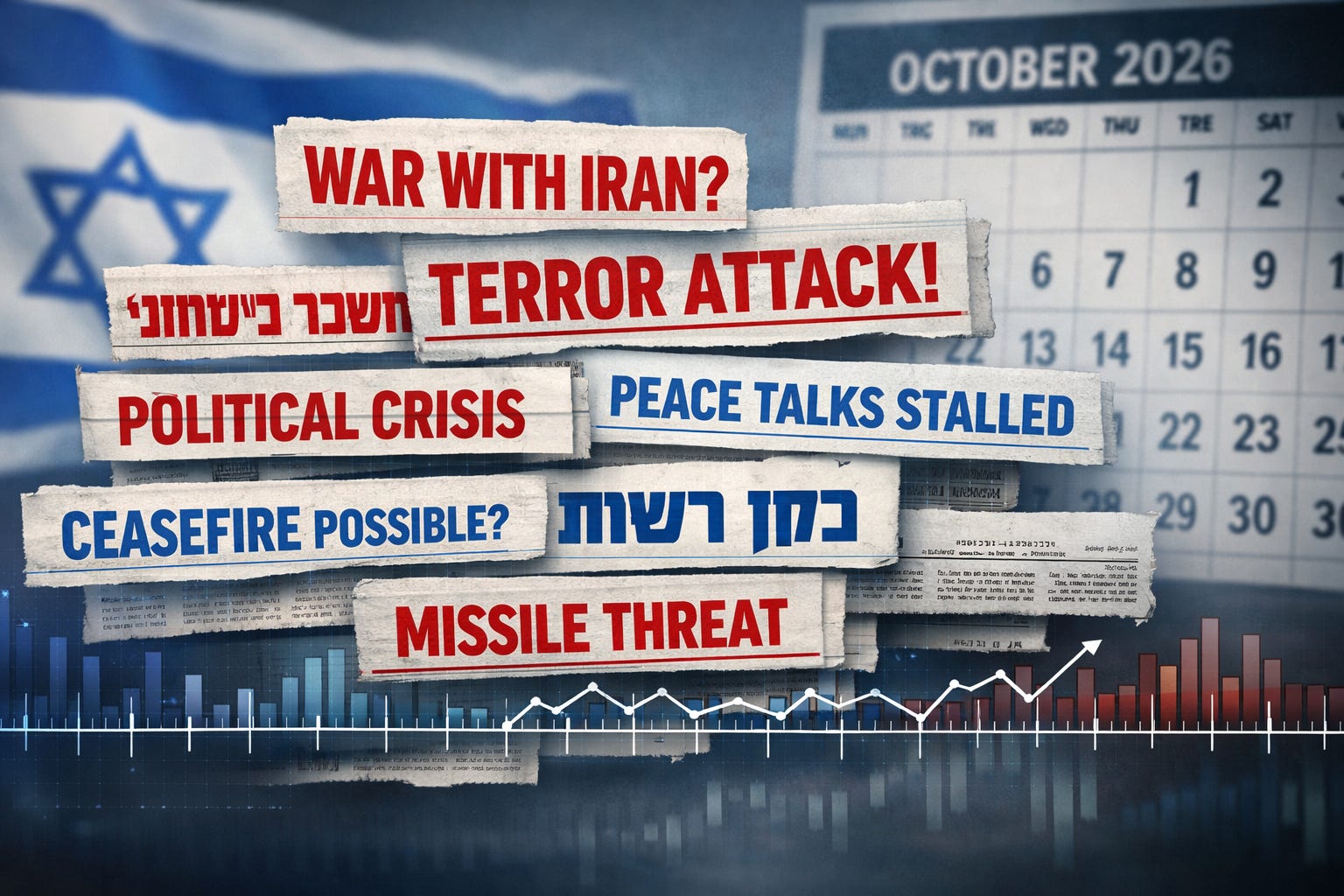
You don’t read most news articles. Neither does anyone else.
Studies show 60% of social media users share articles without reading beyond the headline. In Israel, where news moves fast and most people check their phones at bus stops, that number climbs to 85% for mobile readers. Editors at Ynet, Maariv, and the Jerusalem Post know these numbers. They spend hours crafting headlines while the actual article takes thirty minutes to write. The headline is the message. The article underneath is optional.
This matters because Israeli voters head to the polls in October 2026 while the country remains at war. Headlines about Iranian threats, Hamas attacks, or Hezbollah rocket fire shape what Israelis feel about security—and security determines how Israelis vote. An anxious population votes for strength. A calm population asks questions about competence.
So here’s what this project does: collect Israeli news headlines every day from January through October 2026, count how many focus on threats, and watch what happens as election day approaches. Not to prove manipulation. Not to accuse anyone of lying. Just to see whether the fear level in headlines rises, falls, or stays constant. And whether that level tracks with actual events on the ground—or with the political calendar.
The tricky part? Israel’s been at war since October 7, 2023. Comparing 2026 headlines to “peacetime” 2020 tells you nothing useful. Of course there’s more threat coverage now. The question is: compared to the past 27 months of actual war, does threat rhetoric increase as the election nears?
Setting the Baseline: What Does War Look Like in Headlines?
From October 2023 through December 2025, Israel was unambiguously at war. Not proxy conflict. Not tensions. Actual military operations in Gaza, hostages held in tunnels, rockets falling on civilian areas, reservists deployed for months, and funerals every week.
What did headlines look like during that period? This project collected 472 headlines across those 27 months. The pattern:
55.9% contained threat rhetoric - mentions of Iran, Hamas, Hezbollah, attacks, terrorism, military operations
21.6% mentioned Netanyahu - as Prime Minister managing war decisions
4.0% referenced elections - because elections seemed distant
2.1% covered opposition figures - minimal focus during crisis
That’s the wartime baseline. More than half of all headlines during actual war focused on threats. One in five mentioned the Prime Minister. Opposition voices barely appeared.
Now watch what happens month by month through 2026 as October’s election approaches. Do threat headlines stay around 56%? Drop below because the intensity decreased? Rise above because... why would they rise above wartime levels unless something changed?
Three periods matter here:
Before October 7, 2023: Historical reference. Collected 367 headlines from 2020-2023 to see what “peacetime” looked like. Not useful for comparison to 2026 because peacetime and wartime measure different things.
October 2023 - December 2025: 472 headlines for the 27-month war period. This is the baseline. These headlines came from real, documented military operations and security threats. If 2026 goes above these numbers, something beyond war coverage is happening.
January 2026 - October 2026: This is what we’re tracking. Nine months of headlines leading to an election during ongoing conflict. The question is simple: do the numbers stay stable, reflecting actual conditions? Or do they move in ways that match the political calendar rather than the security situation?
How the Collection Works: Headlines From Two Worlds
Every morning, an automated system pulls headlines from 17 Israeli news sources. This isn’t reading articles. It’s collecting the text that appears at the top—the 8-12 words editors chose to represent the story. These headlines feed through RSS (Really Simple Syndication), the technology that powers news aggregators and social media feeds.
The system captures headlines in two languages because Israeli media operates in two parallel universes:
Hebrew Sources (10 feeds):
Ynet (Israel’s largest news website)
Israel Hayom (largest print circulation, free daily)
Maariv (major centrist daily)
Walla (massive news portal)
Haaretz Hebrew edition
Israeli voters read these. Bus drivers, teachers, IDF soldiers, shopkeepers, and Knesset members scroll Ynet on their phones. They see Israel Hayom in cafes. This is the media environment that shapes Israeli political opinions.
English Sources (7 feeds):
Jerusalem Post
Times of Israel
Haaretz English
Ynetnews (Ynet’s English site)
Israel National News
These reach diaspora Jews, tourists, diplomats, and international journalists. Important audience, but they don’t vote in Israeli elections. English headlines tell you what narrative Israel wants the world to see. Hebrew headlines tell you what Israelis actually see.
The automated collection runs daily. Every morning around 9 AM Amsterdam time (10 AM Israel time), the system logs in and pulls the past 24 hours of headlines from all 17 feeds. January collected no headlines this way, the RSS data collection begun early February.
However, data collected through the Mediastack API was collected. It searches archives of major outlets for specific keywords: “Iran,” “Netanyahu,” “election,” “Hezbollah,” “Hamas,” “Lapid,” “security.” This catches headlines the automated RSS might miss, especially from paywalled sources like Haaretz where RSS feeds hit technical limits.
The combined system in February captured 343 headlines across the first five days. From March forward, expect 1,000-1,300 headlines monthly as both systems run in parallel.
Each headline gets tagged for four things:
Threat Rhetoric: Does it mention Iran, Hamas, Hezbollah, attacks, terrorism, military operations, rocket fire, or security warnings?
Netanyahu: Does it mention Benjamin Netanyahu by name or as Prime Minister?
Elections: Does it reference the October 2026 vote, polling, or campaigns?
Opposition: Does it mention Yair Lapid, Benny Gantz, or opposition coalition activity?
A single headline can hit multiple categories. “Netanyahu warns Iran poses election-year threat” scores positive for all four. The system counts presence, not exclusivity.
One important bias to acknowledge upfront: the dataset skews center-right because that’s where the data flows easily. Ynet, Walla, Jerusalem Post, and Israel Hayom all publish high volumes with reliable RSS feeds. Haaretz sits behind a paywall. Left-leaning outlets tend to be smaller with less technical infrastructure. The sample captures what’s available, not what’s proportional to Israel’s actual media landscape.
This bias actually strengthens certain observations. If right-leaning sources show threat rhetoric rising faster than centrist sources, that pattern means something. If they all rise together, that means something different. The bias becomes data.
The Wartime Numbers: What 27 Months of Actual War Looks Like
Between October 2023 and December 2025, headlines looked like this:
55.9% focused on threats
21.6% mentioned Netanyahu
4.0% referenced elections
2.1% covered opposition figures
Those percentages come from 472 headlines collected during 27 months of actual military operations. Reservists deployed. Hostages held. Rockets launched. This wasn’t hypothetical threat—this was daily reality.
The 55.9% threat baseline means that even during active war, slightly less than six out of every ten headlines dealt with security issues. The other four headlines covered everything else: economy, culture, local news, sports, weather, corruption scandals, budget fights, Supreme Court battles.
Netanyahu’s 21.6% makes sense during wartime—the Prime Minister runs security cabinet meetings, approves military operations, negotiates hostage deals, and briefs the public. One in five headlines mentioning him reflects his actual role managing military operations.
The 4.0% election baseline stayed low because voting seemed far off. The 2.1% opposition baseline stayed low because national unity matters during war—media focus shifts to the government making life-and-death decisions, not opposition figures offering alternative policies.
These numbers establish the ceiling. If August 2026 hits, say, 72% threat rhetoric, that exceeds wartime by 16 percentage points. Why? Did threats increase beyond October 2023 levels? Unlikely. Did something else drive the coverage?
That’s what we’re tracking.
Examples of recent Threat Headlines: Iran Doing Things
The threat-focused headlines mostly came from one source (Times of Israel) and covered three actual events:
“IMF sees Israeli economic recovery from Gaza war, but worries over flareup in regional tensions” (Times of Israel, February 5)
This headline does something clever. It buries the threat (”regional tensions”) inside good news (”economic recovery”). The International Monetary Fund did release a report. The headline accurately reflects that report’s mixed message. But notice what it doesn’t do: it doesn’t say “IMF warns conflict threatens economy” or “Regional tensions risk recovery.” The threat exists as context, not alarm.
“Iran’s army says it is ready for war, if that’s what ‘the enemy chooses’” (Times of Israel, February 5)
Here’s where headline construction matters. The Iranian army did make this statement. It’s newsworthy. But look at the framing: “ready for war” followed immediately by “if that’s what ‘the enemy chooses.’” The conditional clause matters. It transforms “Iran threatens war” into “Iran says it will defend itself if attacked.”
Same facts, completely different emotional impact. The first framing triggers threat response. The second framing sounds almost reasonable—of course any country’s military says it would fight if attacked.
“Iran’s Revolutionary Guards seize 2 oil tankers in Gulf” (Times of Israel, February 5)
This happened. Two tankers seized in international waters. Verifiable event. The headline states fact without editorial amplification. It doesn’t say “Iran STRIKES in Gulf, seizes tankers.” It doesn’t say “Iran escalates aggression.” It doesn’t include urgency language like “today” or “just hours ago.” It reports an event.
Compare these February headlines to typical wartime coverage from late 2023:
October 2023 wartime headlines:
“IDF on highest alert as Iran threatens ‘pre-emptive’ strike within 48 hours”
“Intel chiefs warn: Iran could attack any moment”
“Clock ticking: How long until Iran strikes?”
See the difference? The wartime headlines used temporal urgency (”48 hours,” “any moment,” “clock ticking”). They transformed threats into imminent danger requiring immediate emotional response. The February headlines reported events without urgency framing.
This is the kind of thing to watch across coming months. If September headlines start looking like October 2023 wartime headlines despite no equivalent escalation in actual threats, that shift tells you something about editorial decisions rather than security realities.
The Netanyahu Headlines: Defending Against Conspiracy Theories
Only two headlines mentioned Netanyahu in February:
“Netanyahu said to tell MKs there was ‘no treason’ on Oct. 7, countering his son’s conspiracy theory” (Times of Israel, February 5)
“Benjamin Netanyahu: October 7 massacre was an ‘intelligence failure, but not a betrayal’” (Jerusalem Post, February 5)
Both headlines cover the same story: Netanyahu responding to investigations into whether warnings before October 7 were ignored. His son Yair had posted conspiracy theories on social media about deliberate betrayal. Netanyahu pushed back.
Notice what these headlines don’t do: they don’t frame Netanyahu as strong leader protecting Israel. They frame him as defending himself against questions about failure. The Times of Israel puts “no treason” in quotes—distancing the publication from the claim. The Jerusalem Post acknowledges “intelligence failure” while reporting Netanyahu’s denial of “betrayal.”
During wartime baseline period, Netanyahu headlines looked different:
Late 2023 wartime Netanyahu headlines:
“PM vows: Hamas will pay heavy price”
“Netanyahu to Biden: Israel will finish the job”
“Netanyahu: We will hunt down every terrorist”
Those headlines showed Netanyahu as active, decisive, in command. The February headlines showed him responding to criticism, denying wrongdoing, managing scandal. One headline type makes you feel protected. The other makes you question competence.
Again, watch this across months. If August-September headlines shift back to strong-leader framing despite ongoing questions about October 7 failures, editorial choices rather than facts explain the shift.
A Single Election Headline: Business as Usual
“Poll: Arab Joint List wins 14 seats, maintaining deadlock between PM’s bloc and rivals” (Times of Israel, February 5)
One poll story. Eight months before the election. This is normal pre-campaign coverage—media report polls because they exist, not because campaigns are in full swing. The headline itself is neutral: it reports numbers showing neither bloc has a clear advantage.
Wartime baseline showed 4.0% election mentions because most of those 27 months were far from voting day. February’s 0.3% falls even below that—elections barely register in coverage.
Watch what happens to this metric. If election headlines jump to 8-10% by July despite similar distance from voting day, something changed beyond calendar math.
A Single Opposition Headline: Policy Proposals
“Lapid unveils plan to improve education system, demands Education Ministry portfolio in next gov’t” (Jerusalem Post, February 5)
Yair Lapid, opposition leader, proposed education policy and said he wants to run that ministry if he wins. The headline reports this factually. No editorial framing suggesting Lapid is strong or weak, competent or incompetent, trustworthy or not.
Compare to Netanyahu’s defensive headlines. The opposition gets neutral policy coverage. The incumbent gets scandal coverage. This might reflect where each stands in the news cycle—Netanyahu faces investigation, Lapid doesn’t—but it also might reflect editorial priorities about which stories matter enough to cover.
The 0.3% opposition coverage matches the 0.3% election coverage. Campaigns haven’t started in earnest. Opposition figures get occasional mentions for policy proposals, not sustained attention.
What January Shows: The Pattern Hasn’t Started Yet
January looks like pre-campaign quiet. Threat rhetoric sits 53 percentage points below wartime levels. Netanyahu coverage sits 21 points below. Elections and opposition barely register.
Either security genuinely improved dramatically since the war’s peak, or February represents the baseline before election season begins in earnest. We won’t know which until we see March, April, and May. If numbers stay this low through summer, the first explanation holds. If they start climbing in June-July toward and past wartime levels despite no major security escalation, the second explanation becomes more likely.
The headlines themselves show something useful: when Israeli media operates without urgency framing, threat stories read differently. Iran “ready for war if attacked” carries different weight than “Iran threatens attack within 48 hours.” Netanyahu “denies treason” reads differently than “Netanyahu vows to protect Israel.” The facts might be identical. The emotional impact is not.
That’s what these nine months will track—not whether media reports threats (they always do), but how they frame them, when they amplify them, and whether that amplification tracks with security realities or political calendars.
Seven Months to Watch
Here’s what to look for as October approaches:
Does threat rhetoric start climbing?
Wartime: 55.9%
If June hits 45%, July 60%, August 75%, that trajectory shows amplification beyond wartime levels. If it stays around 3-15% through September, either security genuinely improved or media resists election-year fear escalation.
Does the language change?
February headlines said “Iran ready for war if attacked”—conditional, defensive framing. If July headlines shift to “Iran threatens imminent strike”—urgent, aggressive framing—despite no change in actual Iranian actions, the shift reflects editorial choices.
When does Netanyahu’s visibility increase?
Wartime: 21.6% (one headline in five)
Campaign season should bring more Netanyahu coverage. The question is when and how much. Gradual increase from May through September looks organic. Sudden spike in August-September looks strategic. And what kind of headlines? “Netanyahu vows” or “Netanyahu denies”? Strong-leader framing or defensive framing?
Do different outlets tell different stories?
Israel Hayom leans pro-Netanyahu. Ynet stays centrist. Haaretz leans critical. If Israel Hayom starts running “Iran threatens Israel” headlines three times weekly while Ynet runs them once weekly, source divergence reveals political rather than security drivers.
Do Hebrew and English diverge?
February showed similar patterns in both languages. But Hebrew reaches Israeli voters. English reaches international audiences. If Hebrew headlines ramp up threat rhetoric while English headlines stay measured, Israeli media is telling different stories to different audiences. That split matters.
Does timing match events or calendars?
Watch the dates. If threat headlines spike the week after Netanyahu announces campaign kickoff, that’s calendar correlation. If they spike the day after an actual Iranian military exercise or Hezbollah statement, that’s event correlation. The first suggests coordination. The second suggests journalism.
What This Means for Democracy
You vote differently when you’re scared. Everyone does. Fear overrides analysis. When headlines scream “Iran preparing strike” day after day, voters think “I need someone tough” not “Did the last government prevent October 7?”
Israeli voters deserve headlines proportionate to reality. If threats are up, headlines should reflect that. If threats stayed constant but headlines escalated, something else is happening.
This project doesn’t assume manipulation. It measures what’s there. Nine months of data will show whether Israeli media maintains proportionality through an election during war, or whether fear becomes a campaign tool.
Every month through October, these reports will track the same metrics, analyze the same patterns, and show the same headline comparisons. The data accumulates, and patterns will emerge one way or the other.
Subscribe to see what happens. Watch the numbers. Read the headlines yourself. Compare February throughout October. See if the fear level tracks with reality or with the political calendar.
By October, when Israelis vote, nine months of evidence will show whether they chose based on proportionate information or amplified fear.
The headlines tell the story. We’re just counting them.
Next Report: beginning of March 2026
Published monthly with updated metrics and headline analysis
Follow the Data:
All headline collections and metrics available at [repository location to be determined]
Charts and raw data updated monthly
Contact for questions or collaboration: best reach out to me via Substack
About This Project:
This project started from my professional curiosity as behaviour analyst —specifically in media framing, information control, and how narratives shape decision-making. Israeli headlines during an election year while still at war presented a natural experiment worth documenting. This isn’t formal academic research with institutional backing. It’s careful observation of patterns that matter, conducted independently on a best effort basis without claim to authority, finality, or infallibility.
No political party, media outlet, or advocacy group funds this work or has any stake in the findings. The analysis simply follows what the headlines show month by month. If Israeli media maintains proportionality through October, the reporting will reflect that. If patterns emerge suggesting editorial choices rather than security realities drive coverage, the data will show that too.
The goal isn’t to prove a predetermined conclusion. It’s to collect the evidence, make it visible, and let readers form their own judgments.
Come back next month. Bring your own judgment. Watch the numbers yourself.
A very interesting project. Will follow to see what the trends indicate.
An interesting endeavour!
The Iranian 2026 quote, "if that's what the enemy chooses", brings to mind another quote. In the days leading to the 1967 war, Egyptian president Nasser expressed a similar message: that if the IDF is going to attack, Egypt is ready. Be adressed the then-IDF head Rabin with an ironic "welcome". This was widely quoted in Israeli press, and gave birth to an Israeli wartime pop hit that is still well known to this day: "Nasser waits for Rabin". The song ended with the line ,"Stay put, we will arrive, 100%". There's a Wikipedia page about this song, but unfortunately only in Hebrew. A recording of Nasser's original soeech:
https://www.youtube.com/watch?v=YvZ_ngOvsgk&t=41m28s
In other words, comparing the two situations in the two quotes, it's interesting that in 1967, faced with a similar situation, Israeli headlines expressed hubris rather than self-victimisation.