
The Emperor's New Clothes
Your Feed, Your News, Your Platforms — Now Owned by the President's Friends

Part 2 of “The Transatlantic Censorship War“
On December 22, 2025, a 60 Minutes segment on Trump’s deportees was scraped at the last minute and did not air. It had been screened five times. It had been cleared by CBS lawyers and by the network’s Standards and Practices unit. Its correspondent, Sharyn Alfonsi, considered it factually correct. Thirty-six hours before broadcast, the new editor-in-chief of CBS News, Bari Weiss, pulled it. In a note shared with other outlets, Alfonsi wrote that holding the piece after every internal check had been met was not editorial, it was political.
Consider the timing. The story died one day before Marco Rubio announced visa bans against five Europeans for running what he called the global censorship-industrial complex — the subject of the first installment of this investigation. The same week the administration declared itself the world’s defender of free expression, the most prestigious newsroom in America spiked a vetted report about torture allegations because its content displeased the President. Nobody at the State Department fired a visa ban over that. The suppression was domestic, it was friendly, and so it did not count.
This is the gap. There is a story Washington tells about itself — that it has dismantled the machinery of censorship — and there is the machinery that remains standing, humming, and increasingly under the control of the President’s allies. The story is not false in every particular. It is false in the part that matters.
The Victory Lap
The claim is made in earnest and it is made constantly. Senator Eric Schmitt, who as Missouri’s attorney general filed the lawsuit that exposed the Biden administration’s flagging operations, wrote in December that Rubio and the State Department had taken decisive action to systematically dismantle the US censorship-industrial complex. The Federalist, one of the conservative outlets that sued over being targeted, has chronicled the administration’s dogged devotion to the project.
The record they point to is real. The State Department’s Global Engagement Center, which had a documented history of funding groups that blacklisted right-leaning outlets, shut down in December 2024 after Congress declined to renew its mandate. Its smaller successor office, R/FIMI, was eliminated by Rubio in April 2025. The administration moved against the former CISA chief Chris Krebs, stripping clearances and ordering an investigation into the agency itself. The National Science Foundation terminated support for research aimed at combating misinformation. A federal court in Missouri v. Biden had already found that the prior administration’s partnerships with NGOs amounted to coercion of platforms in violation of the First Amendment.
A person looking only at that list would conclude the censors had been routed. The list is the argument. Let’s look at what is not on it.
The Tell
Everything dismantled was antagonistic to the President’s coalition. The GEC had funded the Global Disinformation Index, which flagged conservative outlets. CISA had run the election-rumor operation that the right considered a vehicle for suppressing its speech. Each demolished node was a node aimed at people who now hold power. Not one piece of the apparatus that those people might find useful was touched.
Recall the definition the censorship-complex’s critics rely on. The journalist Michael Shellenberger, testifying to Congress in 2023, correctly described the censorship-industrial complex as a network of government, NGO, and academic institutions that had discovered the power of censorship to protect their own interests against the risks of democratic competition. Republican lawmakers and the State Department have made that framework their own. The complex is defined by who controls it and whose interests it serves. A network that discovers the value of controlling information does not abolish itself when new managers arrive. It changes whose interests it protects. That is precisely what has happened.
There is, in fact, evidence such offices get relocated rather than ended. The Global Engagement Center (GEC) first shut down in late 2024, under the Biden administration, after Congress cut its funding. But rather than disappear, its staff and budget were folded into a new office, the Counter Foreign Information Manipulation and Interference hub (R/FIMI). Republican staffers who reviewed the internal documents at the time concluded the rebranding was cosmetic — the same function under a different name, fifty-one employees and their funding shifted to a new hub. The principle holds in both directions: an office that can be relabeled rather than removed describes a capability the state is reluctant to surrender, no matter which party holds the keys.
From Suppression to Ownership
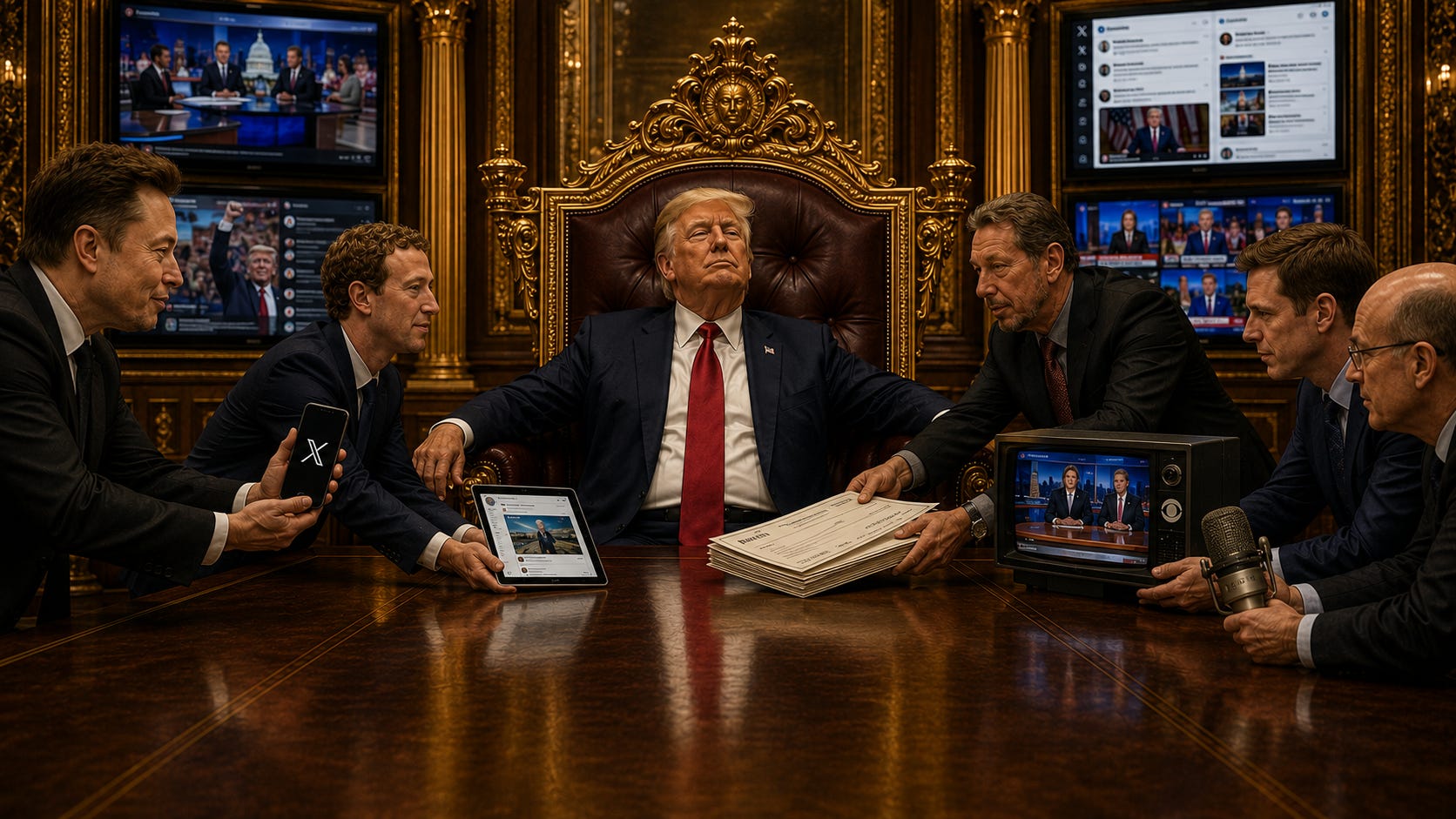
The deeper move is not what the administration tore down. It is what it built, and what it is acquiring. Here the story leaves the realm of executive orders, which the next administration can delete, and enters the realm of ownership, which it cannot.
Begin with the platforms. In January 2025, Meta ended its third-party fact-checking program, with Mark Zuckerberg citing a cultural tipping point and pledging to work with the incoming administration to promote free speech. Asked whether his own past threats had prompted the change, Trump answered: probably. The machinery of moderation did not vanish at Meta; the company simply retuned which speech it would catch and which it would let run. The same is true of X under Elon Musk, whose reversal on European speech law was documented in Part 1. These platforms retain the full apparatus of deplatforming and algorithmic suppression. What changed is the direction it points.
INSERT X
Then there is TikTok. In December 2025, the app’s US operations were signed over to an investor group led by Oracle, the company run by Larry Ellison, a Trump ally. Under the agreement, content moderation rules for almost two hundred million American users would be set by the new investor-controlled entity. One scholar of national security investment put the obvious question out there: the deal raises whether the country is trading one form of undue state influence for another. A platform once cast as a Chinese threat to American minds is now overseen by a man personally close to the President. The censorship concern did not disappear. It was nationalized into friendly hands.
And then there is the centerpiece. In July 2025, Paramount, the parent of CBS, paid Trump sixteen million dollars to settle a lawsuit over the edit of a Kamala Harris interview that legal observers almost unanimously expected him to lose. Six days later, the FCC under Trump loyalist Brendan Carr approved Paramount’s merger with David Ellison’s Skydance, and Ellison and son of the President’s friend and backer Larry Ellison — controlled CBS. To win that approval, Ellison had promised the regulator a focus on diverse viewpoints. Within days of his criticizing the settlement on air as a “big fat bribe,” Stephen Colbert’s Late Show was cancelled. Bari Weiss, whose Free Press Ellison had bought for $150 million, was installed as editor-in-chief. By spring, Scott Pelley and the veteran producer Tanya Simon were gone, with Pelley alleging a thumb on the scale for the President’s version of events — an account CBS disputes. Then the CECOT story died.
This is a chain of public record, not an allegation of hidden intent. Each link is independently documented: the settlement, the regulatory approval, the promises, the firings, the killed segment.
What outlasts any of it is the consolidation now underway. In April 2026, Warner Bros. Discovery shareholders approvedParamount’s roughly $111 billion acquisition of the company, after Netflix declined to counter and walked away. In June, the Justice Department’s antitrust division cleared the deal without requiring a single divestiture or concession. What remains before the Federal Communications Commission, run by Trump appointee Brendan Carr, is a request to approve the foreign investors — Saudi, Qatari, and Emirati sovereign funds taking 38.5 percent of the combined company — over Democratic objections that the review be more than a formality. The deal brings CBS and CNN also under Ellison ownership. And before any of it cleared, the Wall Street Journal reported that Ellison had given Trump officials assurances that he would make sweeping changes to the network. Days later, Trump said publicly it was imperative that CNN be sold and called its leadership a disgrace. For a time, the bid was partly financed by the President’s son-in-law, Jared Kushner, whose firm pulled out in December 2025.
When CNN is taken over, one man close to the President will hold the cloud infrastructure of Oracle, oversight of TikTok’s American feed, CBS, and CNN. That is not the dismantling of an information-control complex. It is its acquisition.
Two Sides of One Coin
The error in the victory narrative is conceptual. It treats censorship — the act of removing speech — as the whole of the threat. But suppression and amplification are the same instrument held at two angles. The GEC flagged content for removal. An owner who kills a vetted story, or installs an editor to favor the President’s framing, shapes the information environment just as decisively, by deciding what reaches the public and in what light. One subtracts; the other curates. Both manufacture the boundaries of permitted opinion.
This was the thesis on which Part 1 closed: that Brussels and Washington shared an identical impulse beneath differing methods, a refusal to trust people to evaluate information for themselves. The domestic picture confirms it. The European Union fines a platform to force a takedown. The American arrangement acquires the platform to set the terms of what stays up and who delivers it. The Brussels model reaches for the levers from outside the company. The emerging American model “owns” the company. The second is more durable, because it does not depend on the law, the regulator, or the party in power on any given morning. It depends only on the deed of sale.
The Counter-Argument, Answered
To those who insist the complex has been dismantled, the reply is not that nothing was done. It is that the test has been failed on its own terms.
A complex defined by the coordinated control of information has not been eliminated when only its hostile branches are pruned. Selective dismantling is not dismantling. It is a change of management. The relevant question was never whether your opponents’ tools were broken. It was whether dissenting speech can still be suppressed or buried — and the answer, demonstrably, is yes. A vetted 60 Minutes story can be spiked to please the President. Platforms retain every mechanism of suppression they ever had, now retuned to a different register. And the visa-ban apparatus described in Part 1 is itself a new instrument of state speech coercion, built by the same officials who claim to have ended censorship, but aimed at foreigners whose advocacy displeases Washington. Rubio’s standing promise to expand that list is not the dismantling of a speech-control regime. It is part of the construction of one.
The administration that shuttered the GEC for pressuring platforms now presides over a media landscape in which the President’s allies are buying the platforms outright. The instrument did not disappear. It was inherited, refurbished, and pointed in a new direction.
The Newsroom
Let’s return to the producer who watched a finished, lawyered, fact-checked story die. She is the figure who sees the gap most clearly, because she stands inside it. She was told the country’s information environment had been liberated, and then she watched a true report about a foreign prison vanish from the schedule to spare a President’s feelings.
The speech that needs protecting was never the speech the old censors wanted gone. It is also never the speech the new owners want buried. If you came away from the first round of this fight believing one side had won it for you, look again at what is being assembled, and ask whose voice it is built to carry, and whose it is built to lose. That was always the only question worth asking.
The freeloading billionaire leechers (and their puppets in gov't) didn't dismantle the censorship industrial complex, they simply changed its direction, changed who it targets (censors, buries and criminalizes) and who it protects (boosts, magnifies and leaves as tye only voice heard)
They made it their own. It now protects their own oligarchic control over the 99.9%.
One criminal gang took over from the other criminal gang the apparatus of information control. Both gangs work for the same elite, not for us. I think it''s hifh time we removed them from power of us
While all of this is true, the over all situation has long been appalling. Anyone who has spent time working in the news media in that country, whether the newspapers or the TV or digital media....the one thing that is very clear and consistent is that a very tiny group of people completely dominate the management and production ranks of all these news outlets.
Access to tell the news is extremely priviledged, and if you are not of certain ethnic backgrounds, well it is easier for the proverbial camel to enter the eye of a needle, than for you to be in those jobs. All of this is a degree of bias that is extreme and is statistically improbable to be random. And it has been so for many decades, reaching into the previous century.
So what we really have here is actually: one set of people who have had pre-ordained priviledged access, being moved out and shut down, to be replaced by another set.
The ownership change and the ratcheting up of the censorship and filtering, should not cloud ones understanding that it the oligarchy who owned these outlets have always filtered certain things our and have always tipped the scales. Well before Larry Ellison & co, and always in service of imperialism. That is how we reached a stage where the Palestinians land and self-determination was stolen from them at the Camp David accords, with the aid of even a coopted US president - and no one said a word about the real story, or the total corruption and hijacking of the process.