
The Surveillance State Found Its Philosopher
The man building Washington's surveillance machine once wrote the book on how governments talk themselves into tyranny

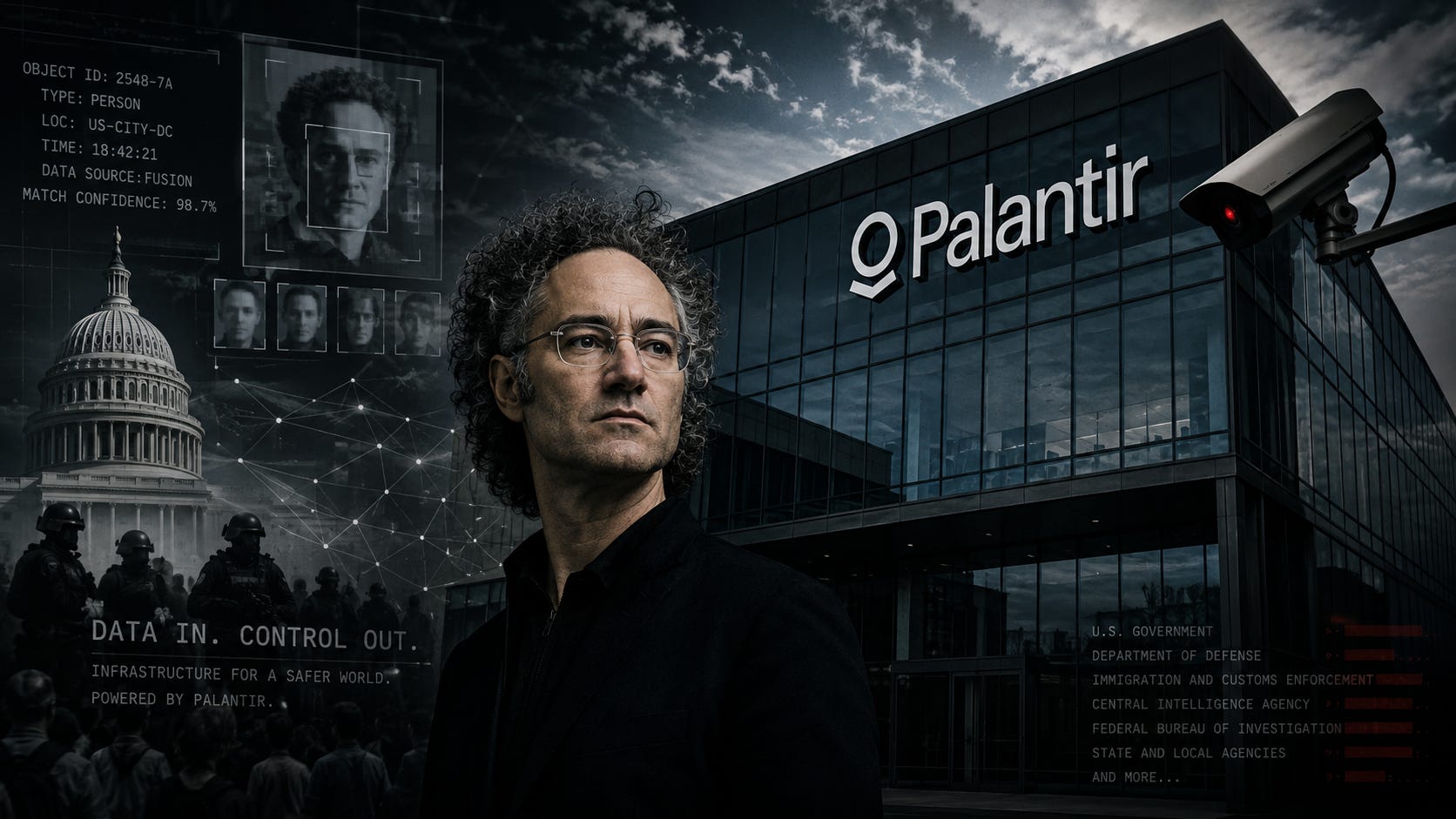
Alex Karp once wrote the instruction manual for how free societies talk themselves into doing terrible things in his PhD thesis. Now he sells the software that does exactly that. One could think this is a paradox, but it’s not, it is a warning, and it is addressed to you.
Consider what is already known about you, somewhere, right now. Where you slept last night, traced through your phone. What you earn, what you owe, what you searched at three in the morning. Your face, captured and indexed. Your medical history. The people you call most often, and the people they call. None of it, on its own, is sinister. Each fragment was surrendered for some small convenience or extracted by some agency with a reason that sounded fine at the time. But the fragments are no longer scattered. They are being stitched together, by machines, into a single legible portrait of a single human life — yours — and the company doing more of that stitching for the United States government than almost any other was built by a man who understands, better than almost anyone alive, exactly what such a portrait can be used for.
He understands because he wrote his doctorate on it.
What the young scholar knew
In 2002, Alexander Karp took a doctorate in social theory from Goethe University in Frankfurt. His dissertation asked a question that should haunt anyone living through this decade: how do decent, ordinary people in a functioning society come to take part in cruelty without ever once feeling cruel?
His answer, built on the philosopher Theodor Adorno, was a thing he called “jargon.” Jargon is the elevated, morally flattering language that lets people act on their ugliest impulses while believing they are doing something noble. It does not announce aggression; it dresses it. Karp wrote that jargon “solidifies integration processes” — it binds the in-group together — by making the present “promising and therefore acceptable.” Strip the academic varnish and the claim is brutal: give people the right words, and they will applaud the very things they would otherwise be ashamed of. They will feel like protectors while behaving like predators. Karp even noted the perpetrator’s central self-deception — that his hostility is merely “a reasonable response to something” the targeted person has done. The cruelty, from the inside, always feels like defense.
He had, in other words, mapped the precise machinery by which a civilization turns on a portion of its own and calls it virtue. He could name every gear.
And he knew what stops the machine. Leaning on the German thinker Helmuth Plessner, Karp argued that the modern nation — bound by a written constitution and the rule of law — is the firewall against fascism, precisely because it guarantees that everyone stands equal before the same rules, regardless of blood or origin or the moment they happened to arrive. The young Karp wrote that firewall into his thesis as the one reliable thing standing between civilization and barbarism. Remember it. We are about to watch its author help dismantle it.
What the older man built
Palantir Technologies, the company Karp co-founded in 2003 with the conservative billionaire Peter Thiel and seed money from the CIA’s venture arm, does not make a product you can hold. It makes the connective tissue of the surveillance state: software that takes the scattered fragments of a population’s data and fuses them into something searchable, sortable, and actionable.
Begin with the most visible case, because it is the proof of concept. Since January 2025, Palantir has signed over $81 million in new contracts with Immigration and Customs Enforcement, on top of a relationship dating back to 2008. The centerpiece is a $30 million no-bid system named, without apparent irony, ImmigrationOS — built to “identify, track, and deport“ people using artificial intelligence. A companion tool reportedly draws on data from the Department of Health and Human Services — the agency that holds medical and refugee records — to map locations and assemble dossiers on those marked for removal.
Now hold the immigration case at arm’s length and ask the question the headlines rarely ask. Civil-liberties lawyers have warned that nobody can explain how a system like this would ever stay limited to the people it currently hunts. That is the point. A machine built to fuse health records, location data, and personal histories into deportation targets is not, at the level of its engineering, a deportation machine. It is a population machine. The category it searches for is a setting, not a structure. Change the setting and the same software finds tax debtors, or protesters, or the readers of a particular newspaper, or you. The immigrant is simply the first person it was pointed at — the test subject for a capability that, once it exists, does not un-exist when the political weather changes.
This is who the company has always been. When the Cambridge Analytica scandal broke in 2018 over the harvesting of up to 87 million Facebook profiles for political targeting, Palantir first denied any link to the firm, then admitted the next day that one of its employees had worked with it — by the company's account, freelancing on his own, with no wrongdoing ever established against Palantir itself. The target then was voters, not migrants; the technique — fusing scattered personal data into a tool for moving people — was the same one now wired into the machinery of the state.
This is the part that should reach past the people who feel safely outside the current target. The infrastructure does not care who you are. It is built to be retargetable, and the only thing standing between its present use and its next one is the restraint of whoever holds power on a given morning — the very firewall Karp once said was the only thing that mattered.
And the retargeting is no longer hypothetical. In 2025, the administration began spreading a Palantir product called Foundry across the federal government, putting it into at least four agencies and laying the groundwork, according to officials, to merge records held separately across the state into unified portraits of ordinary citizens. The data points reportedly sought include bank account numbers, the size of a person’s student debt, medical claims, and disability status — the intimate ledger of an ordinary life, pulled from the agencies that hold it and stitched into one view. The company has earned more than $113 million in federal spending since the term began. Even former Palantir employees balked: data collected for one reason, one told reporters, should not be repurposed for another, because combining it all — however noble the stated intent — vastly multiplies the risk of misuse. That is not a warning about immigrants. That is a warning about everyone whose life leaves a record, which is to say everyone.
What they say, and what is happening
There is a gap here, and it is worth naming, because closing that gap is the whole game.
What Palantir says is that it is democracy’s shield. In his 2025 bestseller The Technological Republic, Karp argues that Silicon Valley has gone soft, squandering its genius on trivial apps while ducking its patriotic duty, and that technologists must re-engage with national defense or surrender the future to authoritarian regimes. The company, in this telling, exists to protect free societies from tyranny.
What is happening is that the same software is already being used to kill. A United Nations investigator reported in 2025 that there were “reasonable grounds” to believe Palantir had supplied predictive-policing and real-time targeting technology used in the war in Gaza, and Karp himself acknowledged that Israeli forces had used Palantir tools. The distance between a system that decides who gets deported and a system that decides who gets killed is a distance the same company sells across.
When critics point this out, Karp does not argue. He sneers. He has called those who describe his company as a surveillance apparatus “parasitic,” insisting they understand neither the product nor the country, and he has told audiences that “not only is patriotism right, patriotism will make you rich.” Set that sentence beside his own dissertation and the effect is vertiginous. It is jargon, by his exact 2002 definition: language that costumes self-interest as virtue, that splits the world into patriots and parasites, that makes an uncomfortable and profitable enterprise feel like a sacred calling. The man who diagnosed the disease has become its most fluent carrier — and he is too intelligent not to know it.
In April 2026 the subtext became text. Palantir published a 22-point manifesto, and scholars across several countries recognized it on sight. Mark Coeckelbergh, a philosopher of technology at the University of Vienna, called it a clear example of “technofascism.” The economist Yanis Varoufakis warned of the danger of fusing advanced artificial intelligence with militarized state power. The document railed against “vacant and hollow pluralism” and declared certain cultures “dysfunctional and regressive” — the vocabulary of civilizational superiority that every previous authoritarian movement has used to justify what came next. Coeckelbergh’s deeper warning is the one to keep: the real danger is not the jackboot but the normalization of surveillance, the handing of human judgment to machines no one can inspect, the quiet concentration of power among the few who build them.
This is not (only) an American story
It would be a comfort to file all this under American politics and turn the page. That comfort is not available.
The condition Karp’s machinery serves is global, and it is worsening on every continent. For the first time in more than twenty years, the world now holds more autocracies than democracies — ninety-one to eighty-eight — and liberal democracies have become the rarest form of government on Earth. The rot has reached the wealthy nations once thought immune. A 2026 study found the United States deteriorating at “unprecedented speed,” with six of the ten newest backsliding countries located in Europe and North America. We are living through the worst stretch for self-government in half a century, and we are living through it everywhere at once.
Into that current, American firms are shipping the tools. A surveillance platform perfected on the bodies and records of one population — funded by taxpayers, refined on the vulnerable, sold by a company headquartered in the United States — does not stay where it was built. It becomes a product. Other governments watch, and some of them buy. The genius of this new authoritarianism is that it never arrives looking like the thing your grandparents were warned about. There is no torchlit rally. There is a procurement contract, a software update, a press release about efficiency and safety. By the time the system is pointed at people who look and vote and pray like you, it has been ordinary for years.
That is the warning, and it is not abstract. The data that would feed such a turn already exists, gathered in a thousand transactions none of which felt like surrender. The machine that would read it already exists, sold by men who speak the language of freedom while building the architecture of oppression. And the firewall — the rule of law, the principle that no algorithm and no agency may dissolve a person’s equality before the same rules as everyone else — is the one thing being worn away in real time, in dozens of countries at once, by the very people who profit from its absence.
Alex Karp knew all of this once. He wrote it down, in careful prose, and earned a doctorate for understanding it. The most damning witness against the man he became is the young scholar he used to be. His thesis is still there, waiting to be read. The only open question is whether the rest of us read it before the machine he built is turned, at last, toward you.
Note on the dissertation: Alexander C. Karp, “Aggression in the Living Environment: The Extension of Parsons’ Concept of Aggression by Describing the Context of Jargon, Aggression and Culture” (Goethe University, Frankfurt am Main, 2002). Quotations come from the English rendering of the German original.
I am a 78 year old US citizen. Thank you very much for this post, What you describe is exactly what I have been watching. And it frightens me. None of my peers seem to understand the implications. It is happening so quickly.
one sick and demented one at that..