

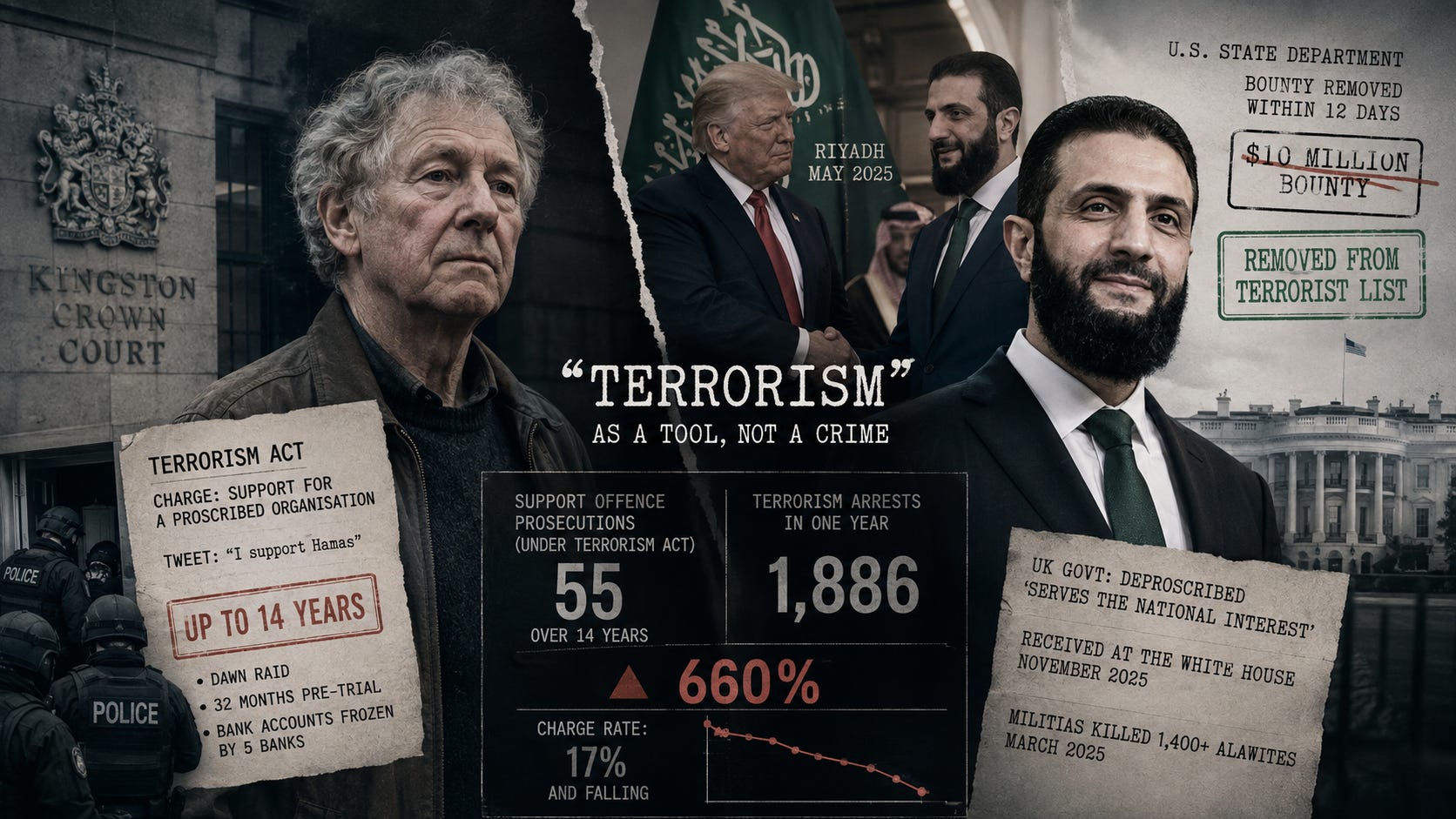
Today a Brighton pensioner goes on trial for a tweet. Nine months ago, the man who founded al-Qaeda’s Syrian branch was welcomed into the Oval Office. One word governs both stories — and it has stopped meaning anything.
This morning, Tuesday 18 August 2026, a 72-year-old grandfather named Tony Greenstein walks into Kingston Crown Court in southwest London to be tried by a jury for terrorism. He is a carer. He is the son of an Orthodox rabbi who marched against Mosley’s Blackshirts. The evidence against him is a tweet of seven words from 2023, and if the jury agrees with the Crown, he can be sent to prison for 14 years.
I want to hold his case next to another one, because only together do the two make sense. Nine months ago, a man who founded al-Qaeda’s Syrian branch — a man the United States hunted with a $10 million bounty — became the first Syrian head of state ever received at the White House. Tony Greenstein and Ahmed al-Sharaa will never meet. But between them they show you what the word “terrorist” has actually come to mean in the hands of the governments that wield it. It is not a description of what a person has done. It is a measure of whether that person is useful.
The pensioner
Let me give you Greenstein’s record in full, because the prosecution will, and I would rather you heard it from someone sympathetic. He was expelled from the Labour Party in 2018. He sued the Campaign Against Antisemitism for calling him a “notorious antisemite” and lost, the court ruling the phrase was honest opinion. He took a suspended sentence for a Palestine Action attack on an Elbit arms factory. He is abrasive, litigious, and entirely unrepentant. None of that is why he is on trial today.
He is on trial because, in November 2023, an anonymous account goaded him into declaring himself, and he replied: “I support Hamas against the Israeli army.” Five weeks later, at half past six in the morning, counter-terrorism officers were at his door. They took his computers and his phones, held him for nine hours, and released him under bail conditions forbidding him to post about the war at all. “This is Orwellian,” he told them. He was not wrong, and he was, if anything, being generous.
Then the state settled in for a siege. It took eleven months to charge him and the better part of another year to bring him to trial, which was adjourned once already. By the time the jury is sworn today, he will have spent thirty-two months under seizure, gag, and the threat of prison — the punishment served in full before any verdict is reached. And while he waited, his banks left him, one after another. In a statement published two weeks ago, he described being cut off by five institutions since his arrest: Nationwide after twenty-five years, then HSBC and First Direct — including the account he and his wife kept for the care of their autistic son — then Santander, which froze his personal accounts and those of a registered charity he serves as treasurer, then a savings bank that shut out his family entirely. None of them gave a reason. None has to. Banks warned that a customer is under suspicion are forbidden by law to tell him.
He suspects a state hand behind it, and here is the part you might not expect: the government’s own terrorism watchdog saw it coming. The Independent Reviewer of Terrorism Legislation warned in 2023 that enforcing proscription would push banks into dumping customers to keep clear of the law — “de-risking,” the industry calls it, as though a man’s family accounts were a bad investment. When Coutts closed a single account belonging to Nigel Farage, the prime minister weighed in and the chief executive of NatWest was gone within weeks. A Jewish pensioner debanked six times on his way to a terrorism trial has produced, from the same newspapers, near silence.
The president
Now the other man. His record does not need a sympathetic narrator or a libel lawyer, because the United States government wrote it down and published it. Ahmed al-Sharaa — then calling himself Abu Mohammad al-Jolani — joined al-Qaeda in Iraq in 2003, was captured by American forces, spent five years in their custody, and then went to Syria to build al-Nusra Front, al-Qaeda’s local branch, swearing loyalty on video to Ayman al-Zawahiri.
The State Department’s own wanted notice records what his organization did. It “carried out multiple terrorist attacks throughout Syria, often targeting civilians.” It abducted around 300 Kurdish civilians from a checkpoint. In the Druze village of Qalb Lawzeh, in Idlib, its fighters lined up and shot twenty residents. It claimed suicide bombings in Damascus, Homs, and Quneitra. In 2014 al-Sharaa personally called for retaliatory attacks on the American-led coalition. For all of this the UN froze his assets and banned his travel, and the $10 million bounty on his head placed him among the five most-wanted jihadists on earth — the same list as Baghdadi, the same list as Zawahiri. This is the conduct the word “terrorist” was built to carry: emptied villages, detonated city centres, years of dead civilians and dead soldiers in the ground.
How the word came off
Then Damascus fell, on 8 December 2024, and I want you to watch how quickly the word dissolved. Twelve days later — twelve — an American delegation sat down with al-Sharaa and announced the bounty was being lifted. The file had not changed. The grave at Qalb Lawzeh was exactly where it had been left.
What followed was not a quiet normalization but a public courtship, and it proceeded through fresh blood. In March 2025, as militias aligned with al-Sharaa’s new government swept the Alawite coast, Amnesty International documented the deliberate, sectarian killing of civilians and called for a war-crimes investigation. Al-Sharaa’s own fact-finding committee would later confirm that 1,426 people had died, most of them civilians. Two months after those massacres, in May, Donald Trump received al-Sharaa in Riyadh and appraised him for the cameras like a prizefighter: “Young, attractive guy, tough guy, strong past.” In June came an executive order lifting sanctions so that Syrians could have “a chance at greatness.” In July, Washington revoked the terrorist designation of the very group he had built.
Britain kept pace. Only weeks earlier the prime minister had called deproscription “far too early” to consider. Then in July his Foreign Secretary flew to Damascus to shake al-Sharaa’s hand — while the man’s organization was still formally proscribed under the Terrorism Act as an alias of al-Qaeda. That is the identical legal status Hamas holds in the indictment Tony Greenstein faces today. When the contradiction became awkward, the government did not prosecute the Foreign Secretary. It erased the proscription in October, on the stated ground that doing so “serves the national interest.” By November al-Sharaa was in the Oval Office, signing Syria into the American-led coalition against ISIS. No jury weighed the graves. No dawn raid preceded any of the handshakes. The men who had written the wanted poster simply took it down.
The clause no draftsman wrote
Hold the two files side by side and the law confesses what it is for. Section 12 of the Terrorism Act was amended in 2019 so that a person now commits an offence simply by expressing an opinion supportive of a proscribed organization, reckless as to whether anyone hearing it might be encouraged. Parliament wrote that clause precisely because the courts had ruled the old law could not reach opinions. By its plain words, a Foreign Secretary renewing relations with the commander of a then-proscribed group sits closer to the offence than anything Greenstein ever typed. Nobody proposes charging him, and that is exactly the point.
For my American readers, understand that no such law could stand in the United States. Even Holder v. Humanitarian Law Project, the Supreme Court’s furthest reach into criminalizing “material support,” expressly held that “any independent advocacy in which plaintiffs wish to engage is not prohibited.” Greenstein’s seven words are protected speech in America. Which is why the administration that lifted al-Sharaa’s bounty, unable to prosecute its own dissidents’ words, simply deports the people who say them. Mahmoud Khalil, a green-card holder, was seized over his campus activism and held 104 days, missing the birth of his first child, never charged with a crime. Rümeysa Öztürk, a doctoral student, was taken off a Massachusetts street by masked agents and jailed for 45 days over an op-ed. The same State Department that certified a student’s op-ed a threat to American foreign policy spent the year certifying that an al-Qaeda founder’s government was not. The terror list and the visa list, it turns out, are the same list, kept for the same purpose.
What the numbers admit
If you think I am building this on a handful of vivid cases, look at what the state counts. Across the fourteen years to mid-2025, the Ministry of Justice records just 55 people prosecuted under the Terrorism Act’s membership and support provisions — about four a year, across the entire era of ISIS. Then the subject shifted from bombs to opinions. In the twelve months to September 2025, the Home Office counted 1,886 terrorism arrests, a rise of 660 percent, and 86 percent of them were for supporting Palestine Action — a protest group proscribed for spraying paint on warplanes in the same season al-Sharaa was being rehabilitated. Over the same period, the share of terrorism arrests that led to a charge collapsed from 47 percent to 17. Read that plainly: five of every six people seized under terror law are never meant to see a courtroom. The arrest itself is the product.
More than 2,700 people have now been arrested for supporting Palestine Action, 522 in a single day, most of them holding cardboard signs. The UN human rights chief called the ban “disproportionate and unnecessary.” When the High Court ruled it unlawful this February, police paused for six weeks and then resumed, a commissioner explaining that they must “enforce the law as it is at the time” as officers carried eighteen more people off the steps of Scotland Yard. The Supreme Court will decide in November whether any of it was ever lawful. The government’s own reviewer confirms that terrorism prosecutions now run at record levels, “dominated by documentary offences and proscription related charges.” An apparatus built to catch the authors of Qalb Lawzeh now processes placards — while the author of Qalb Lawzeh signs coalition papers in the Oval Office.
The verdict already in
The machine has not spared the reporters who cover it. Richard Medhurst was the first journalist arrested under the same section now aimed at Greenstein — fourteen months under investigation, no charge, his files quietly passed to Austria so the ordeal could go on abroad. Ten officers raided the home of Asa Winstanley over his posts; a court later found the warrants unlawful and ordered his devices returned. Nobody was convicted. Everybody lost months of work and sleep, which may be the actual point. Even inside Kingston Crown Court today, prosecutors have fought to keep Greenstein’s own writings on Hamas and Gaza out of the jury’s hands, the judge citing an old rule that courts are not sounding boards for political views — in a trial where the defendant’s political views are the entire charge.
Greenstein believes his verdict will set the price for everyone arrested behind him: an acquittal endangers the whole campaign, a conviction licenses it. He may be right. But the deeper verdict was handed down long before his jury filed in this morning — delivered in Riyadh, sealed in the Oval Office. Terrorism, as our governments actually practise it, is not a category of act. It is a category of usefulness. Ahmed al-Sharaa became useful, and the word let him go. Tony Greenstein remains inconvenient, and so the word arrives at his door before dawn, freezes the account he keeps for his disabled son, and asks twelve of his neighbours to call seven words an act of terror.
The trial is listed for five days. Whatever the jury decides about Tony Greenstein, the word he is charged under has already been tried elsewhere, on a far larger body of evidence, and found to mean nothing at all. Watch what Kingston does with him this week. Then remember who walked out of the White House a free and courted man, and ask yourself what “terrorist” was ever supposed to mean.
This spate of prosecutions appears to be aimed at thought crimes. What concrete support was actually given? He's not a member, is he? If I say I support having a million quid in the bank against poverty, it's not going to make a difference to my situation unless I act on it and organise a heist. And Oceans Eleven I am not. If the authorities are worried that these words put an idea into the ether then it's closer to sending a letter to Santa Claus and superstition. Is our judicial system now run on magical thinking? I have to say, it is a poor show when a Brit can't even criticise terror.
Terrorism is not a word that describe deeds . Therefore it is a vague and general accusation, it is some murder or attempted murder. It is false category in laws vocabulary because the ones called terrorists by some are liberator fighters by others.
It's even worse than a though crime because the "justice" system cannot define in an unambigeous form. Its the expression of arbitrary power over any kind of dissent.