
Trump’s Corruption Is the Product
How and Administration stops preteding

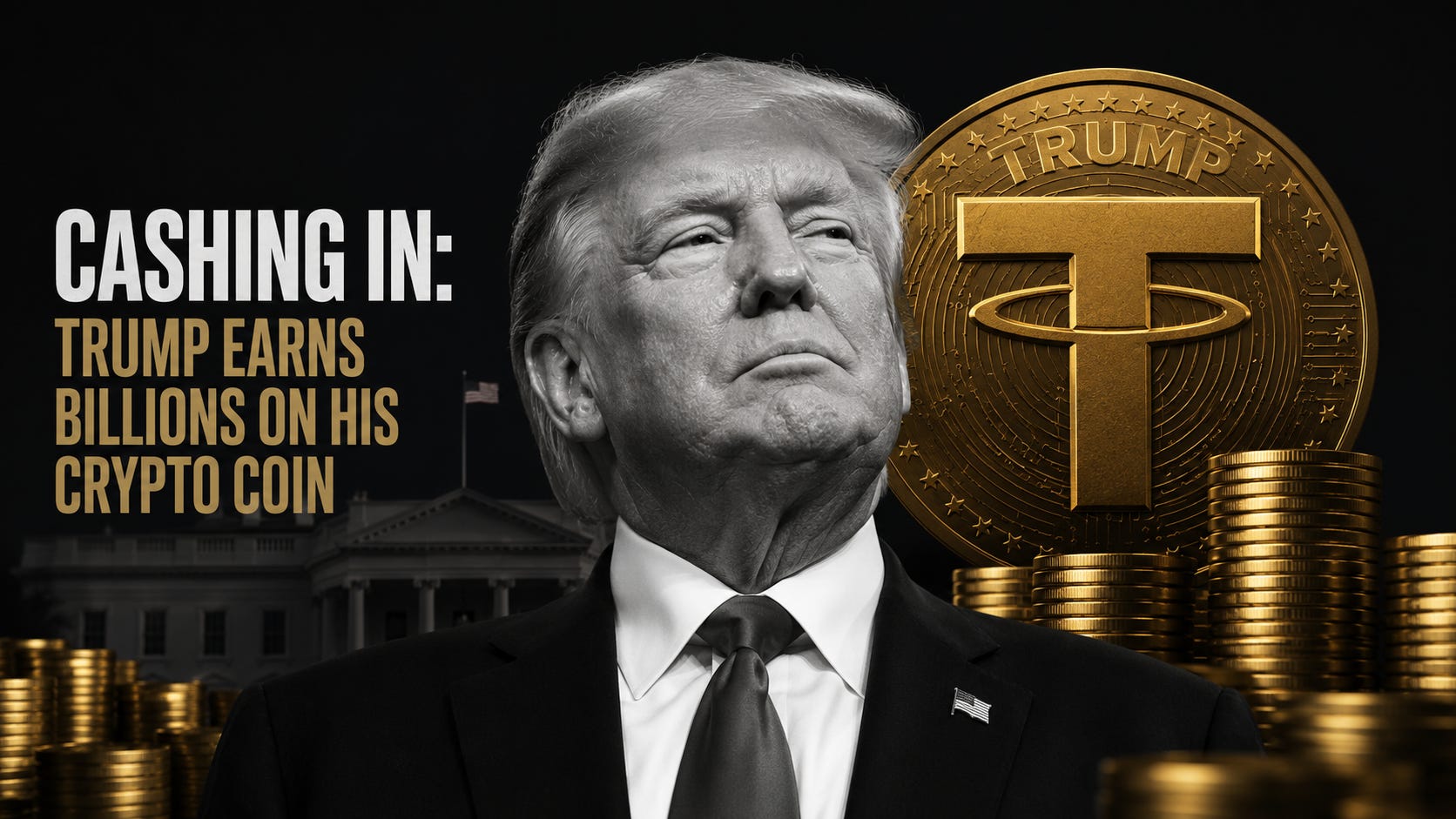
On the evening of 22 May 2025, a line of cars moved up the drive of the Trump National Golf Club in Sterling, Virginia, past demonstrators holding signs that read like indictments. Inside, two hundred and twenty people who had spent, on average, around $1.8 million each were taking their seats for dinner with the President of the United States. They had not donated to a campaign. They had not bundled contributions or bought a table at a gala. They had bought a cryptocurrency — the $TRUMP coin — and the two hundred and twenty who had bought the most were rewarded, according to a promotion that ran for weeks on a website, with what the marketing called the most exclusive invitation in the world. The top twenty-five were promised a private reception and a tour.
There was no intermediary, no envelope, no deniability. The transaction was the point, and it was advertised. A sitting president had built a machine that converted money into proximity to himself, published the price list, and ranked the buyers on a public leaderboard. When he rose to speak, he told the room that the last administration had persecuted crypto innovators and that he was bringing them home. And then he explained his motives. He was doing all of it, he said, not for himself. “For you.”
To understand what has happened to American corruption, hold that scene in mind and set beside it a second image. It is the picture stamped on the coin those two hundred and twenty people bought: Donald Trump, fist raised, blood on his ear, above the words Fight, Fight, Fight. It is the image from Butler, Pennsylvania, from the July afternoon in 2024 when a bullet grazed his right ear and killed a man in the crowd behind him, and the candidate rose with his fist up and shoutedthe word that became the movement’s war cry. That image is the most sacred object MAGA possesses. It was turned, within six months, into the label on a financial product that moved the savings of the faithful into the accounts of the man they had watched bleed.
The oldest arrangement, made new
Selling access to power is not an American invention, and it is not a Trump invention. What is new is the disappearance of the disguise.
For most of the modern history of the republic, the machinery of anti-corruption law rested on a single assumption: that the corrupt act would be hidden. Bribery statutes, disclosure rules, the emoluments clauses of the Constitution — all of them presuppose concealment. They exist to drag a hidden thing into the light, because the people who wrote them assumed a man selling his office would be ashamed to be seen doing it, and would therefore hide it, and could therefore be caught. The scandals of the twentieth century — the special prosecutors, the paper trails, the follow-the-money — all assumed a money that did not want to be followed.
Remove the concealment and something strange happens to the law. There is no conspiracy to prove, because nothing was concealed. There is no cover-up to unravel, because nothing was covered. The act stands in daylight, wearing the costume of legitimate commerce, and the statutes built to punish hiding find they have nothing to grip. This is the innovation of the Trump crypto operation, and it deserves to be understood as a discovery about the law rather than a lapse in ethics. Do the thing openly enough, and dress it as a product, and you can walk through the wall a century of law spent building. Francis Fukuyama, watching the same process, put it this way: what is remarkable about this administration is the degree to which it is open about its own corruption.
The $TRUMP coin is that discovery made concrete. It is not, in any real sense, an investment; the project’s own website carries a disclaimer advising buyers to treat the purchase as a gesture of support rather than a financial strategy. It is a mechanism, and the mechanism is elegant. A cut of every transaction flows automatically to wallets tied to the Trump Organization, which with an affiliated entity owns about 80 percent of the coin’s supply. The more the coin is traded, the more the family earns, whether it rises or falls. By early May 2025, analysts at Chainalysis counted more than $324 million in trading fees routed to the creators. The coin did not need to succeed as an asset. It needed only to be traded.
Who was left holding the fist
Here is the part of the story that should be read slowly, because the (Maga) movement itself has not yet fully absorbed it.
The people who initially bought the $TRUMP coin were, overwhelmingly, his own. They were not Wall Street desks, though those came later and cleaned up. They were the small holders, the believers, the ones who saw the raised fist and the word Fight and understood the purchase as an act of loyalty — because they had been told, in as many words, that it was. And they were destroyed.
Of the roughly 1.48 million wallets that bought the coin after its launch, the blockchain analytics firm Nansen found that 988,905 — nearly two out of every three — were underwater by the end of June 2026. Their combined losses came to $3.81 billion. The winners were a small band of early buyers who got in during the first hours of trading, before the coin spiked toward $75 and collapsed; fewer than half a million wallets captured gains, concentrated among the fast and the connected. In the earliest weeks, the arithmetic was starker still: for every dollar the creators took in fees, ordinary investors lost twenty.
Against those losses, set the President’s take. His June 2026 financial disclosure — a 927-page filing with the Office of Government Ethics — reported $636 million in royalties from the $TRUMP coin alone, part of roughly $1.2 billion in crypto income for the year. Nearly a million of his supporters lost close to four billion dollars so that he could book six hundred million. He told them he was doing it for them, and they believed him, and they paid for the privilege of the belief.
There is no euphemism gentle enough to soften this. It is a president using the iconography of his own near-assassination — the single most charged image his followers hold — to run what analysts describe as one of the largest retail-loss events the political-memecoin sector has produced, and calling it a gift. John Pilger used to distinguish between worthy and unworthy victims, the ones a system mourns and the ones it does not. The MAGA small holder is the unworthy victim of this administration’s signal financial achievement, mourned by no one in power, least of all the man whose fist they bought.
The instrument becomes an embassy
The meme coin was the crude door, the retail entrance. The sophisticated door is called World Liberty Financial, and through it the money stops being small and stops being American.
World Liberty was launched in September 2024 by Trump’s sons together with two men whose backgrounds would once have ended a project before it began. Chase Herro, who has described himself as the “dirtbag of the internet,” did time on drug charges and left a trail of failed ventures behind him. His partner Zak Folkman once ran a seduction business called Date Hotter Girls. They broadcast themselves on YouTube trading tokens and dispensing the patter of the get-rich-quick trade. By early 2025 the Trump family had taken control of the venture through a holding company and eased the two founders out of their directing roles, though they kept a revenue share. Seventy-five percent of the proceeds from the token sales flow to a Trump entity.
What World Liberty built was a stablecoin, USD1 — a token pegged to the dollar and backed by Treasuries, the kind of instrument whose issuer earns the interest on the reserves that back it. And in the story of USD1, the machinery of private enrichment and the machinery of the American state stop running on separate tracks and begin to converge.
Follow the sequence, because the sequence is the argument. Four days before the inauguration, on January 16, 2025, an Abu Dhabi vehicle called Aryam Investment 1 — backed by Sheikh Tahnoon bin Zayed Al Nahyan, the UAE’s national security adviser and brother of its ruler — bought a 49 percent stake in World Liberty for $500 million, in a deal signedby Eric Trump. Of the first installment, $187 million went straight to Trump family entities. Months later the administration reversed Biden-era export controls and cleared the sale of hundreds of thousands of advanced AI chips to the UAE — roughly a fifth of them reserved for G42, another firm chaired by Tahnoon, whose ties to the sanctioned Chinese giant Huawei were the reason the chips had been blocked in the first place. Then, in May 2025, a company chaired by Tahnoon named MGX used $2 billion of World Liberty’s USD1 stablecoin to finance an investment in Binance, the world’s largest crypto exchange. That single transaction took a stablecoin that had existed for five weeks and vaulted it into the top tier of its industry, and it put the Trump family on the interest of a two-billion-dollar float.
The former senior export-control official Chris McGuire, asked to justify the chip reversal on the merits, told the Wall Street Journal it was impossible to defend on national-security or economic grounds. There was, he said, only one explanation for the policy shift: the UAE paid for it.
Foreign state money went in. Within the same span, American state favors came out: chips, a data center, and the keystone — a pardon.
The pardon
Binance’s founder, Changpeng Zhao, known everywhere as CZ, had pleaded guilty in 2023 to failing to maintain controls against money laundering on the exchange he built, and had agreed to a $4.3 billion settlement with the Justice Department. The government said he had caused significant harm to national security; the Treasury Secretary at the time said Binance had let money flow to terrorists, cybercriminals, and child abusers through its platform. He served four months. His company had helped World Liberty launch USD1. The Emirati fund he benefited from routed two billion dollars through a Trump-family stablecoin. The Securities and Exchange Commission, under new leadership, dropped its case against him. And on October 23, 2025, Donald Trump pardoned him.
Asked about it afterward on 60 Minutes, the President said of the man whose exchange underwrites his family’s fortune: “I don’t know who he is. I know he got a four-month sentence or something like that. And I heard it was a Biden witch hunt.” Pressed on the appearance of pay for play, he answered that he knew nothing about it because he was too busy.
There was no secret meeting to expose, no wiretap to obtain. The stablecoin deal was announced from a stage in Dubai. The pardon was issued in writing. The denial was broadcast on network television. Every element sat in the open, and the openness was the defense: how can it be a conspiracy when nothing was hidden?
CZ is not the isolated case. He is the clearest instance of a pattern running through the whole exercise of the pardon power. Trevor Milton, the electric-truck entrepreneur convicted of defrauding his investors with a video of a prototype truck that was in fact rolling downhill after being towed to the top of a hill, was pardoned two weeks after prosecutors asked a judge to order him to pay $680 million in restitution to shareholders; he and his wife had donated more than $1.8 million to a Trump campaign fund weeks before the election. The founders of the BitMEX exchange, convicted of violating anti-money-laundering law, were pardoned the same day. The Governor of California’s office, tallying the restitution erased by these acts of clemency, put the figure approaching $2 billion owed to defrauded victims and the public, wiped away. Congressional Democrats have opened an inquiry into whether the pardons were, in effect, for sale.
The regulator regulates himself
The largest holder of the $TRUMP coin, the man at the top of that leaderboard, was Justin Sun, a crypto billionaire born in China. Sun had a problem when Trump took office: the SEC had charged him with fraud and market manipulation, accusing him of orchestrating hundreds of thousands of wash trades. He also had a solution. He put $75 million into World Liberty Financial — a stake that would swell, with unvested tokens, toward $700 million. Three weeks into the new administration, the SEC asked a court to pause its fraud case against him. In March 2026 it settled for $10 million, paid not by Sun but by one of his companies, with no admission of wrongdoing and the charges dismissed with prejudice. The man who had invested most heavily in the President’s private venture watched the federal fraud case against him dissolve.
Here the architecture reveals its final feature. USD1 is regulated by federal agencies. The President has asserted direct control over those agencies by executive order. The regulator of the President’s stablecoin, in other words, answers to the man who profits from it. When Congress wrote the stablecoin law known as the GENIUS Act and signed it in July 2025, it included a provision barring members of Congress and their families from profiting off stablecoins. It pointedly declined to extend that bar to the President and his family. The exemption was not an oversight. It was written in.
The White House answer to all of this is consistent and worth stating. The President has placed his businesses in a trust managed by his sons; neither he nor his family, the press secretary said, have ever engaged or will ever engage in conflicts of interest. Its voluntary ethics agreement bars the firm from dealing directly with foreign governments — while still allowing deals with private companies abroad, a looser standard than the first-term pact, which barred foreign companies too. These are the defenses, and they are the defenses precisely because the openness of the conduct has made the older defenses unnecessary. One need not allege a hidden bribe when the counterparty is a sovereign wealth fund chaired by a foreign intelligence chief, the payment is a matter of public record, and the favor is announced from a podium. But a trust run by one’s own children is not a wall between a president and his money. It is a curtain, and a thin one, hung in a room where all the lights are on.
The precedent
Elizabeth Warren has called the GENIUS Act a super highway for corruption. The metaphor is right but incomplete, because a highway can be closed. What has been built is more durable than that. It is a body of law and precedent in which a sitting president may issue a personal financial instrument, sell it to foreign governments and his own supporters alike, regulate it through agencies he controls, and reward its largest buyers with pardons and licenses and the quiet death of federal investigations — and in which all of this is not merely tolerated but, in the case of the stablecoin, expressly permitted by statute.
The political scientists who study this kind of state have a word for it. In a patrimonial order, as Stephen Hanson and Jeffrey Kopstein describe it, the interests of the people are equated with the personal interests of the ruler and his household, so that in principle no conflict between them can arise. Under such a system, they write, the idea that an official might have a conflict of interest becomes a quaint anachronism — because the phrase assumes a line between public duty and private gain that the system has erased. That is the transformation beneath the crypto ventures and the pardons. The rules are not merely being broken. The premise they rested on — that a president’s private enrichment and the public good are distinct things that can come into conflict — is being retired. Fukuyama has a name for the larger process: repatrimonialization, the retreat of a modern impersonal state back into a family concern, the way the kings of old-regime France sold the right to collect taxes to the highest bidder.
When Zach Witkoff, the son of Trump’s Middle East envoy and a co-founder of World Liberty, announced the $2 billion Emirati deal from the stage in Dubai, he offered a phrase his critics seized on and history may keep. “It’s only the beginning.”
He was talking about his company. But the sentence describes something larger than any coin. The machinery now exists. The legal architecture is codified. The precedent is set, in daylight, with the receipts published and the denials televised. Whoever holds the office next inherits not a scandal to be lived down but a demonstration of what can now be done, and a body of law that says, in the one place it mattered most, that it may be done again. The corruption is no longer the thing the system hunts. It is the product the system sells. And the first customers, the ones who paid with their savings and their faith, were told it was a gift.
The thing is that, regardless of the letter of the law, the rich and powerful people in that country have long been immune to any accountability for it. They could do anything and they would never ever pay the price that a normal person would. And if they did symbolically, they would buy a pardon anyway, Matt Taibbi did a great job of describing this phenomenon in his 2014 book "The Divide: American Injustice in the Age of the Wealth Gap". It's well worth reading.
Elsewhere, and also relevantly, Taibbi also has noted that when you see any of the powerful in that country actually facing any charges for anything, its a sign of factional battles among the oligarchy - in other words one group is using the law as a tool to take out the other - not actual principles. Taibbi also likened this tactical application of the law among the oligarchy to another place he had seen it up front while working there as a correcspondent: post-soviet Russia.
It's with great irony then that the country has slumping to the level of blatant corruption and oligarchy as post-soviet Russia.....while spending huge amounts of money to topple and split up an what it calls an "autocractic" Russia.
Last but not least, it should not be a surprise that the country has sunk to this: the great weakness of the country has long been its complete surrender to worshipping money and deifying those who have it. When money is the only compass in a society, well guess what happens?
There is no point blaming all this on the orange one. The people are to blame. When you see rats leave the sewers and start walking boldly down the middle of the street, it ain't because the rats have changed - it's because the place has been dirty and uncleaned for a very long time and everywhere is now a sewer.
It's entirely up to the people in the country to get their act together. There is no one leader who will magically step forward and save them. They all each have to do the work in their own hearts and minds and souls.
Greed & corruption: the rot of the human soul.