
When iPhones Learn to Read Your Mind
Apple's $1.6 Billion Acquisition of the Israeli Q.ai and the Intelligence Pipeline Hiding in Plain Sight

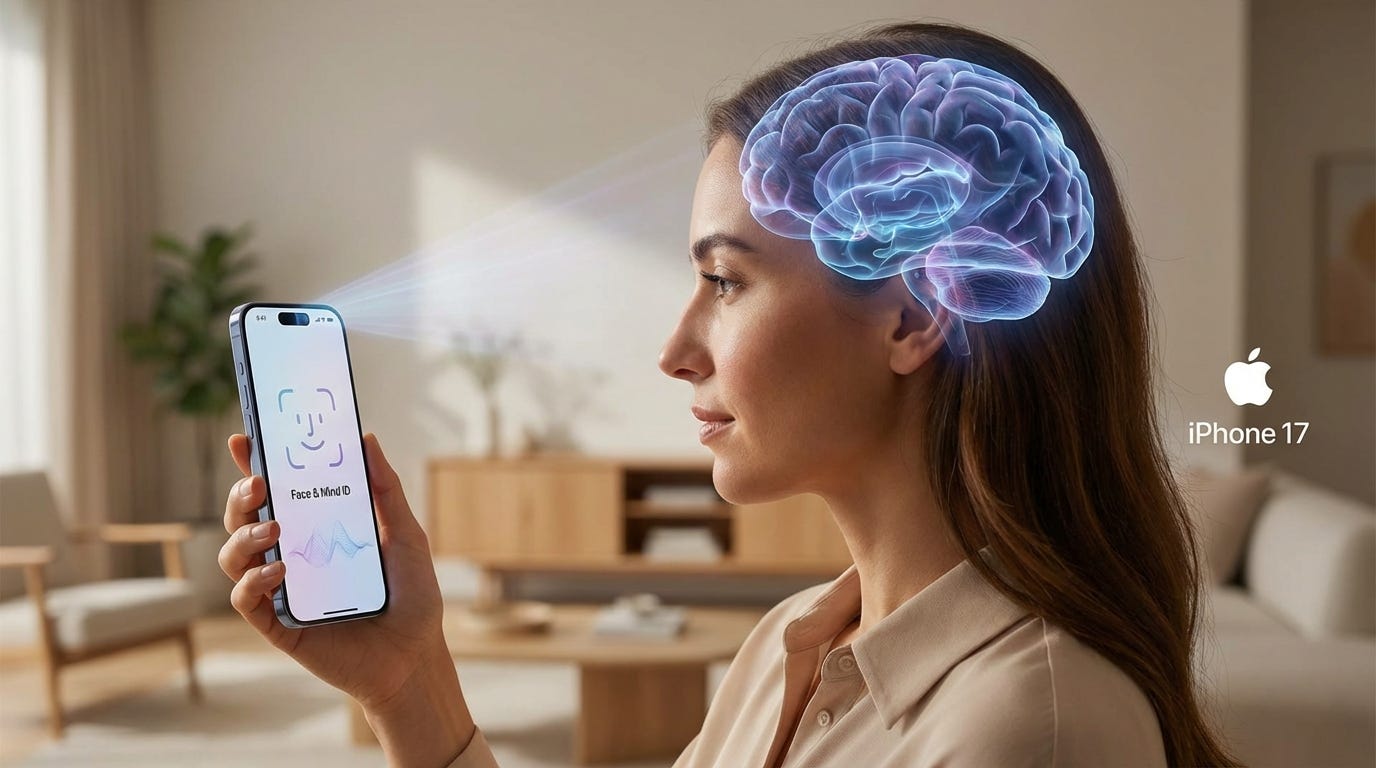
In January 2026, Apple paid close to two billion dollars for a company most people had never heard of.[1] Q.ai, founded in 2022 in Ramat Gan, Israel, had no public product, no revenue stream, and a website consisting of a single cryptic tagline: “In a world full of noise, we craft a new kind of quiet.”[2] What the company did have was a technology that reads the involuntary movements of human faces—micro-contractions of muscle invisible to the naked eye—and translates them into words, emotions, heart rate data, and respiratory patterns.[3] Apple’s hardware chief Johny Srouji called Q.ai “a remarkable company that is pioneering new and creative ways to use imaging and machine learning.”[4] The patents tell a more complete story. They describe optical sensors embedded in headphones and glasses that decode silent and whispered speech by projecting infrared light onto skin and tracking what comes back.[5] The system can identify a person, assess their emotional state, monitor vital signs, and interpret words that were never spoken aloud.[6]
This is Apple’s second-largest acquisition in history, behind only Beats Electronics in 2014.[7] It is also the second time Apple has bought a company founded by Aviad Maizels—a man whose biography, posted by the Weizmann Institute, notes that he “served in an elite intelligence unit in the IDF as head of a technological R&D section.”[8] The first company Apple bought from Maizels, PrimeSense, became the foundation of Face ID, the facial recognition system embedded in more than two billion iPhones.[9] A pattern is forming. It deserves scrutiny.
The Founders
Aviad Maizels studied computer science at the Technion and applied mathematics at the Weizmann Institute under the guidance of Adi Shamir, the cryptographer whose name forms the “S” in the RSA encryption algorithm.[10] Before entering the private sector, Maizels led a technological R&D section in an elite IDF intelligence unit.[11] The Israeli press has not specified which unit, though the description aligns with the ecosystem surrounding Unit 8200, the IDF’s signals intelligence division, which the Wall Street Journal has profiled as Silicon Valley’s “hot talent pipeline.”[12]
His co-founders bring complementary credentials. Dr. Yonatan Wexler, Q.ai’s CTO, spent eleven years at OrCam Technologies—founded by Hebrew University professor Amnon Shashua—overseeing R&D in computer vision and machine learning.[13] Wexler is a Marr Prize recipient, the highest distinction in computer vision research, and his work at OrCam produced a wearable device named “Best Invention of the Year” by Time Magazine.[14] Before OrCam, he worked at Microsoft on the Virtual Earth project and filed more than fifteen patents.[15] Dr. Avi Barliya, the third co-founder, is an AI researcher and serial entrepreneur who previously worked on self-driving systems and contributed to SpaceIL’s lunar spacecraft project.[16]
The team raised $24.5 million in January 2023 from GV (formerly Google Ventures), Kleiner Perkins, Aleph, Spark Capital, and Exor, then went silent.[17] For three years, approximately one hundred employees worked in stealth on technology that combined physics, machine learning, and what Wexler described as “human sciences.”[18] Tom Hulme, managing partner at GV, revealed a detail about this period that went largely unremarked: after October 7, 2023, roughly thirty percent of Q.ai’s employees were drafted into IDF military service, and for months afterward, weekly meetings were interrupted by staff scrambling into bomb shelters.[19]
The integration of civilian and military life this detail exposes is unremarkable in Israel. It is also precisely the dynamic that deserves closer examination when the technology in question can read what a person is saying without them making a sound.
What the Technology Actually Does
Q.ai’s patents describe a system that uses optical sensors—small cameras emitting infrared light—to detect micro-movements of facial skin, cheeks, jaw, and throat muscles during speech or subvocalized thought.[20] The technology works when a person whispers, mouths words silently, or even engages in “internal speech”—the neural firing of speech muscles that occurs when someone thinks in words without visible movement.[21] Unlike MIT’s earlier AlterEgo project, which required electrodes adhered directly to the skin, Q.ai achieves this optically, without physical contact.[22]
The consumer applications are self-evident. Imagine asking Siri a question on a crowded train by mouthing words. Imagine AirPods that transcribe a whispered phone call in a windstorm. Apple’s products—AirPods, Vision Pro, the rumored smart glasses—stand to gain substantially from a silent speech interface.[23]
The patents, however, describe more than speech recognition. According to Reuters, the filings detail technology capable of identifying individuals and assessing “their emotions, heart rate, respiration rate and other indicators.”[24] A single optical sensor, pointed at a face, performing facial recognition, emotional analysis, biometric monitoring, and silent speech decoding simultaneously.
Within days of the acquisition announcement, Dr. Alona Barnea, head of the neurotechnology department at MAFAT—Israel’s equivalent of DARPA—gave an interview to Ynet explicitly connecting this class of technology to military applications. “Think about the operational implications,” Barnea said, “when there is a need for silent communication or activity in a noisy area.” She confirmed that MAFAT is actively pursuing silent speech projects using electrodes on facial muscles, adding: “In the future, we will not even need that. The brain alone will be enough.”[25]
MAFAT, the Directorate of Defense Research and Development, operates as the bridge between the IDF, the Israeli Ministry of Defense, academia, and private startups.[26] In January 2025, it established a dedicated AI and Autonomous Systems Administration, and since October 2023, more than three hundred defense-tech companies have worked with MAFAT, with over 130 participating directly in military operations.[27] The Jerusalem Post reported that MAFAT’s Chief Technology Officer highlighted advanced facial-recognition technology among systems expected to be deployed by the IDF.[28]
Q.ai is not a defense contractor. There is no public evidence it has worked with MAFAT or any intelligence agency. The point is structural: in Israel’s tightly interwoven defense-technology ecosystem, the distinction between civilian innovation and military application is maintained by policy choice, not by technical limitation.
The Pipeline
The pattern of Israeli military-intelligence alumni founding surveillance-adjacent technology companies, which are then acquired by American corporations, is now well-documented enough to constitute an industrial phenomenon.
The Wall Street Journal reported in 2024 that Unit 8200 alumni have founded dozens of cybersecurity companies, with at least five publicly traded in the U.S., collectively valued at around $160 billion.[29] Wiz, founded by four veterans who met during their Unit 8200 service, was acquired by Google in March 2025 for $32 billion—Google’s largest acquisition ever.[30] CNN confirmed that the four Wiz co-founders “met years ago when they were drafted into Unit 8200.”[31] Palo Alto Networks, itself a product of the Unit 8200 pipeline, has purchased several companies led by unit alumni in recent years.[32]
The unit’s most notorious graduate venture is NSO Group, developer of the Pegasus spyware. Wikipedia’s entry on NSO, drawing on extensive reporting, notes that “almost all of NSO’s research team is made up of former Israeli military intelligence personnel, most of them having served in Israel’s Military Intelligence Directorate, and many of these in its Unit 8200.”[33] Pegasus is classified as a military export by Israel, and its sale is controlled by the government—which, the New York Times reported, “has long seen Pegasus as a critical tool for its foreign policy” and “treated NSO as a de facto arm of the state.”[34] The spyware exploited zero-day vulnerabilities in Apple’s iOS to surveil journalists, dissidents, and government officials across dozens of countries.[35] Apple sued NSO Group in November 2021, calling for a permanent injunction.[36] A U.S. court ruled in December 2024 that NSO was liable for hacking 1,400 WhatsApp users’ devices.[37]
A researcher quoted by Drop Site News reported documenting over 1,400 current and former members of Unit 8200, Israeli Military Intelligence, and the IDF Cyber Defense Directorate working at major Silicon Valley companies, including Cisco, Microsoft, NVIDIA, Intel, and Google—some of whom remain active reservists.[38]
Paul Biggar, a software engineer and founder of Tech for Palestine, articulated the concern bluntly regarding the Wiz acquisition: “Wiz should not be trusted, because it takes all user data and runs it through an Israeli company run by former intelligence officials.”[39]
Apple’s acquisition of Q.ai sits in this lineage. The company’s CEO previously led an IDF intelligence R&D section. His previous company gave Apple Face ID. His current company can read what you’re saying without you opening your mouth. The technology will be embedded in devices worn on the faces and in the ears of a billion people.
The Broader Architecture
Place this acquisition alongside recent developments and a landscape emerges.
In September 2024, Oracle co-founder Larry Ellison told analysts at the company’s Financial Analyst Meeting that AI-powered surveillance would soon ensure good behavior. “Citizens will be on their best behavior,” he said, “because we’re constantly recording and reporting everything that is going on.”[40] He described police body cameras that could never truly be turned off—Oracle would always be recording, accessible by court order—and AI that would continuously monitor the feeds for problems.[41] Fortune compared the vision to China’s social credit system.[42] TechCrunch noted that the evidence linking surveillance to reduced crime is weaker than Ellison suggested.[43]
Meanwhile, NATO’s Science and Technology Organization published a Chief Scientist Research Report on Cognitive Warfare in 2025, identifying “technology able to alter human behaviour” as a central concern and establishing Cognitive Warfare as a strategic research challenge alongside “Cognitive Superiority” and “Influence & Power Projection” as Warfare Development Imperatives.[44] A 2021 NATO symposium document stated the objective with unusual candor: “We must be able to ‘read’ the brain of our adversaries in order to anticipate their reactions. If necessary, we must be able to ‘penetrate’ the brains of our adversaries in order to influence them and make them act according to our wishes.”[45]
Technologies that read faces, decode unspoken words, measure emotional states, and monitor biometrics are not abstract research papers. They are products being integrated into consumer hardware by the world’s most valuable company. Q.ai’s technology—optical, non-contact, embeddable in ordinary eyewear—represents a qualitative leap in the intimacy of machine perception. The previous generation of surveillance required you to type, to click, to speak. This one requires you only to think.
What Remains Unknown
Several critical questions have no public answers.
Apple has not disclosed what data Q.ai’s technology will collect, where it will be processed, or who will have access to it.[46] Apple’s stated commitment to on-device processing—a cornerstone of its privacy brand—provides no assurance, because the company has been less transparent than its marketing suggests. Its partnership with Google, announced earlier in January 2026, to have Gemini models power Apple Intelligence features raises questions about what data traverses Apple’s ecosystem.[47]
There is no public record of Q.ai having contracted with any intelligence or defense agency. Nor is there public evidence that Maizels’s military service was specifically in Unit 8200 rather than another elite IDF intelligence unit. These distinctions matter. The absence of a confirmed direct intelligence connection is not equivalent to its absence, and responsible reporting requires clarity on this point.
What is confirmed: the CEO served in an elite IDF intelligence R&D unit.[48] Thirty percent of the company’s employees were called to IDF military service during the Gaza war.[49] The technology has explicit dual-use applications acknowledged by Israel’s defense research establishment.[50] And the company was acquired by a corporation whose devices are carried by roughly two billion people worldwide.[51]
The Fundamental Question
The question here is not whether Apple intends to surveil its users. By every available indication, Apple intends to build better AirPods, a more responsive Siri, and a viable pair of smart glasses. The consumer case for Q.ai’s technology is powerful and genuine.
The question is what infrastructure is being built, and who has the training, the network, and the institutional memory to repurpose it. A camera that reads your face while you think is a consumer product and a surveillance apparatus simultaneously. Which one it becomes depends entirely on governance—on laws, on corporate policy, on access controls, on the choices of individuals with the technical knowledge to exploit it. The history of the Israeli military-intelligence-to-Silicon Valley pipeline, from Pegasus to the AI targeting systems deployed in Gaza, demonstrates that the boundary between these uses is permeable.[52]
As Tom Hulme of GV wrote in his announcement of the acquisition: “For decades, we have been forced to speak the language of the machine. We believe we are in the midst of a new tech revolution: an era where the machine finally learns to understand us.”[53]
Understanding. The word carries a promise and a warning in equal measure. The machine that understands what you’re saying when you don’t speak is the machine that understands what you’re thinking when you don’t want it to. Two billion dollars says that machine is coming. The question nobody at the announcement was asked is: who else will be listening?
Sources
This article is based on extensive open‑source research, including reports, investigations, policy papers, corporate documents, and legal or NGO analyses related to Gaza, AI‑assisted targeting, surveillance infrastructure, and post‑war reconstruction schemes.
For readability, individual sources are not listed here in full. If you want to review the complete bibliography, including direct links, outlet names and publication dates, you can request it by sending me a private message on Substack. I will share the full source list and additional background material on request.
Lobotomise all the iPhones.
WITH A HAMMER
The problem here comes from the model of telemetry. Such innovations having to come always with the centralization of the data on the internet to Apple or other data hoarder potential unknown(or cell provider, IDK). Why is it that such a possibly civilian useful tool always has to come with an obscure layer of centralization (information back to the cloud). If there could be transparent local data protected space in such body appendage that the populations have consented to wear all day long, and keep looking at also all day long.. perhaps that would be something good. I think the problem is perhaps the constant tethering that old computers did not have to have to function. Even now a computer can work without always having to phone home.. Could it be the app store model?
But one has to find that this technology can be of use other than the usual world crap industry. I am tried of using the word military.....