
Where Christmas Happened
Memory, Power, and the Place the Christian Story cannot afford to forget

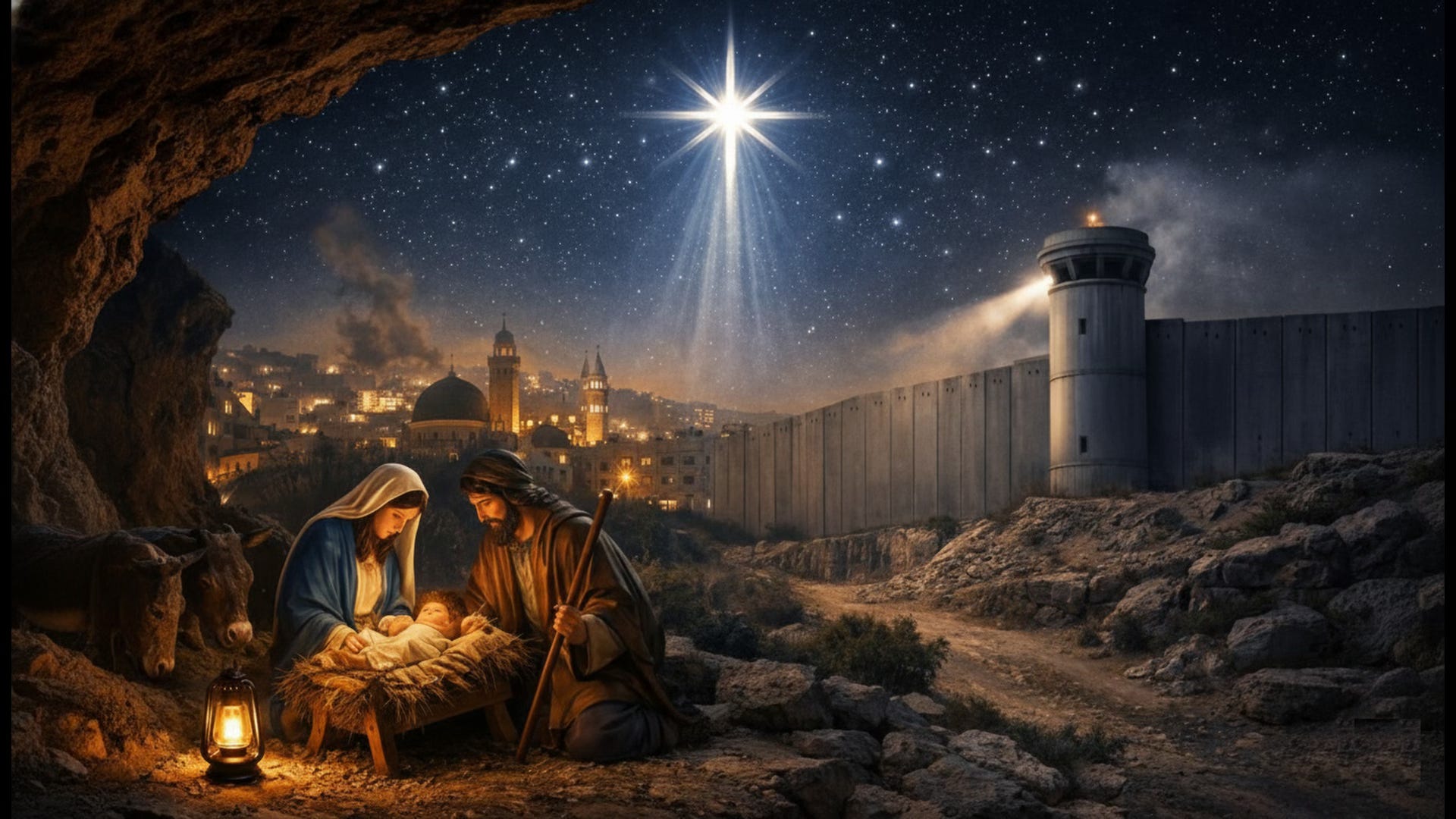
Some texts don’t argue — they reposition. Rev. Munther Isaac in his opinion piece on Al Jazeera does not ask Western Christians to rethink Christmas as an act of goodwill or sentiment. He forces a far more uncomfortable question: what happens to a faith when its founding story is stripped of place, power, and consequence? This piece is not about reclaiming tradition for nostalgia’s sake. It is about restoring geography to memory — and with it, the political and moral weight that Christmas was never meant to lose.
For many readers, this season is bound up with family rituals, quiet moments, and memories that are genuinely cherished. Christmas, for all its distortions, still carries a deep emotional grammar — of warmth, reflection, and the hope that the world might be gentler than it usually is. To acknowledge that is not to trivialise the season; it is to take it seriously.
What follows should not be read as an accusation, nor as a demand to abandon what Christmas means personally or spiritually. Rather, it is an invitation to pause the familiar imagery for a moment, to allow the story we think we know to regain some of its original depth and friction.
The Christmas narrative was never meant to be comfortable, even if it later became comforting. It speaks to people living under pressure, uncertainty, and rule by distant power — and it does so without erasing tenderness, intimacy, or hope. Holding those tensions together is difficult, especially in a season that encourages simplification. But it is precisely this difficulty that gives the story its enduring force.
Reading this piece does not require agreement on every conclusion. It asks only for attentiveness — to place, to history, and to the lives that continue where the story began. In that sense, engaging with it can itself be a Christmas act: an exercise in presence, humility, and the willingness to see beyond what is easiest to celebrate.
One of the most effective ways power sustains itself is by relocating stories.
Not rewriting them outright — that would be too visible — but moving them, gently and over time, from the ground where they happened into a symbolic elsewhere where they no longer threaten anyone. Christmas is perhaps the most successful example of this relocation. A story born under occupation, displacement, and imperial administration has been slowly evacuated of geography, politics, and risk, until it could be safely staged in shopping malls and snow globes.
Rev. Munther Isaac intervenes by restoring location and agency. And that turns out to be far more destabilising.
The problem he exposes is not that Western Christianity has become commercial — that critique is old and largely harmless. The deeper problem is that Christianity has been abstracted from the conditions that gave it meaning. Once Bethlehem becomes an idea rather than a place, the story becomes manageable. Once the holy family is imagined as timeless rather than situated, empire disappears. And once empire disappears from the story, so does responsibility.
Modern Western political culture is deeply uncomfortable with stories that implicate power structures rather than personal morality. So Christmas is reduced to kindness, charity, and private sentiment — virtues that require nothing from systems and ask nothing of states. A God who arrives as an infant under occupation is quietly replaced by a God who affirms cultural identity and geopolitical alignment.
That substitution matters.
Because when Christianity is framed as “Western”, those who live where it began are recast as outsiders to their own story. Palestinian Christians do not merely become invisible; they become inconvenient. Their continued presence contradicts the mythology that allows Western states to sacralise Israel while ignoring Bethlehem, Gaza, and the broader reality of life under occupation.
Isaac’s intervention is unsettling precisely because it is conservative in the deepest sense: it refuses innovation and insists on fidelity. Fidelity to geography. Fidelity to history. Fidelity to the political implications of incarnation itself.
To remember that Christmas happened somewhere is already to remember that it happened to someone. And once that memory is restored, neutrality collapses. You cannot honour the birth story while dismissing the conditions it emerged from — not without hollowing it out entirely.
This is why Bethlehem remains dangerous, not sacred, because of what it still reveals.
Remembering Bethlehem today is not nostalgia. It is a choice about which stories we allow to remain intact — and which ones we feel compelled to domesticate for comfort.
And perhaps that is the real question Christmas poses, now as then:
not whether God is with us, but whether we are willing to stand with the people who live where that story actually unfolded.
Merry Christmas.
the creator of the universe has no real estate nostalgia. The believers opine that Jesus Christ has been exalted to the lofty position of King of God's kingdom, so why should he bother with the birthplace of his fleshly version. His main concern now is to plan the demise of the wicked. As such he needs to reappear as a powerful warrior spirit, not a man.