
Tracked at Prayer
How the Israeli Foreign Ministry paid to log worshippers' phones during Sunday service

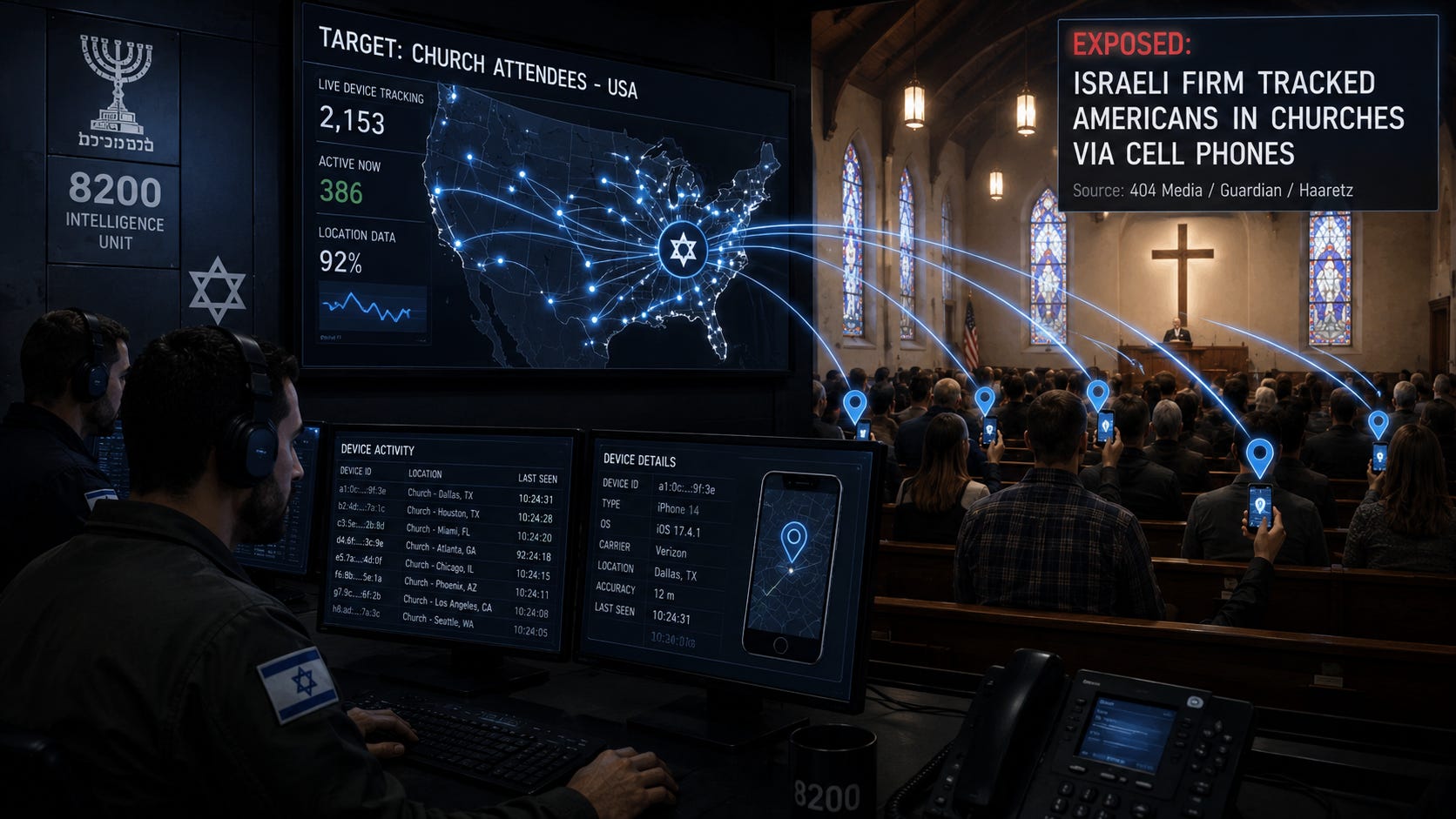
Somewhere in Prescott, Arizona, a man walks into church on a Sunday morning carrying, like everyone else, a phone in his pocket. He has come to worship. He does not know that the building he is entering has been drawn inside an invisible boundary, that his device will be logged the moment he crosses it, and that in the days afterward his screen will fill with advertisements paid for by a foreign government. He did not consent. He was never asked. He was not even told. The congregation, a church worker there explained to a reporter, has no idea any of this is happening, and the only thing left to do is to make people aware of it.
This is not a hypothetical. In late September 2025, a newly formed San Diego firm called Show Faith by Works, LLC registered with the U.S. Department of Justice as a foreign agent of the State of Israel. Its FARA filing described, in the firm’s own words, the largest Christian Church Geofencing Campaign in US history: a plan to draw digital perimeters around the boundaries of every major church in California, Arizona, Nevada and Colorado during worship times, and around Christian colleges on weekdays, then to track attendees and continue to target them with ads. The contract ran to roughly $3.2 million, with a reported ceiling, once the firm asked for more, of $4.1 million. The money arrived not from Jerusalem directly but through Havas Media Germany, a German subsidiary of a global advertising conglomerate, which received the first tranche of about $325,881.
The messaging was not subtle. The ads were to be, in the language of the filing, pro-Israel and anti-Palestinian, designed to combat low American Evangelical Christian approval of Israel and to link the Palestinian population, as a whole, with terrorism. A mobile trailer fitted with a fifty-five-inch touchscreen, virtual-reality headsets, strobe lights and staged scenery would tour parking lots as an October 7th Experience. And pastors themselves were to be recruited and paid to produce favorable content, valued in the filing less as shepherds than as gate-openers to the very communities the campaign meant to influence.
I should be careful here, because precision matters. After the reporting broke, the firm’s principal, Chad Schnitger, told one outlet that the coverage had been sensationalized, that geofencing was a routine commercial tool, a 1-way ad push that sends nothing back to a foreign entity. Months later he told another that the geofencing portion was scrapped. Both claims deserve to sit on the page. But notice the move, because it is the move at the center of this entire story: the reframing of surveillance as advertising. Schnitger is technically correct that the mechanism is a marketing tool. That is precisely what makes it dangerous. The thing has been normalized to the point where its operator can describe tracking worshippers during prayer in the same flat register a retailer uses to describe a coupon.
The behavior beneath the language
I spend my working life watching how behavior is shaped, and the first thing you learn is that the most effective influence is the influence the subject never notices. Overt persuasion invites resistance; people argue back, raise their guard, weigh the source. Covert influence skips all of that. It works on the person before the person knows there is anything to work on. It does not change a mind so much as arrange the conditions in which a mind changes itself, and then lets the target believe the conclusion was their own.
Geofencing, stripped of the marketing vocabulary, is a behavioral instrument of exactly this kind. It identifies people not by what they have asked for but by where their bodies happen to be: in a pew, in a clinic waiting room, on a campus quad. Megan Iorio, senior counsel at the Electronic Privacy Information Center, called the practice a privacy nightmare, and explained that data brokers vacuum up location signals from ordinary apps and resell them to whoever wants to reach a body in a place. What unsettles her is not that the technique is exotic but that it is incredibly invasive and has become entirely ordinary. The targeting is keyed to a moment of openness, of communal feeling, of belief. The worshipper is reached when he is most receptive and least defended, and he is reached without ever being asked whether he wishes to be.
A man in Colorado Springs who began warning his neighbors after finding seven local churches on the target list put it more plainly than any privacy lawyer could. Reading the filing, he wrote, what jumps out is how the whole document treats Christians as targets to be manipulated. This is not respectful outreach, he said. It is warfare language. He is right about the language, and the language is not an accident. It is the tell.
Not one campaign but a method
The church operation does not stand alone, and this is where it stops being a curiosity and becomes a pattern. It is one prong of a far larger architecture, funded by a $150 million public-diplomacy budget that Foreign Minister Gideon Sa’ar secured in late 2024, roughly twenty times what Israel had previously spent on such efforts, and which the foreign minister himself described in terms of consciousness warfare. The phrase is worth pausing on. It is not the vocabulary of persuasion. It is the vocabulary of contested terrain, of a battle fought inside the heads of people who do not know they are a battlefield.
I have written before about a second prong of that same architecture, the influencer operation code-named the Esther Project, run by a Delaware firm called Bridges Partners and routed, like the church campaign, through the very same Havas Media Germany. Under a contract worth up to $900,000, between fourteen and eighteen American social-media influencers were to post pro-Israel content twenty-five to thirty times a month, reportedly paid around $7,000 per post. The defining feature of that campaign, the reason watchdogs at Public Citizen and the Quincy Institute filed a formal FARA complaint, was concealment: none of the influencers had registered as foreign agents, and the followers scrolling past their content had no way of knowing a government had paid for the sentiment they were absorbing while discussing caffe latte and nail polish. The same logic governs the church pews and the influencer feeds. In both, the audience is reached without being told who is speaking, or why.
A third prong sharpens the picture further. The former Trump campaign manager Brad Parscale, through his firm Clock Tower X, took a contract worth a reported $1.5 million a month to produce a hundred ads monthly in five thousand variations, and, more strikingly, to shape the outputs of GPT-based chatbots, steering what the machines tell people when they ask, in apparent innocence, about Israel and Palestine. Three operations, one structure: identify a population, reach it through a channel it trusts, and remove from view the hand doing the reaching.
If you want to see just how pro Israel biased chat GPT really is, follow me down the truth funnel in this clip.
A technique without a flag
Here I want to be exact about what I am and am not saying. NATO did not run this campaign. There is no evidence the alliance had any part in tracking American churchgoers. But the technique on display belongs to a doctrine that NATO has spent years developing in the open, and which I have examined at length elsewhere: what its own strategists call cognitive warfare, the deliberate management of a target population’s perceptions, beliefs and behavior, conducted in many cases on populations that include one’s own civilians, and conducted by design beneath the threshold of their awareness. The Israeli foreign minister’s phrase, consciousness warfare, and the NATO theorists’ phrase, cognitive warfare, are not borrowed from each other. They have arrived independently at the same place, which is the more disturbing fact. When two separate state apparatuses, working from different doctrines, converge on the same conviction, that the human mind is terrain to be operated upon rather than a citizen to be addressed, the convergence is the story.
And it is not confined to states courting Christians. The most instructive precedent sits in American politics, where the same instrument was turned on women. In 2015 a data broker named Copley Advertising was hired to geofence abortion clinics and push ads to the phones of women sitting in the waiting rooms. Years later Senator Ron Wyden disclosed that another broker, Near Intelligence, had harvested the location data of people visiting nearly 600 reproductive health clinicsacross forty-eight states, without consent, and sold it to an anti-abortion group for a targeted ad campaign. A tool called Locate X, built by the surveillance contractor Babel Street, let users trace a single device as it traveled from one state to another to reach a clinic. The pattern is always the same. A sensitive place. A vulnerable moment. A body logged without its owner’s knowledge. A message engineered to arrive when defenses are lowest.
What is actually being normalized
The instinctive objection is that none of this is illegal, that geofencing is a settled commercial practice, that the worshipper’s phone was emitting its location anyway. That objection is the symptom, not the rebuttal. The defense rests entirely on how thoroughly the surveillance has been laundered into the ordinary. A growing list of states has begun to notice: Washington now prohibits tracking individuals whose phones are inside a healthcare facility, and California, Massachusetts and Illinois have moved toward consent requirements for location data. The Federal Trade Commission has warned that gathering such data without informed consent may itself be deceptive. The law, in other words, is straining to catch up to a behavior the market long ago decided was unremarkable.
The Baptist General Convention of Texas saw the deeper stakes more clearly than most. In a letter to the U.S. Attorney General, its Christian Life Commission warned that allowing a foreign government to track and message worshippers on church grounds would entangle houses of worship with state-approved foreign political campaigns and produce a chilling effect on the freedom to assemble and worship. They grasped that the harm is not only the surveillance itself but what the surveillance does to the space it enters. A sanctuary that can be quietly mapped, entered and worked upon is no longer quite a sanctuary.
Whether this particular campaign is now fully operational, partly scrapped, or quietly continuing under another name almost does not matter, and that is the point I want to leave standing. The filings are public record. The budget was real. The German intermediary was real. The technique is proven, cheap, legal in most of the country, and growing. What one foreign ministry attempted against American Christians this year, another government can attempt against any congregation, any clinic, any campus, any neighborhood next year, with the same tools and the same flat reassurance that it is only advertising.
The man walking into church in Prescott will not feel any of it happen. That is the design. The most consequential thing about the campaign to reach him is that it was built, from the ground up, so that he would never know he had been reached. A free people can argue with a propagandist it can see. It cannot argue with one it has been engineered not to notice. The first defense, the only one available to the man in the pew, is the thing his neighbor in Colorado Springs understood instinctively when he started knocking on doors: to be told. To know the boundary is there. To see the hand.
Phone based Faraday bags in the meantime. Repeat after me!
Sigh....
And that is how the genocidal israeli regime manages to bomb to bits the churches and christian holy shrines in Palestine and Lebanon....while securing political support and media support from Christians in the US whose taxes pay for the israeli destruction.
Targeted brain washing.
Folks, step away from Facebook, Snapchat and all these other personal profiling and tracking and mind control machines that are being marketed as "free social media apps"! For your own good. The entire purpose of those things is to, as "apps" sit in your phone collecting data on on your location, whether you are paying attention to the phone, how close you are to the phone, what is in your calendar, who is in your list of contacts, what other devices are present on your home wifi network, what time you are awake, what time you are at home, at work, at church. That is what is inside all those permissions that the apps require, including the vaguely defined "diagnostics", which basically means recording your interactions with the app- keylogging on steroids.