

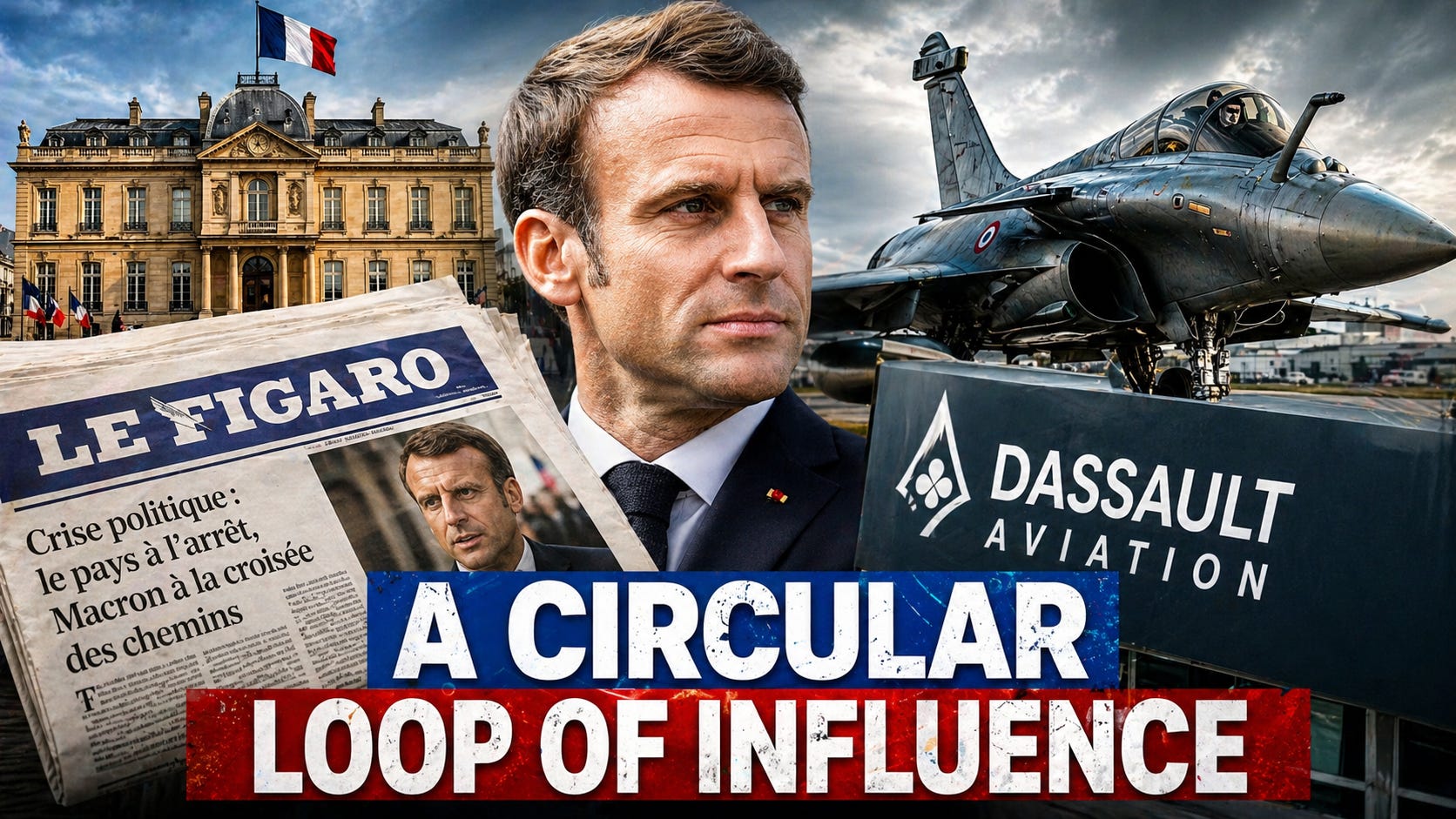
A defense conglomerate whose revenues depend on government contracts owns the newspaper that shapes how millions of French citizens think about defense policy.
The Tripling of Power
In March 2004, Serge Dassault — arms dealer, sitting senator, and heir to France’s most powerful aerospace dynasty — completed his acquisition of Socpresse, the publisher of Le Figaro, raising the Dassault family’s stake from 30 percent to approximately 82 percent for around 230 million euros. Figaro acquisition He did not attempt to conceal his motive. In 1999, five years before the deal closed, he told the French television channel LCI: “For me, it is important to be owner of a newspaper to express my opinion, but also to respond to journalists who have written nonsense.” Figaro acquisition
The acquisition made Dassault simultaneously France’s leading private aviation and defense manufacturer, a conservative UMP senator (a post he assumed that same year), and the proprietor of Le Figaro, one of France’s oldest and most-read national dailies. Globe obituary Rarely, in a modern democracy, does so much concentrated power reside in a single family’s hands so nakedly. Public choice theory has a term for what happens when actors in a political economy wear this many hats simultaneously: capture. The question worth pressing is what exactly was being captured, and who bears the cost.
The answer, under any honest analysis, is the French reading public.
A Business Model Built on Political Favor
Dassault Aviation is not a normal industrial company. Its flagship product — the Rafale multirole fighter jet — exists only because governments decide to buy it, and those decisions are saturated with political calculation. By late 2025, 533 firm Rafale orders had been placed, including 80 for the UAE in a $16 billion deal, 36 for India, 55 for Egypt, 36 for Qatar, 24 for Greece, and 42 for Indonesia. Rafale orders France’s arms exports rose by 47 percent between 2014–18 and 2019–23, making it the world’s second-largest arms exporter behind the United States, according to the Stockholm International Peace Research Institute. SIPRI France exports
Each of those export deals was brokered with the active involvement of the French state. French presidents fly to Riyadh, Abu Dhabi, and New Delhi not merely as heads of government but as salesmen for Dassault. When Emmanuel Macron visited the UAE in December 2021, the 80-Rafale deal — announced as “the largest ever obtained by the French combat aeronautics industry” — was signed on the same trip. UAE Rafale deal The company’s fortunes are thus inextricably linked to French foreign policy narratives: whether France is seen as a credible power, whether NATO spending debates resolve in favor of European sovereign defense, whether the Rafale’s combat record is framed as decisive rather than marginal. These are not abstract policy questions. They are, for Dassault, existential commercial ones — and Le Figaro covers all of them.
The Spiked Article and the “Healthy Ideas” Doctrine
The mechanism of editorial capture rarely announces itself. It operates through omission, through a particular sensitivity to which stories get assigned, which angles get developed, which sources get called. But occasionally the machinery becomes visible.
In 2004, shortly after Dassault completed his acquisition of Le Figaro, French media reported that a controversial article concerning the Rafale fighter jet deal was killed before publication. Nieman Lab report Independent watchdog organizations, including Reporters Without Borders, expressed concern about the implications for press freedom. Nieman Lab report At the time of the acquisition, the journalists’ union USJ-CFDT issued a public statement: “We are genuinely concerned about the threat to editorial independence.” Campaign Live
Their concern was not hypothetical. Serge Dassault had telegraphed his editorial philosophy explicitly. In November 2002, as he began consolidating his stake in Socpresse, he declared that his newspapers “must promulgate sound ideas,” and added that “left-wing ideas are not sound ideas.” Wikipedia Censorship France He had said something similar in the magazine Entreprendre, using the possessive that most reveals an owner’s real attitude toward editorial independence: “my papers.” Lutte Ouvrière
This is the doctrine of a man who treats journalism as a branch of his public relations department. In most industries, a vendor who also controls the review publication covering his industry would face regulatory action. In French media law, it produced a senator.
Senator, Arms Dealer, Press Baron: The Revolving Door as Identity
The concept of the revolving door typically describes officials who rotate between regulatory agencies and the industries they oversee. Serge Dassault collapsed that distance entirely: the roles were not sequential but simultaneous. He was a senator for the Essonne department from 2004 to 2017, an outspoken advocate of conservative economic and fiscal positions, a champion of defense spending, and — throughout — the controlling owner of France’s most prominent right-of-center newspaper and the chairman of its leading arms manufacturer. Wikipedia Serge Dassault
His son, Olivier Dassault, served as a deputy in the National Assembly. Wikipedia Serge Dassault The family was not merely embedded in French conservative politics; it constituted a significant node of it — funding the conversations, setting the ideological parameters, and supplying the aircraft.
What makes this arrangement particularly corrosive from a libertarian standpoint is not that a wealthy man holds political views and funds institutions reflecting them. That is, in isolation, unobjectionable. The problem is the circularity: Dassault Aviation’s revenues depend on government contracts secured by political relationships cultivated in part through a media operation that shapes public opinion and political debate about the very defense policies that generate those contracts. Public choice economists from James Buchanan onward have documented how concentrated interests reliably exploit diffuse publics in exactly this fashion. The Dassault model is that theory illustrated in a single family tree.
The biographical record contains further revelations. In December 1998, a Belgian court handed Serge Dassault a two-year suspended sentence for bribing politicians in the Agusta-Dassault scandal, in which Belgian officials were paid to secure helicopter contracts. Globe obituary In June 2009, a French civil court stripped him of his mayoral position after finding him guilty of making cash payments to voters in Corbeil-Essonnes. Globe obituary This is the man who simultaneously owned France’s most-read conservative newspaper and sat in its upper legislative chamber. The accountability mechanisms that should govern the relationship between arms dealers, politicians, and the press were absent — because in this case, those roles were all inhabited by the same person.
The State Subsidy That Closes the Loop
There is one detail that makes the arrangement even more structurally perverse: Le Figaro receives substantial direct funding from the French state. The Figaro group received more than 16 million euros in public press subsidies in 2021 alone. Heinrich Böll Foundation The French state is, simultaneously, Dassault Aviation’s primary domestic customer, the source of political cover for its export deals, and a direct financial contributor to the newspaper the Dassault family uses to shape how those deals are received by the public.
This is not a market. It is a closed loop of mutual subsidy, in which citizens pay taxes that fund both fighter jet contracts and the newspaper that tells them those contracts are wise. The Heinrich Böll Foundation’s analysis of French media concentration put it plainly: approximately ten billionaires now own 80 percent of France’s national daily newspapers, with Dassault controlling Le Figaro as France’s leading conservative daily. Heinrich Böll Foundation Reporters Without Borders has flagged that French mechanisms to combat conflicts of interest in the media are “insufficient, inadequate, and outdated.” RSF France
This Is Not a French Anomaly
Those inclined to treat this as a peculiarity of French political culture should consider the parallels elsewhere.
General Electric, one of the largest defense contractors in the United States for decades, owned NBC and MSNBC from 1986 until 2011. Media critics documented how NBC was notably slow to cover GE’s environmental record and defense-contractor controversies — a pattern one analyst attributed to an implicit “corporate zeitgeist” rather than direct editorial dictates. GE NBC Jack Welch, GE’s CEO, reportedly told NBC News leadership directly that they worked for GE and should be mindful of coverage that affected share prices. GE NBC
Jeff Bezos, founder of Amazon — whose cloud computing division pursues multi-billion-dollar Pentagon contracts — purchased The Washington Post in 2013. NPR Washington Post Amazon contested a $10 billion Department of Defense JEDI cloud contract in court, alleging that the Trump administration improperly steered the award away from Amazon partly due to Trump’s hostility toward Bezos as the Post’s owner. Amazon JEDI ABC The intertwining of the Post’s editorial independence with Amazon’s Pentagon ambitions created precisely the structural conflict that critics had warned about.
In each case, the mechanism is the same: a company whose revenues depend on government favor acquires a media platform that shapes public understanding of the policies generating that favor. The transaction need never be explicit. The owner need not call the editor to kill a story. The editors simply understand, over time, which stories generate friction and which generate none.
What French Citizens Are Actually Reading
When a French citizen picks up Le Figaro and reads its coverage of NATO spending debates, of Rafale export announcements, of Egypt’s or India’s or the UAE’s strategic relationship with Paris, they are consuming journalism produced within an institutional structure in which the owner of the newspaper is the manufacturer of the aircraft being discussed, and was simultaneously a member of the legislature that approves defense budgets.
That is not journalism. It is, at minimum, a profound structural conflict. At worst, it is something more deliberate — what the editors of Le Figaro’s journalists’ union feared from the beginning: a media platform instrumentalized to manufacture consent for the commercial and political interests of a single industrial dynasty.
The libertarian critique of state power traditionally focuses on government censorship. But the Dassault-Figaro arrangement illustrates a complementary and equally dangerous mechanism: the capture of nominally private information infrastructure by interests whose revenues flow from state contracts. The result is not a free press. It is a subsidized one — subsidized by defense spending, by public press grants, and by the accumulated political capital of a family that has made itself indispensable to French military prestige. The individual citizen, reading about the latest Rafale deal in a newspaper owned by Rafale’s manufacturer, has no obvious way of knowing that the editorial chain above their morning paper leads back to the Champs-Élysées offices of Groupe Industriel Marcel Dassault.
That, in the end, is the most precise definition of concentrated, unaccountable power: power that is invisible to those it affects.
Sources
Figaro acquisition — “L’industriel Serge Dassault réalise son rêve en devenant propriétaire du «Figaro»,” Le Temps, January 7, 2016. https://www.letemps.ch/economie/lindustriel-serge-dassault-realise-reve-devenant-proprietaire-figaro
Globe obituary — “French billionaire Serge Dassault ran an aviation empire,” The Globe and Mail, May 30, 2018. https://www.theglobeandmail.com/business/international-business/european-business/article-french-billionaire-serge-dassault-ran-an-aviation-empire/
Wikipedia Serge Dassault — Serge Dassault, Wikipedia. https://en.wikipedia.org/wiki/Serge_Dassault
Wikipedia Groupe Figaro — Groupe Figaro, Wikipedia. https://en.wikipedia.org/wiki/Groupe_Figaro
Rafale orders — “Rafale Orders Explode! India Eyes Becoming Production Hub,” Air Power Asia, December 2, 2025. https://airpowerasia.com/2025/12/02/rafale-orders-explode-india-eyes-becoming-production-hub-for-french-jets-after-biggest-ever-iaf-deal/
SIPRI France exports — “France Is Boosting Rafale Fighter Production,” Eurasian Times, March 16, 2025. https://www.eurasiantimes.com/nfrance-is-looking-to-increase-arms-sale-by-banking-on-rafale/
UAE Rafale deal — “France’s Macron heads to UAE aiming to secure major Rafale fighter jet sale,” France 24, December 3, 2021. https://www.france24.com/en/diplomacy/20211203-france-s-macron-heads-to-uae-aiming-to-secure-major-rafale-fighter-jet-sale
Nieman Lab report — “The Rendell Inquirer? The specter of the instrumentalization of American news media,” Nieman Journalism Lab, February 2012. https://www.niemanlab.org/2012/02/the-rendell-inquirer-the-specter-of-the-instrumentalization-of-american-news-media/
Campaign Live — “Figaro asserts independence as Dassault acquires control,” Campaign Live. https://www.campaignlive.co.uk/article/world-media-analysis-figaro-asserts-independence-dassault-acquires-control/209713
Wikipedia Censorship France — “Censorship in France,” Wikipedia. https://en.wikipedia.org/wiki/Censorship_in_France
Lutte Ouvrière — “Dassault s’achète Le Figaro,” Lutte Ouvrière, March 18, 2004. https://www.lutte-ouvriere.org/journal/article/2004-03-18-dassault-sachete-le-figaro-la-presse-aux-mains-des-industriels-et-des-banquiers_8288.html
Heinrich Böll Foundation — “Press freedom in France is threatened by crisis, concentration, and a lack of independence,” Heinrich Böll Stiftung Brussels, April 25, 2024. https://eu.boell.org/en/2024/04/25/press-freedom-france
RSF France — France country page, Reporters Without Borders. https://rsf.org/en/country/france
GE NBC — “General Electric and NBC,” Business-Managed Democracy / Heritage Institute. https://www.herinst.org/BusinessManagedDemocracy/environment/media/GE.html
NPR Washington Post — “’Washington Post’ journalists plea to Bezos: Don’t gut our newsroom,” NPR, January 30, 2026. https://www.npr.org/2026/01/30/nx-s1-5692923/washington-post-bezos-layoffs
Amazon JEDI ABC — “Amazon lost $10B Pentagon contract because of Trump’s ‘personal vendetta,’ lawsuit argues,” ABC News, December 10, 2019. https://abcnews.go.com/Business/amazon-lost-10b-pentagon-contract-trumps-personal-vendetta/story?id=67606505
Editor’s note: The 2004 Rafale article spiking allegation originates with Nieman Lab’s February 2012 report, citing French media accounts from the period. Independent verification of the specific article and editorial decision chain was not available at time of publication.